Subtext in Dialogue: Writing What Isn't Said | Skrib
The standard instruction is to have characters talk around the thing rather than about it. Follow it literally and you get a scene of people being vague, which reads as imprecision rather than depth.
That’s because the advice describes a symptom instead of the mechanism.
Subtext isn’t in the line. It’s in the gap between the line and what the audience already knows.
Consider: Would you like some tea? There is no subtext there. It’s an offer of tea.
Now suppose the audience has watched her pack a suitcase in the previous scene. Or knows he has just been named in a will she hasn’t seen. Or that these two have not spoken in eleven years and one of them has driven four hours to be in this room.
Same line. The words haven’t changed. What changed is what the audience is holding while they hear it - and that, rather than any quality of the sentence, is where subtext lives.
This sits under our complete playwright’s guide.
What is subtext?
Subtext is the meaning an audience derives from a line beyond its literal content, produced by the difference between what is said and what the audience knows about the situation. It’s a structural effect rather than a style of writing: the same sentence carries subtext in one context and none in another, depending entirely on what has been established beforehand.
The consequence: you can’t write subtext into a line
This is the practical turn, and it changes how you revise.
Writers try to add subtext by making a line more oblique. They take a character who was going to say I know what you did and have them say something sideways about the weather instead. Sometimes that works. Very often it produces a line that means nothing, because the audience has no idea what the weather is standing in for.
The fix is almost always upstream. If a line needs subtext, the usual repair is not to change the line - it’s to give the audience something earlier that makes the plain line resonate.
Pinter’s Betrayal is the demonstration case. The play runs backwards, so the audience knows the ending from the start and holds it through every scene. Ordinary conversational lines - arrangements, pleasantries, questions about a flat - become almost unbearable, not because the lines are clever but because the structure has loaded them.
The rule that follows: subtext is a setup-and-payoff structure, and the setup is the part that does the work.
The four gaps
Subtext comes from asymmetries in who knows what. There are four, and they produce different effects.
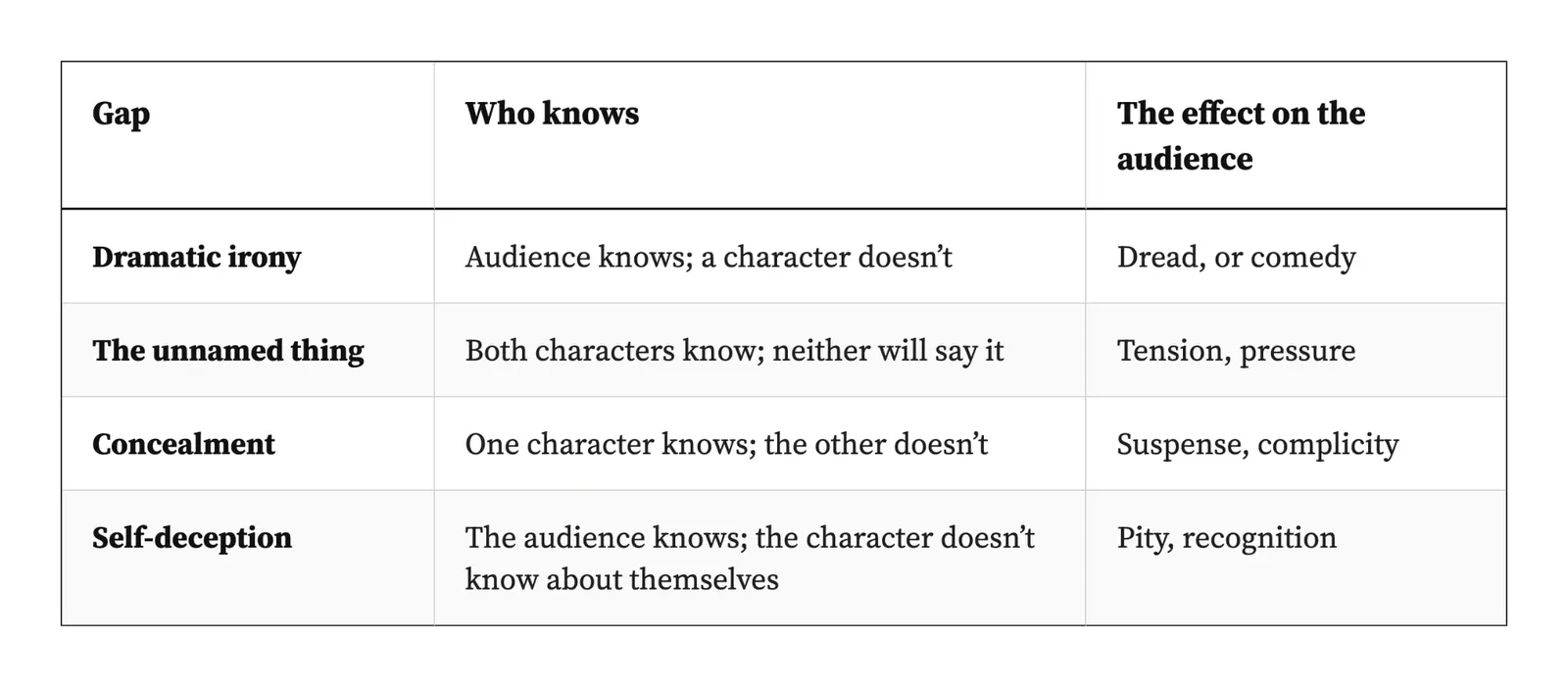
Dramatic irony is the most powerful and the least used by newer writers, because it requires giving information away early. Every horror film runs on it. So does most tragedy.
The unnamed thing is theatre’s home ground - a family who all know why the eldest son isn’t here, conducting an evening in which nobody says so. Every line about something else is a line about that.
Concealment creates a different pressure, because the audience is watching one character work on another and can see the seams.
Self-deception is the hardest and often the richest: a character asserting something about themselves that the audience has watched be untrue. Nothing needs to be said sideways; the plain assertion is the subtext.
Most strong scenes run two of these at once.
On-the-nose dialogue is a symptom
The usual note is this is too on the nose, and the usual fix is to make the line less direct. That fixes the wrong thing.
A writer states something directly when they don’t trust the audience to have it. And usually they’re right not to - the setup genuinely isn’t there, so the indirect version wouldn’t land, and instinct correctly reaches for the explicit version.
So the diagnosis inverts. On-the-nose dialogue is evidence that the scene is under-prepared, not over-explained.
The repair sequence:
Find what the line is telling the audience. Usually one fact or one emotional state.
Ask whether they could have known it already. From an earlier scene, from behaviour, from someone else’s reaction.
Put it earlier, in a different form. Show the packed suitcase.
Now cut the line back to something ordinary and let the context do the work.
Doing step four without steps one to three is how scenes end up vague.
Six ways to write the gap
Once the setup exists, these are how the gap surfaces line by line. Examples below are written for this article.
The displaced object. Characters conduct the real argument through a substitute - a piece of furniture, a meal, a dog. The safe subject absorbs everything the dangerous one can’t hold. > You’ve moved the chair. > It was in the way. > It’s been there since Mum bought it.
The refused question. A character answers a question that wasn’t asked. The refusal is the information. > Did you call him? > There’s a train at six if you want it.
Over-precision. A character who supplies excessive detail is managing something. Nobody specifies the make of the car unless the car matters.
The change of subject, timed exactly. The topic switches on the precise beat where the dangerous thing was about to surface. The audience feels the swerve as clearly as they’d have felt the statement.
Unnecessary politeness. Formality between intimates is aggression. Two people who normally interrupt each other, suddenly taking turns, is a scene about something.
Silence. The strongest and the cheapest. A character who doesn’t answer has answered - and on stage, in real time, the pause is felt at its actual length. How you mark those on the page is a formatting question covered in our play format guide.
Why the stage runs on it
Every medium uses subtext. Theatre depends on it more than any other, for a structural reason.
Film has a camera to show you the interior. A close-up on a face carries the whole gap between said and meant, in silence, with no dialogue at all. The line can stay ordinary because the image is doing the subtext.
Theatre has no close-up. There is no reliable way to make three hundred people look at one face at one instant. So the gap has to be built into the language, the pauses, and what the audience was told two scenes ago - which is why stage dialogue can sustain more elaborate evasion than screen dialogue and why it needs to.
Our stage vs. screen guide covers the wider set of differences.
The other stage-specific route to interiority is the monologue - the one place a character can approach saying the thing directly without breaking the form. Writing Monologues That Reveal Character and Move the Plot covers when a play has earned one.
When not to use subtext
A necessary corrective, because this technique is easy to over-apply.
Subtext needs a floor. A play in which nothing is ever said directly is exhausting and, past a certain point, unreadable - the audience stops decoding because decoding has stopped being rewarded.
The direct statement is a resource you’re saving. When a character finally says the thing plainly, the moment lands because of everything indirect that preceded it. Spend that too early and you have nothing; never spend it and the play never arrives.
Some information should just be delivered. Practical facts the audience needs - who these people are, why they’re here, what the deadline is - can be stated. Wrapping logistics in subtext is how first acts become confusing.
And some characters don’t do it. A character with nothing to hide, or no capacity for indirection, is a legitimate and often necessary presence - usually the one who says the unsayable thing and detonates the scene. What a character can and can’t articulate follows from who they are, which our character architecture guide covers.
Adding subtext to a scene that hasn’t got any
A working process for a scene that reads flat.
1. Name what the scene is actually about. Not its topic - its subject. Two people discussing a funeral may be having a scene about money.
2. Check whether the audience knows it. If not, that’s the whole problem, and it’s fixed in an earlier scene rather than this one.
3. Give each character something they want from the other in this scene. Subtext requires pursuit; two people exchanging information have nothing to be indirect about.
4. Give at least one of them a reason not to say it. Shame, strategy, kindness, fear, habit. No reason to withhold means no reason for indirection.
5. Find the displaced object. What safe thing is available in the room to conduct it through?
6. Cut the line that explains it. There’s almost always one - the sentence where a character summarises the dynamic. It’s usually the last line of the scene.
7. Read it aloud. Subtext is the element most reliably tested by performance, because actors either find the second layer or they don’t. The Table Read for Playwrights covers what to listen for.
Where it goes wrong
Vagueness mistaken for subtext. Characters being unclear about nothing in particular. The test: can you state what the scene is really about in one sentence? If not, neither can the audience.
Subtext with no setup. The gap exists in the writer’s head and nowhere else.
Everyone equally indirect. If all five characters evade identically, the technique becomes wallpaper and the scene flattens.
The explaining line left in. A scene that does the work beautifully and then has someone summarise it. Cut it; it’s almost always there.
Stage directions doing the work. (She is thinking about the affair.) An audience cannot read that. If it isn’t in the dialogue, the pause or the behaviour, it isn’t in the play. How much to specify is a live debate covered in Writing Stage Directions That Directors Actually Want to Follow.
Keeping track of what the audience knows
Subtext depends entirely on the audience’s running knowledge, and that state is invisible in a linear script. By act two most writers can’t say with confidence what has been established, in which scene, and what the audience is therefore holding when a line lands - which is exactly the information the technique depends on.
Skrib keeps that visible. The Board is a canvas beside the writing where an information map can sit - what the audience learns, in which scene, and which lines later depend on it - with the Draft open next to it. When you move a scene and the setup for a payoff moves with it, that’s the surface where you notice.
The Library keeps every version searchable, which matters when a reading tells you a moment isn’t landing and you need to find where the setup went.
Whether the gap is landing is something actors and an audience tell you, and nothing else does. A table read finds in ten minutes what a solo reread misses for months. What a studio changes is that the information map doesn’t live in a different application from the scene. You can start free.
Frequently asked questions
What is subtext in dialogue? The meaning an audience takes from a line beyond its literal content, produced by the difference between what’s said and what the audience already knows. It’s structural rather than stylistic - the same sentence carries subtext in one context and none in another.
How do you write subtext? Usually by adding information earlier rather than making the line more oblique. Give the audience something in a previous scene that makes an ordinary line resonate, then let the plain line stand. Writing sideways without that setup produces vagueness instead of depth.
What does on-the-nose dialogue mean? Dialogue that states directly what should be conveyed indirectly. It’s best read as a symptom rather than a style problem: writers state things explicitly when the audience doesn’t have enough context for the indirect version to land, which means the fix is usually in an earlier scene.
Can a play have too much subtext? Yes. If nothing is ever said directly, audiences stop decoding, and the moment a character finally speaks plainly loses its force because there’s no contrast. Practical information the audience needs can and should be stated directly.
Why is subtext more important in theatre than in film? Film has the close-up, which carries the gap between said and meant in a single silent image. Theatre has no reliable way to direct every audience member’s eye to one face at one moment, so the gap has to be built into language, pauses and what the audience was told earlier.
How do you test whether subtext is working? Read it aloud with actors. Subtext is the element most reliably exposed by performance - actors either find the second layer or they don’t, and when they don’t it’s usually because the setup is missing rather than because the line is wrong.