Draft
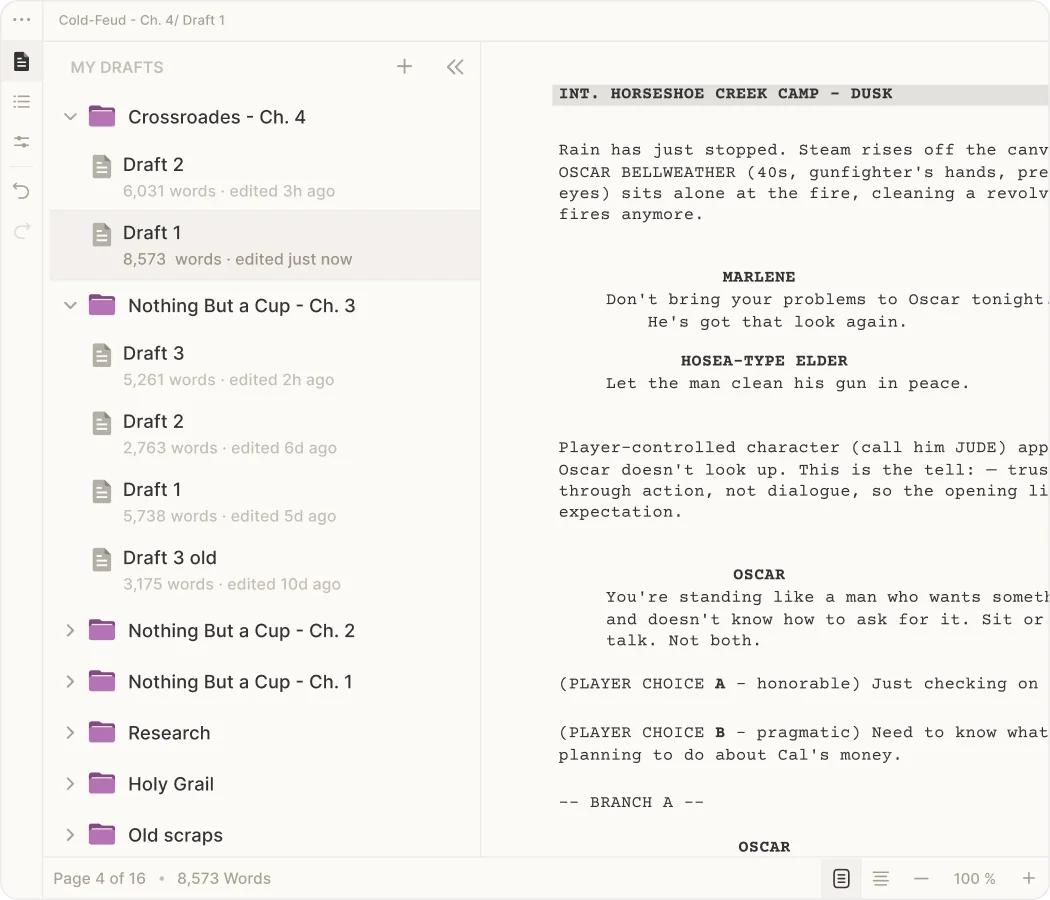
Capture scenes and dialogue trees in a focused editor. Keep each scene grounded in its branch, so you always know which version of a character speaks when.
Stop wrestling with spreadsheets and scattered notes. Skrib is built for writers who craft interactive stories, manage dialogue trees, and ship scripts that developers can actually use.
Free to start · Your work stays yours

Writing a game script isn't writing a novel. You're mapping conditional branches and tracking character voice across a hundred nodes. Skrib gives you three surfaces built for that: Draft captures scenes and dialogue trees, Board visualizes branching paths, Library indexes every bark and quest line. No spreadsheets, no seventeen document files.
Capture scenes and dialogue trees in a focused editor. Keep each scene grounded in its branch, so you always know which version of a character speaks when.
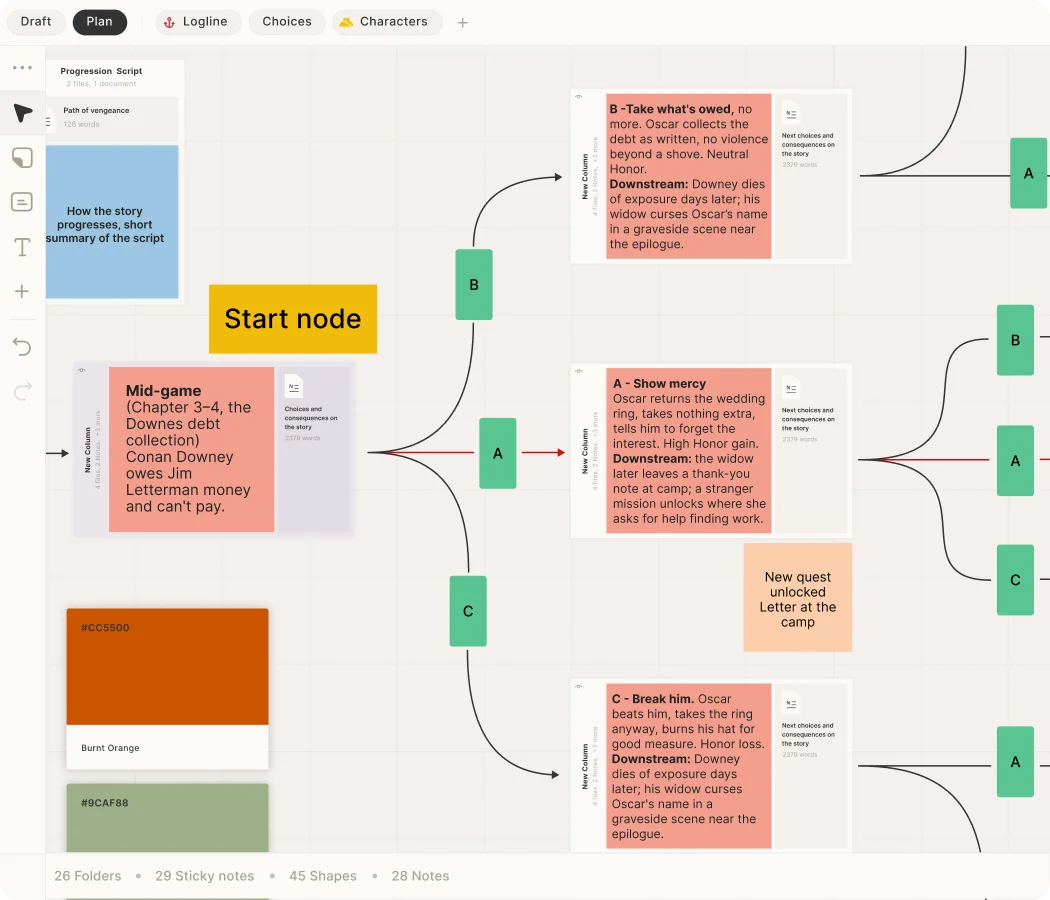
Visualize branching paths and see where choices lead. Map quest logic, conditional branches, state changes, and shifts in your protagonist's voice on one open canvas.
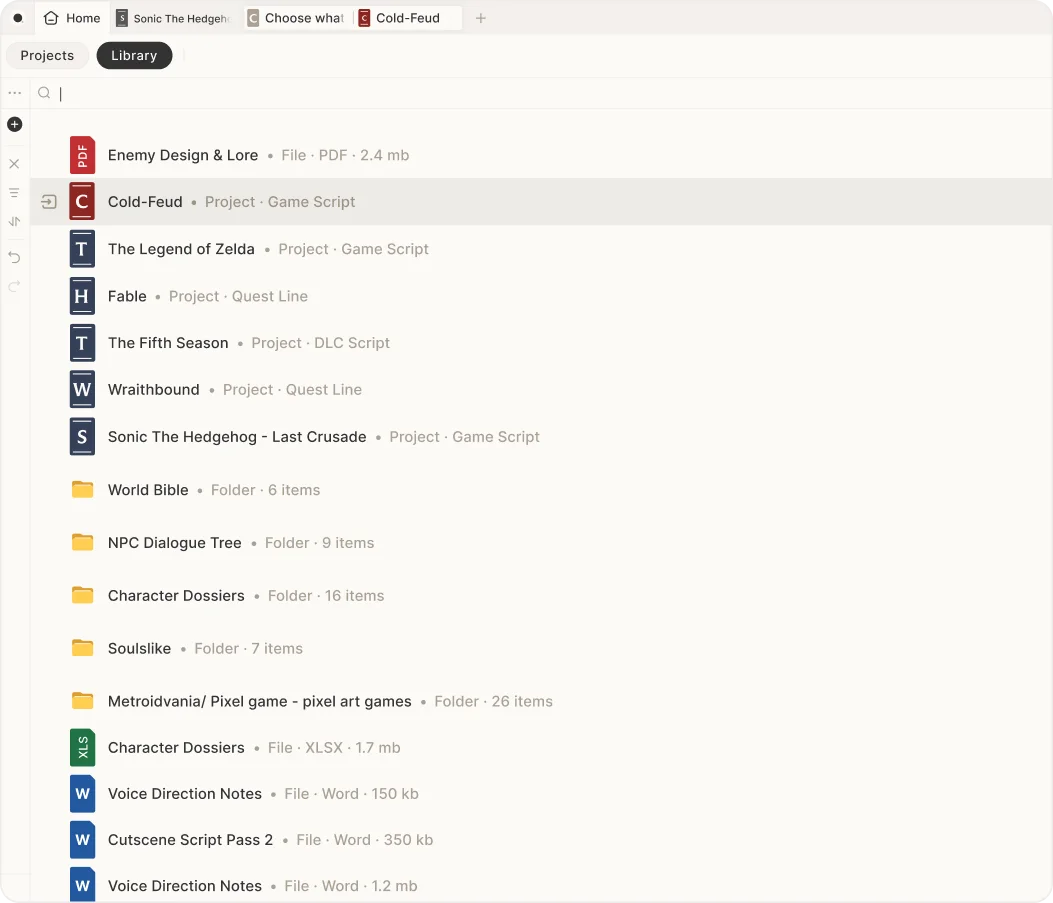
Index every character bark, quest line, worldbuilding document, and recurring choice in one space. No spreadsheets, no seventeen document files.
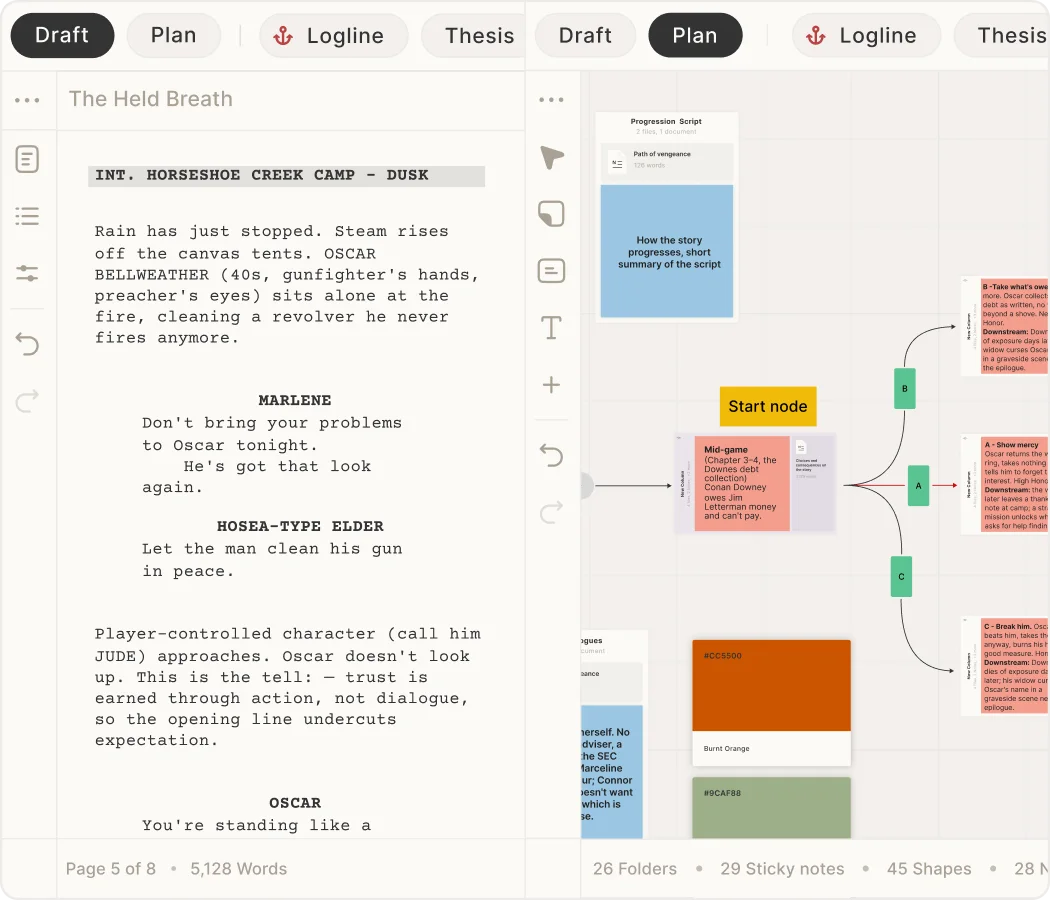
Managing complex quest logic means continuity is everything. The Companion learns your story as you write: your characters, your branching decisions, your conditional logic. When you need to confirm what a character knows at a given node, it's there. Not outsourcing your work, just a research assistant that remembers it.
Too many writers finish a dialogue tree only to find the format doesn't work for their dev team. Skrib exports structured scripts that import directly into engine tools: dialogue, branching conditions, character assignments, variables, and cues already in the format developers need.
A quest tree with five decision points can hold fifty distinct scenes: main objective, companion commentary, failed-check dialogue, optional rewards. Skrib's Board shows every path at once, so you spot redundancy and gaps immediately. Draft keeps each scene grounded in its branch node, so you always know which version of a character speaks when.
Companion arcs need to align with questlines, and relationship state from one quest affects dialogue in another. Skrib's Library becomes your shared truth: character profiles, dialogue variations keyed to story state, branching logic. Everyone works from the same source, and exports reach developers with all conditions intact.
When your ending depends on decisions made in chapter two, a flat list of dialogue stops working. The Board is built for this: construct choice trees visually, attach dialogue to nodes, track variable state across branches. Export structured and tagged, ready for your engine or parser.
The short answers writers tend to ask first.
Flowchart tools visualize structure, but they're built for general use. Skrib's Board visualizes branching structure and keeps your dialogue and character logic attached to each node. When you're working on a quest, you're not drawing empty boxes and linking them in another application. You're writing dialogue directly into branches, reviewing it in context, and tracking state changes that affect later scenes.
Yes. Skrib exports structured dialogue and branching logic in formats that most game engines can import directly. JSON, XML, and proprietary engine formats are all supported. The export includes dialogue text, choice logic, character assignments, and any variable conditions you've set. Your developer doesn't have to rebuild your script structure.
Skrib's Library and Board are designed for narrative teams. Multiple writers can work on different questlines or character arcs, and all changes sync to the shared Library. Each writer can see the full dialogue context and how their work connects to others' scenes and dialogue branches.
The Companion assists with continuity and context. You write every line. You make every choice about what your character says and how branches develop. The Companion helps you stay consistent with decisions you've already made; it doesn't write your dialogue for you.
Skrib works online. Your scripts sync automatically, so you can pick up on any device. We also support exporting your entire project for backup.
Still have a question? Visit the Help Center
