Play Script Template
A play is written for a room, not a page.
Which is why formatting it in a word processor is a fight - the stage directions drift, the character names lose their alignment, and by the third rewrite the cues have wandered. Skrib holds stage format steady while you work, and puts the shape of the play on a Board beside the script: who is on stage, what changes, and where the act break lands.
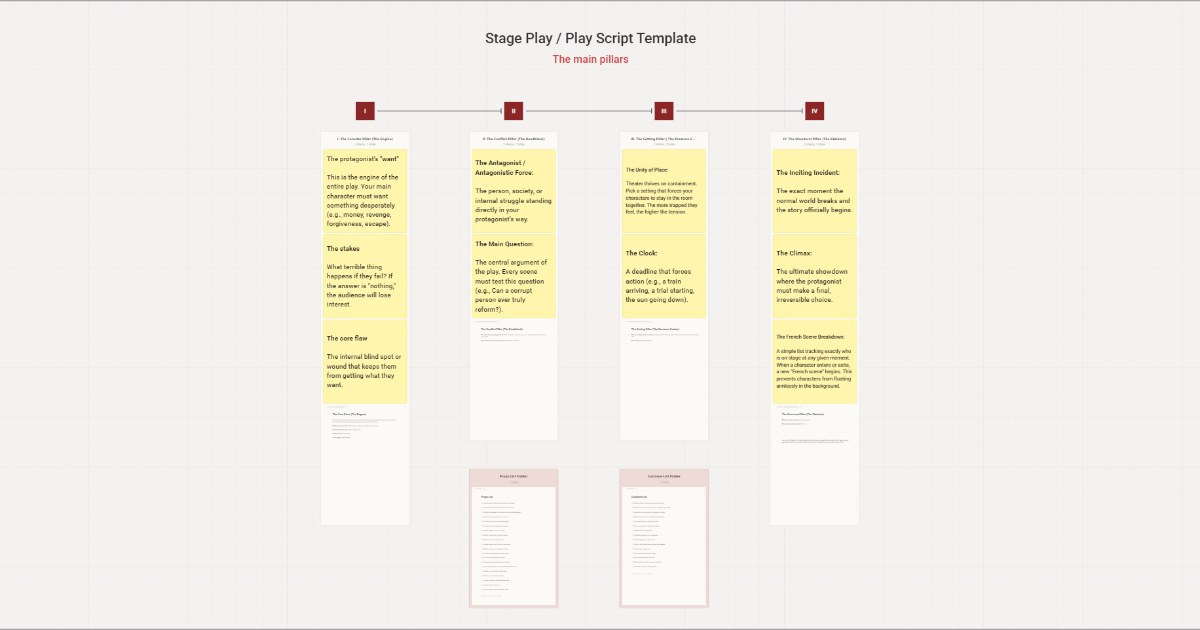
What’s in the play script template
Everything from the title page to the final cue, as editable cards and a formatted Draft.
• Title Page & Cast List: Characters, descriptions, doubling notes and running order.
• Setting & Staging Notes: Where and when, plus what the audience sees before a word is spoken.
• Act and Scene Lanes: Group scenes into acts on the Board and see the proportions at a glance.
• Scene Cards: Who’s on stage, what they want, and what has changed by the exit.
• Character Cards: Objective, obstacle and arc, linked to every scene they appear in.
• Dialogue & Stage Directions: Stage play formatting that holds through revisions.
• Entrances and Exits: Track who is on stage when, and catch the character you left standing there for nine pages.
• Props and Costume List: Built while you write instead of reconstructed for rehearsal.
• Sound and Light Cues: Numbered cue cards, kept beside the line they fire on.
• Beat Breakdown: Break any scene into beats without leaving the Board.
• Running Time Estimate: Because the second act is always longer than you think.
Why write your play in Skrib?
Stage formatting that stays put, and a plan you can still read after the rewrite.
• Format That Doesn’t Fight You: Stage layout holds steady - scene breaks and cues stay where you put them through every draft.
• Block It on the Board: Move scenes, group them into acts, and see the play’s shape before anyone stands up in a rehearsal room.
• Cards Open Into Pages: Click a scene card and write the scene in the Draft. Structure and dialogue never separate.
• Export for the Table Read: .pdf for the room, .docx for the dramaturg, .fountain for anyone working in script tools.
• Rehearsal Notes Survive: Every version stays in your Library, so the cut you made on day three is recoverable on day nine.
Who is this play script template for?
• Playwrights writing full-length plays, one-acts and monologues.
• Drama Teachers giving students a correct stage play format to work in.
• Students writing scripts for coursework, competitions and school productions.
• Theatre Companies developing and devising new work.
• Youth and Community Theatre scripting for a specific cast and a specific stage.
• Radio and Audio Drama Writers working in a close cousin of stage format.
Put the play on its feet
Drop the template on your Board, block the scenes, and write it in a format that holds.