Poem Template
Form isn’t a cage. It’s a set of decisions already made.
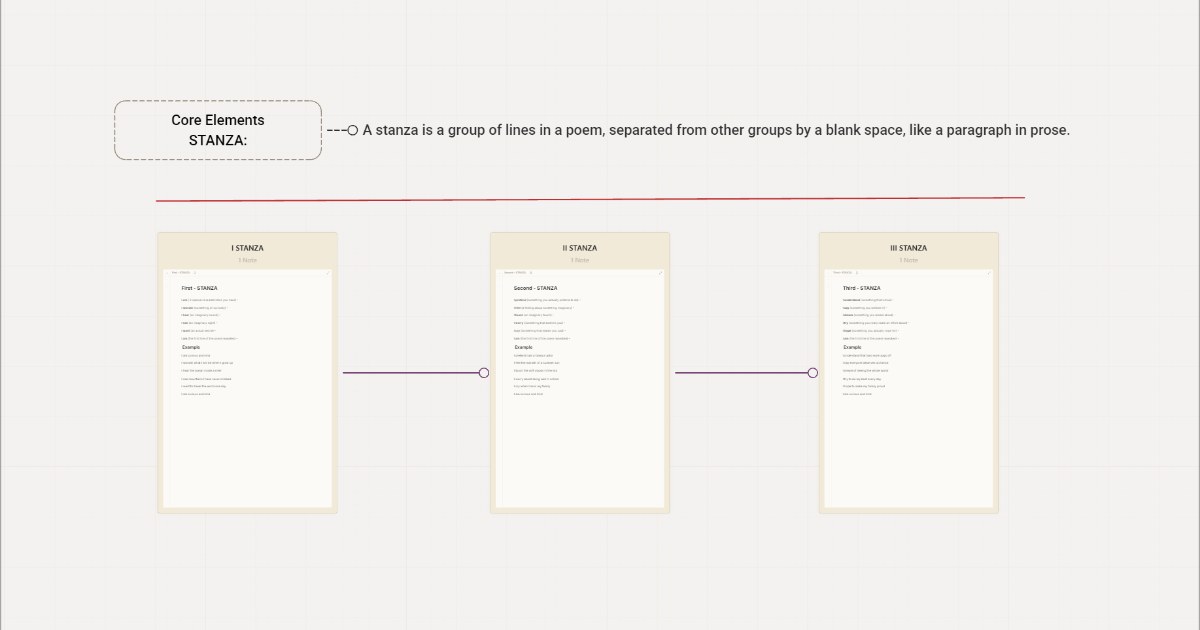
A blank page asks you everything at once: how long, what rhythm, what shape, where it ends. A form answers most of that before you start, which is why poets who could write anything so often choose fourteen lines and a rhyme scheme. These templates give you the structure of each form - the counts, the schemes, the turns - with room to write inside it.
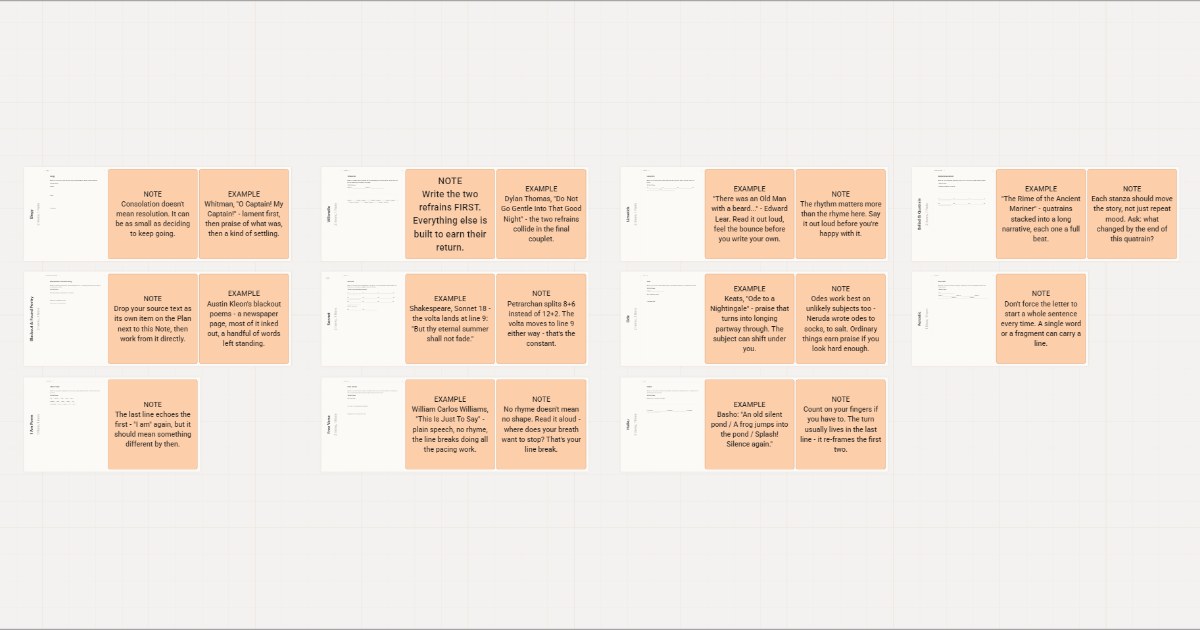
What’s in the poem templates
A template per form, each with its structure laid out and its rules where you can see them.
• Free Verse: No fixed metre or rhyme, with prompts for the things free verse still has to decide - line break, image, ending.
• Sonnet: Fourteen lines in Shakespearean or Petrarchan form, with the rhyme scheme marked and the volta flagged.
• Haiku: Three lines, five–seven–five, with a syllable count per line and a note on the seasonal turn.
• Villanelle: Nineteen lines, two refrains, six stanzas - the repetitions positioned so you can hear them building.
• Acrostic: Your word down the margin, a line beside each letter.
• Ballad & Quatrain: Four-line stanzas with an alternating rhyme scheme and a story to carry.
• Ode: A form for praise, with prompts for the subject and the reason it deserves one.
• Elegy: Structure for grief - lament, praise, consolation.
• Limerick: Five lines, AABBA, and a metre that has to bounce.
• Blackout and Found Poetry: A source text on the Board and a poem pulled out of it.
• I Am Poem: A prompted, repeating form that works with any age or experience level.
Why write poetry in Skrib?
Poems live in revision. Most tools throw the revisions away.
• Every Draft Kept: The version from Tuesday is still there on Sunday. For poetry, where a poem can be ruined and recovered in one sitting, this matters more than in any other form.
• A Collection on One Board: See a whole chapbook or sequence at once, reorder it, and find the shape of the collection rather than the individual poem.
• Form Stays Visible: Line counts, syllables and rhyme schemes sit beside the poem while you write, not in a browser tab.
• Notes Beside the Poem: Source texts, images and fragments upload straight to the Board.
• Export Clean: .pdf or .docx for a submission, a reading or a print run - with your line breaks intact.
Who are these poem templates for?
• Poets working in fixed forms or building a collection.
• Students writing to a set form for coursework, competitions and exams.
• Teachers introducing poetic forms with the structure already laid out.
• Songwriters and Lyricists borrowing from metre and rhyme scheme.
• Spoken Word Performers shaping a piece for a stage rather than a page.
• Anyone Writing Their First Poem who would rather start with a shape than a blank page.
Pick a form and start
Drop a template on your Board, write inside the structure, and break it once you know why