How to Build a World: Step-by-Step World
Build a fictional world step by step: geography, history, magic, factions and culture. See each step on a real board, then copy the free template.
How to Build a World: Step-by-Step Worldbuilding Guide
Worldbuilding is the part of writing fantasy and science fiction that is most fun and most dangerous. Fun, because inventing a kingdom is a joy. Dangerous, because it is easy to spend a year on maps and family trees and never write a scene.
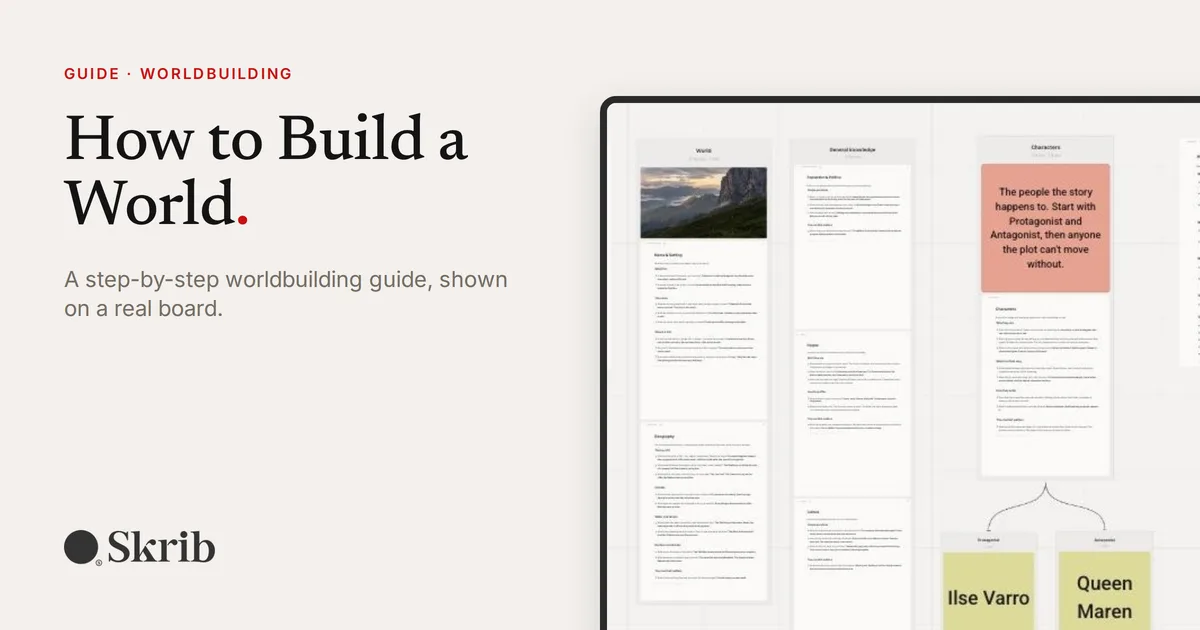
This guide shows you how to build a world in seven steps, in the order that keeps the story in charge. Every step is shown on a real Skrib board, where we built a small fantasy world called Tidemark for a novel called The Salt Crown. Follow along with your own world as you read. The board is a free template in Skrib, the writing studio where your worldbuilding, your outline and your draft share one tab, so you can copy it and build as you go.
Why worlds fall apart mid-draft
Most worlds don't fail on page one. They fail around chapter twelve, when a rule you invented in March quietly contradicts a scene you wrote in June. The magic suddenly solves a problem it shouldn't be able to solve. A city is two days' ride away in chapter four and a morning's walk in chapter nine. A religion that mattered in the first act disappears.
This happens for two reasons:
The world was built without the story in mind, so half of it never matters and the half that matters was never thought through.
The world lives in too many places. Some of it is in a notebook, some in a document, some in your head. Nobody can keep forty documents consistent.
The fix is to build the world around the story, answer a small number of good questions, and keep all the answers on one board you can see while you draft. In Skrib that board sits right next to your manuscript, so the world is always one glance away from the scene you are writing.
The finished board
This is where you are heading. The whole world of The Salt Crown, built from Skrib's free World building template: the basics, the land, the people, the characters, the history, the magic and the canon rules, all on one board.

The one-line version of this world: in the salt kingdom of Tidemark, memories can be stored in salt and eaten, and a young salt-raker tastes proof that the Crown caused the flood everyone blames on the sea.
Step 1: Start with the story, not the map
Before you draw a single coastline, answer the questions that decide what kind of world this needs to be. What genre is it? What era? Is it grounded or larger than life? And most important: what is the one thing this world has that ours doesn't, and how does it set the story moving?
If you only do one thing from this guide, do this. A world is a stage for a story. Build the stage the story needs, not every stage you can imagine.

Do it in Skrib: the World building template opens with this note already written, questions and all. Type your answers under each one and move on.
In Skrib, the template puts these same questions on sticky notes next to the characters, so the inciting incident sits right beside the world it breaks:

Notice that every answer points at the plot. The salt that holds memory is not decoration. It is how the heroine finds out the truth.
Step 2: Geography
Now the land. You don't need a full map yet. You need to know the shape of the place, the one natural feature that dominates it, what splits it into sides, and what the weather forces people to do.
Geography matters because it decides where people live, what they fight over and what they can't escape. In Tidemark, a salt flat that floods every spring decides who is rich (the people on the cliffs) and who is in debt (the people on the flats).

Do it in Skrib: drop a hand-drawn map or a reference photo onto the board next to this note. Images, PDFs and links sit on the same canvas as your answers.
A useful test: for every geographical feature, ask who lives on each side of it. If the answer is "nobody in particular," the feature is scenery. If the answer is "two groups who hate each other," it is plot.
Step 3: History and timeline
Every world carries a past it can't put down. Pick the one event that shaped this world into what it is now, then ask who tells the story of it today, what got buried, and who is still paying for it.
Then write a short timeline. Five lines is enough to stop your dates drifting between chapters.

Do it in Skrib: keep the timeline in this note and link it to the characters it affects with an arrow, so you can see who was alive for the event that shaped them.
The best history gives your characters something to discover. In The Salt Crown, the official history says the sea broke the dike. The real history is that it was cut. That gap between the story the world tells and the truth is the engine of the whole novel.
Step 4: Magic or technology rules
Whether your world runs on magic, technology or both, the rules matter more than the wonder. A system with no limits has no stakes, because every problem can be solved with more power.
Answer four things:
What it can do. Name the actual capability, not "powerful."
What it can never do. The hard boundary. What it cannot undo is usually the most important line.
What it costs. Every use should cost something the user cares about.
Who is shut out. Access is where magic turns into politics.

Do it in Skrib: pin this card beside your draft in split screen while you write any scene that uses magic. The rules stay in view, so they stay consistent.
Salt-binding in Tidemark can move a memory from one person to another, but it can never create one, and the binder loses the memory they bind. That single cost creates a class system, a black market and the villain's motive.
Step 5: Factions and power
A faction is a group of people who want the same thing and can't all have it. For each group in your world, write down who they are, what they value most, what they are known for, and what would make them act.


Do it in Skrib: give each faction its own color on the board. When you zoom out, you can see at a glance which parts of the world belong to whom.
Three factions is plenty for most novels. Two is enough for a tight one. The last question on this card is the most useful: which group does your main character belong to, and what does the world assume about them before they say a word?
Step 6: Culture, religion and language
Culture is what people do when nobody is making them. Keep it practical. What do people believe, and what do they do about it? How do they mark birth, marriage and death? What do they eat, wear and sing? What do they fear?
For language, you don't need to invent one. A handful of words, sayings and curses that come from the world itself will do more than a full grammar. In Tidemark, the worst curse is may you be unsalted, meaning: may you be forgotten.

Do it in Skrib: collect your invented words and sayings at the bottom of this note. Skrib's search finds them later, so you never misspell your own language.
The final question is the best one in the template: what does this culture punish that ours forgives? It tells readers instantly that they are somewhere else.
Step 7: Canon rules and a contradiction log
This is the step most worldbuilding guides skip, and it is the one that saves your draft.
Make one note with two parts:
Canon rules: five to ten facts about your world that can never be broken. The limits of the magic, key distances, key dates.
Contradiction log: every time you notice the draft breaking a rule, write it down with the chapter number and a fix. Don't stop drafting to fix it. Just log it.

Do it in Skrib: we added this note to the template ourselves. Add a note to your board, call it Canon, and it is always one click away from the chapter you are drafting.
When you revise, the log becomes your checklist. And because the rules sit on the same board as the draft, you check them in a glance instead of searching through forty documents.
Build your world in Skrib
That is the whole method. Start with what the story needs, then answer a short list of questions about the land, the past, the magic, the powers, the culture and the rules. Keep the answers together, next to your draft, so the world stays consistent from the first chapter to the last.
Quick worldbuilding checklist:
One line on what makes this world different from ours
The land: its shape, what divides it, what the weather forces people to do
One defining historical event and a five-line timeline
Magic or technology: what it can do, what it never can, what it costs
Two or three factions and what each one wants
A few beliefs, rituals and sayings
Canon rules and a contradiction log
Every item on that list is already a note on the free World building template in Skrib. Copy it, swap Tidemark for your own world, and open your draft beside it. Your notes, your maps, your research and your manuscript all live in one tab, so the world you build is the world you write.
It is free to start, no card needed.