How to Start Writing a Book: Plan It in 7 Steps (With Examples)
How to start writing a book: plan your idea, characters, structure and first chapter in 7 steps. Each step shown on a real board. Free template included.
How to Start Writing a Book: Plan It in 7 Steps (With Examples)
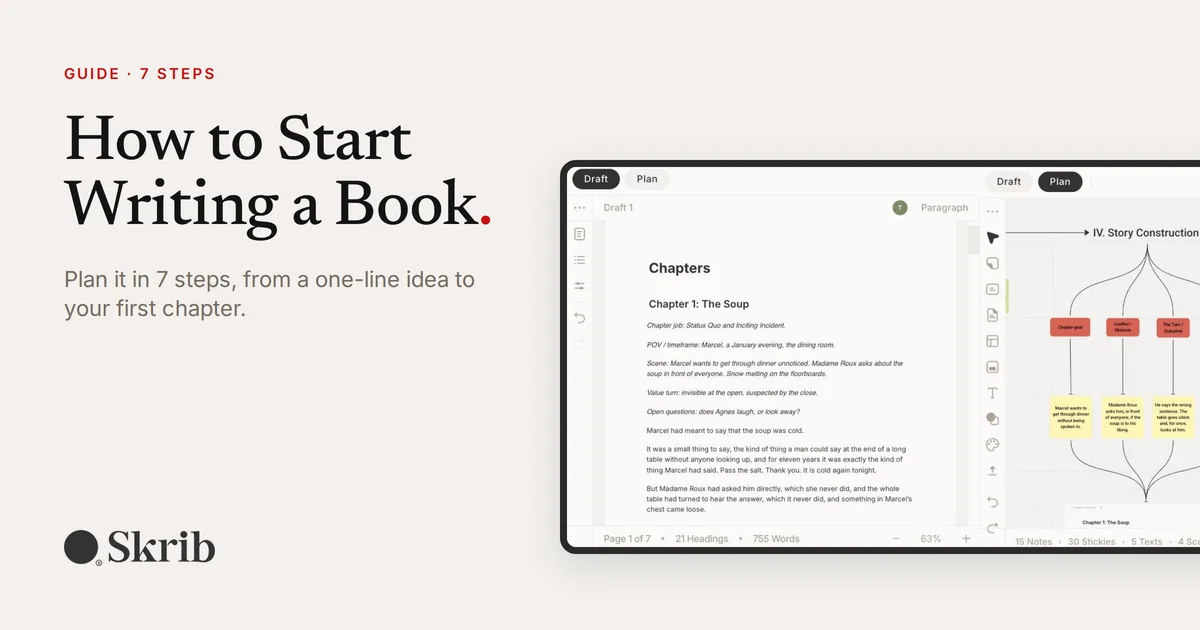
If you want to know how to start writing a book, here is the short answer: don't start on page one. Start with a plan you can see. This guide walks you through planning a novel in seven steps, from a one-line idea to your first chapter. Every step shows the same real book being planned on a Skrib board, so you can follow along with your own story.
It works for a first novel, a memoir or a story you have been carrying around for years. You don't need any writing experience. You need about an afternoon.
We built every example in Skrib, a writing studio where your plan and your draft live side by side in one tab. You can copy the exact board from this guide for free and fill it in as you read, so by the end of the post your book is already planned.
Why most books stall in chapter three
Chapter one is easy. You have been imagining it for months. Chapter two still has the energy of the idea. Then chapter three arrives and you realise you don't know what happens next, who these people really are, or where any of it is going.
That is the point where most first drafts quietly stop. It is rarely a talent problem. It is a planning problem. The book only exists in your head, spread across a notes app, a notebook and a half-finished document, and every writing session starts with rebuilding it from memory.
The fix is not a 40-page outline. It is a light plan with seven parts, all on one board, so you can see the whole book before you write it and come back to it whenever you get lost. That is exactly what a Skrib board is for: the idea, the characters, the structure and the chapters in one place, with the draft one click away.
The finished plan
Here is where you are heading. This is the finished plan for our example novel, The Held Breath, built from Skrib's free Book Writing for Novelists template. From left to right: the premise, the acts and turning points, the main character, the scene construction and the first four chapters.

The story in one line: Marcel, a quiet lodger who is sure he is completely unremarkable, is overheard confessing to something he never did, and discovers he would rather be suspected than ignored.
Now let's build it.
Step 1: One-line premise
Before characters, before structure, write your book in one sentence. This is your premise (writers also call it a logline or elevator pitch). It names the main character, what happens to them and what is at stake.
A shape that works for most stories:
When [something happens], [a character] must [do something], or else [what they stand to lose].
Next to it, write your theme: the one idea the whole book is quietly arguing. Every big scene should connect back to it.
For The Held Breath:
Premise: A lodger who fears he is utterly unremarkable is overheard confessing to something he never did, and must choose between clearing his name and keeping the one interesting thing anyone has ever believed about him.
Theme: Being looked at is not the same as being known.

Do it in Skrib: the premise and theme cards are already waiting at the top of the Book Writing for Novelists template. Type over the example text and they stay pinned where you will see them every time you open the book.
If you can't write the sentence yet, that is useful. It usually means you know your world and your mood but not what your main character wants. Keep going to step 2 and come back.
Step 2: Main characters
A book is only as strong as the person at the centre of it. You don't need a 20-page biography. For your main character, answer six questions:
Want: what are they chasing, out loud?
Need: what do they actually need underneath?
Wound: what happened in their past that still drives them?
Flaw: what gets in their own way?
Arc: who are they on page one, and who are they on the last page?
Voice: how do they talk, and what would they never say?
The gap between the want and the need is where your story lives. Marcel wants to be noticed. What he needs is to be known by one person. The whole book happens in the space between those two things.

Do it in Skrib: the template gives every main character a profile note with these six questions already written in. Answer them once and the card sits on the same board as your plot, so you never have to dig through old files to remember what your hero wants.
Do the same for two or three other important characters. For each one, the most useful question is: what do they want from the main character?
Step 3: Pick a structure
This is where many beginners freeze. They try to invent the shape of a novel from nothing. You don't have to. Writers have used the same few structures for centuries, and nobody has ever finished a novel and thought, this was clearly a three act structure, how disappointing.
Pick one to start:
Three-act structure. Setup, confrontation, resolution. The simplest place to begin, and the one we use in this example.
Save the Cat beat sheet. 15 beats that tell you roughly what should happen where. Good for commercial fiction.
Hero's Journey. 12 stages. A natural fit for fantasy, adventure and coming-of-age stories.
In Skrib these structures come as ready templates, so the acts and beats arrive on your board already laid out. Your job is only to fill them in.

Do it in Skrib: open the template library, pick Three-Act, Save the Cat or Hero's Journey, and the beats land on your board in one click. Every template is free to copy.
Step 4: Turning points
A structure is only useful once you fill in the moments where the story turns. For a three-act book, you need about eight:
Status quo: what normal life looks like before anything happens.
Inciting incident: the event that disrupts it.
Crossing the threshold: the point of no return.
Rising action: the obstacles that pile up.
Midpoint: a revelation that changes what the story is about.
All is lost: the lowest point, where winning looks impossible.
Climax: the final confrontation.
New status quo: how the world and the character have changed.
Here is The Held Breath, act by act:

Do it in Skrib: the act grid on the template has a slot for every turning point. When your idea changes, drag a card to another act instead of rewriting the whole outline.
Notice the ending is already decided. You are allowed to change it later, but knowing where the book lands makes it far easier to start, because every chapter has somewhere to go. This is the step that gets most writers past chapter three.
Step 5: Scene list
Turning points tell you what happens. Scenes tell you how you will show it. Break the first few turning points into chapters, one scene per chapter to start. For each chapter, write four short lines:
Scene: what happens, in a sentence.
Value turn: what is different by the last line? (Invisible to suspected. Alone to watched.)
Chapter job: which turning point does this chapter serve?
POV: whose head are we in, and when and where does it happen?

Do it in Skrib: chapters are columns and scenes are cards. Drag a card from one column to another and the order of your book changes in a second, with nothing to copy and paste.
You don't need every chapter planned before you start. Plan the first four or five, and add the rest as the draft teaches you what the book is.
Step 6: Set a writing rhythm
A plan without a rhythm is a very nice wish. Decide three numbers before you write a word: your target length, your daily or weekly word count, and a date for the finished first draft.
For The Held Breath: 80,000 words, 500 words a day, five days a week, first draft by the end of March.

Do it in Skrib: put your targets on a sticky at the top of the board. The Draft counts your words as you type, so you can check your daily number without opening a spreadsheet.
A few habits that help first-time novelists finish:
Keep the target small. 300 to 500 words a day adds up to a full draft within a year.
Don't edit yesterday's chapter before writing today's. Finish first, fix later.
Stop mid-sentence. Tomorrow starts with an easy half line instead of a blank page.
Write out of order when you are stuck. Jump to a scene card you are excited about.
Step 7: Draft chapter one beside the plan
Now write. Open your draft next to your board, look at the chapter one card, and write that scene. Not the perfect opening. Just the scene.
A few rules for how to start a novel's first chapter:
Open with your main character doing something, not with the weather or the history of the town.
Show what they want early, even if it is small. Marcel wants to get through dinner without being noticed.
End the chapter with something changed. By the last line of chapter one, Marcel is the man who confessed.

This is the part that keeps books alive past chapter three. When you lose your way, you don't have to rebuild the story from memory. You look to the right.
In Skrib this is one click: open the Draft, open the Plan beside it, and write with the chapter card in view. No second window, no notebook, no twenty tabs.
FAQ
How do I start writing a book as a complete beginner? Start with a plan, not a first page. Write your story in one sentence, sketch your main character's want and need, pick a simple structure like three acts, and decide your turning points and ending. Then write chapter one with that plan beside you.
Should I plan a novel before writing it? Some writers plan every scene and some plan almost nothing. Most beginners finish more often with a light plan: a premise, one or two character profiles, the main turning points and the first few chapters. You can change all of it as you write.
How do I plan a story quickly? Do steps 1, 3 and 4 in one sitting: one sentence, one structure, eight turning points. That is enough to start writing, and you can fill in characters and scenes as you go.
How long does it take to plan a book? Anywhere from an afternoon to a few weeks. If you have been planning for months without writing a scene, start the draft and plan the rest as you go.
What is the best way to start the first chapter of a novel? Start with your main character in motion, show what they want, and end the chapter with something changed. Most writers rewrite their opening once the book is finished, so don't let it stop you from starting.
Start your book in Skrib tonight
You don't need the whole book. You need one sentence, one character and a structure to fill in. The free Book Writing for Novelists template in Skrib gives you all seven steps from this guide on one board, with the same prompts we used for The Held Breath:
Premise and theme cards at the top of the board
Character profiles with the six questions already written in
A three-act grid with a slot for every turning point
Chapter columns for your scene cards
Your draft open beside the plan, in the same tab
Copy it, replace our example with your story, and write chapter one tonight. It takes about a minute to set up and it is free to start, no card needed.