Structuring a Two-Hander: Plays Built Around Two Characters
Two-handers have no configuration to vary. Use relationship states, the absent third party and five proven shapes to hold a stage with only two characters.
Two-handers get recommended to new playwrights for the wrong reason. They’re cheap to stage, so the advice goes: write small, get produced.
It’s true about the economics and misleading about the craft. A two-hander is one of the hardest structures in theatre, and it’s hard for a reason most writers don’t discover until they’re forty pages in and the play has stopped moving.
The problem isn’t sustaining interest in two people. It’s that you’ve given up the cheapest source of variety the form has.
Our complete playwright’s guide covers the constraints this form pushes hardest against.
What is a two-hander?
A two-hander is a play written for two actors, in which the entire drama is carried by a single relationship. The term is more common in British usage; two-character play means the same thing. It’s distinct from a play that happens to have two leads - in a true two-hander, no third character appears on stage at any point.
The configuration problem
Here’s the structural fact underneath everything else.
With three characters, you can rearrange the stage. A and B against C. Then B and C against A, while A watches. Then C leaves and A and B say what they couldn’t in front of her. Each rearrangement is a genuinely new dramatic situation, and it costs nothing - no new information, no plot development, just an exit and an entrance.
A three-hander has seven possible on-stage configurations. A two-hander has three, and only one of them is a scene. A alone. B alone. A and B.
That’s the whole board. You have one relationship and no alliances, because an alliance requires somebody to be allied against.
Which means a two-hander cannot get variety from configuration. It has to manufacture it another way - and every craft decision in the form follows from that.
What replaces configuration: relationship states
The answer is that the relationship itself has to keep changing.
Not escalating - changing. This is the distinction that separates two-handers that work from two-handers that grind. An escalating two-hander is two people arguing more loudly for ninety minutes. A working one is a sequence of different relationships between the same two people.
Interrogator and suspect becomes something closer to collaborators. Collaborators becomes teacher and student. Teacher and student inverts. Then it curdles into something adversarial that is not the same adversarial as the opening, because everything in between has happened.
Each state is a new configuration achieved without a new body on stage. That’s the substitution: what a three-hander gets from entrances, a two-hander gets from transformation.
A practical test. Write down the relationship in one phrase at five points through your draft - pages 1, 20, 40, 60, 80. If you write the same phrase twice in a row, that stretch is where the play stalls, and no amount of sharper dialogue will fix it.
Two-handers also lend themselves naturally to contrast structures, where each character exists partly to make the other legible - our character foils guide covers how that works and why similarity, not opposition, is what makes it land.
The absent third party
Look closely at successful two-handers and a pattern appears: most of them are three-handers where one party never appears.
’night, Mother has the men who aren’t in the house.
Oleanna has the tenure committee.
Educating Rita has a husband on one side and a marriage on the other.
Red has the art world, and the younger painters coming for Rothko.
The absent third solves the alliance problem. Two people alone have nothing to align with or against. Give them an offstage force and suddenly they can be allies against it, or divided by it, or competing for its approval - and the alliance dynamic you lost by cutting the third actor comes back for free.
Three ways to use one:
A shared enemy the two are united against, until one of them defects.
A shared loss they hold differently - the surest generator of long-form conflict between people who love each other.
An authority whose judgment matters to one and not the other.
The absent third should exert pressure, not deliver plot. If they start sending messages that advance the story, you’ve written a three-hander with an offstage character, which is a different and weaker thing.
Five shapes a two-hander takes
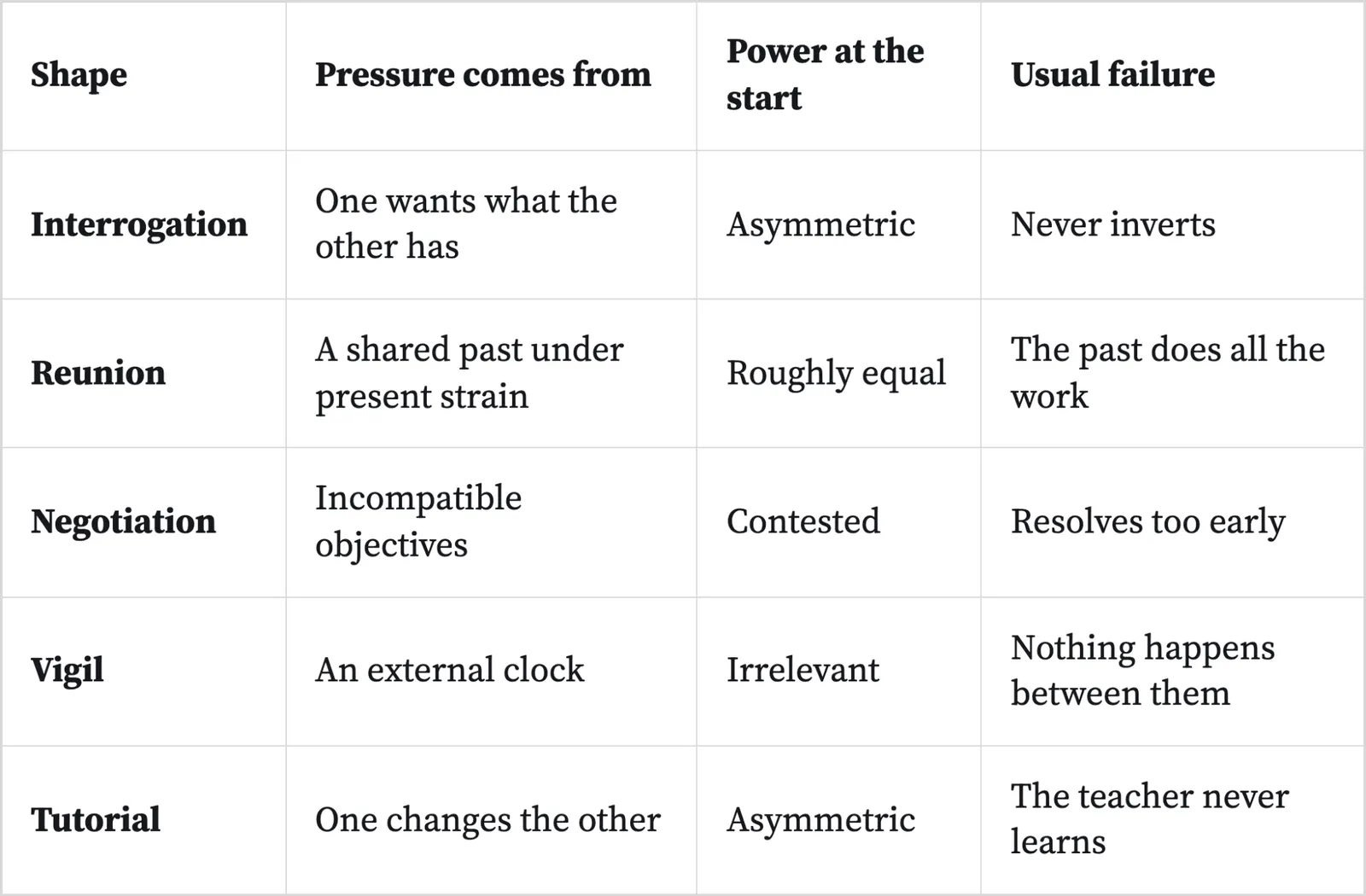
Most fall into one of these, and knowing which you’re writing tells you where the pressure comes from.
The interrogation. One wants something the other has - information, admission, permission. Power is asymmetric at the start and usually inverts. Oleanna is the hard version.
The reunion. Two people with a shared past, brought together by present pressure. The past is the engine and the present is the excuse.
The negotiation. Both want something, and the wants are incompatible. Structurally the cleanest, because both characters have active objectives from page one.
The vigil. Two people waiting for something external - a verdict, a death, a delivery. Pressure comes from outside and time, not from either of them. The Dumb Waiter runs on it.
The tutorial. One changes the other, and is changed by the exchange. Educating Rita and Red both use it, and both invert the direction before the end.
Mixing is normal. Many strong two-handers begin as one shape and become another, which is itself a relationship-state change.
Why they can’t leave
Every play needs a reason its characters stay in the room. In a two-hander it isn’t a background condition - it’s the load-bearing wall, because either character walking out ends the play immediately.
An audience will register an unlocked door faster than anything else in the form. If a scene has become unbearable and one character could simply go, and doesn’t, and the play hasn’t told us why, the tension collapses.
What holds people in a room: obligation, blood, money, weather, a locked door, a job, a deadline, love, guilt, and the specific pull of a conversation that has gone too far to abandon.
The best two-handers make the reason itself dramatic rather than circumstantial. A snowstorm is a mechanism. A daughter who cannot leave because she knows what her mother will do is a play.
Entrances, exits, and the one-person stage
With two characters, an exit is enormous. It doesn’t rearrange the stage - it empties it.
You get very few, and each one is a structural event. Used well, an exit is the strongest punctuation the form has. Used casually, it’s a hole.
The alone stage is a resource. One character left on stage produces exactly one thing: direct address to the audience, or behaviour observed with no witness. Both are potent and both are expensive, because the play stops being a relationship for their duration. The monologue in a two-hander needs to be earning something no exchange could - Writing Monologues That Reveal Character and Move the Plot covers when a play has earned one.
Practical note on exits: in a two-hander, an exit and an immediate re-entrance is almost always weaker than not leaving at all. If a character goes out and comes straight back, the audience registers that nothing happened.
The endurance problem
A consideration that’s easy to overlook on the page and impossible to overlook in rehearsal.
Two actors are carrying ninety minutes with no relief. No scene off, no crossover to catch breath, no colleague to take a page. The memorisation load is roughly double what an ensemble member carries, and the stage time is total.
Write breathing space in deliberately:
Business. Something physical to do - cooking, packing, sorting - that occupies hands and lets a scene run without continuous speech.
Uneven distribution. A stretch where one character carries the talking and the other mostly listens, then the reverse.
Silence. Which the form can afford more than most, because the audience is already locked onto two people.
It’s also worth knowing that two-handers are the most producible shape in theatre - the practical arithmetic is covered in our economics of staging guide.
Where two-handers fail
The relationship never changes state. The single most common failure. Two people in the same dynamic for eighty minutes, arguing with increasing volume.
The door is unlocked. No credible reason to stay.
No absent third. Nothing outside the room, so the pressure has only one source and it exhausts.
Symmetrical characters. Two people equally articulate, equally powerful, equally motivated. Two-handers need asymmetry - of power, knowledge, need or fluency - and they need it to move.
Information as substitute for change. Revelations arriving to keep things going. A revelation changes what the audience knows; only a state change alters what the play is.
Both characters saying everything. With two people and no third to conceal from, writers often let them be completely direct with each other. Then the play has no gap for the audience to work in - see subtext in dialogue for what that costs.
When two is wrong
Not every intimate play is a two-hander, and forcing it is a real failure mode.
If your play needs an alliance to shift, you need three. That’s what the third body is for, and no absent character reproduces it fully.
If the two characters have nothing to conceal from each other, the form is working against you - a third presence gives people a reason to perform.
If you chose two for producibility rather than for the story, it will read that way. A two-hander written to be cheap is a compromised play, and literary managers see a great many of them.
The honest question: is this play about a relationship, or does it merely have few characters? Only the first is a two-hander.
Tracking a relationship that keeps changing
The state-change problem is hard to see while drafting, because you’re inside the scene rather than above the play. The dynamic feels different as you write it and reads identically two months later - which is why so many two-handers stall in the same place, around the point where the writer thought the relationship had turned and it hadn’t.
Skrib makes the shape visible. The Board is a canvas beside the writing where the relationship can sit as a sequence of states - what these two are to each other at page 1, 20, 40, 60 - along with a card for the absent third and what force it exerts. The Draft stays open next to it with stage formatting that holds through the restructuring this kind of revision usually causes.
The Library keeps every version searchable, which is useful when a reading tells you the middle sags and you want to compare it against a draft where it didn’t. You can start free.
Frequently asked questions
What is a two-hander play? A play written for two actors in which one relationship carries the entire drama, with no third character appearing on stage. The term is more common in British usage; two-character play means the same thing.
Why are two-handers difficult to write? Because you lose the ability to rearrange the stage. A three-character play generates new situations for free through entrances and exits - seven possible configurations against a two-hander’s three. Without that, variety has to come from the relationship itself changing state.
How do you keep a two-hander from becoming repetitive? Make the relationship become a different relationship, repeatedly, rather than the same one under rising pressure. Writing down what the two are to each other at five points across the draft exposes the stretches where nothing has changed.
Do two-handers need an offstage character? Most successful ones have one. An absent third party - a dead relative, an institution, a rival - restores the alliance dynamic you lose by cutting the third actor, giving the two something to unite against or be divided by.
Are two-handers easier to get produced? Yes, on arithmetic. Two actors is the most producible shape in theatre. But a two-hander written for that reason rather than because the story is two people in a room usually reads as compromised, and literary managers see many of them.
How long can a two-hander sustain? Full-length is entirely achievable - many of the form’s best-known examples run ninety minutes or more. What determines it is the number of genuine state changes available in the relationship, not the number of pages two people can fill.