Environmental Storytelling in Level Design | Skrib
Evidence, not exposition. The three registers, the environmental storytelling toolkit, why absence is the strongest tool and how to write a beat as a spec.

The standard example is a skeleton slumped against a wall with a note in its hand. It’s the standard example because it’s the entry-level version, and most advice on environmental storytelling stops there - which is why so much of it in shipped games amounts to bodies and audio logs.
The technique is usually explained as show, don’t tell. That’s misleading, because environmental storytelling isn’t showing.
It’s withholding. You don’t tell the player what happened in this room. You leave evidence and let them work it out, and the story that results is assembled in their head rather than delivered by the level. The environment is a crime scene, not a diorama.
Which makes the craft a matter of what you leave out - and the most common failure over-specification, not under.
It’s one of several channels covered in our video game writer’s handbook.
What is environmental storytelling?
Environmental storytelling is narrative delivered through the arrangement of space, objects and physical evidence rather than through dialogue or cutscenes. The player infers events, character and world rules from what they encounter, and the inference is the mechanism - nothing is stated. It’s also the one narrative channel that is entirely opt-in, which makes it behave quite unlike backstory delivered through dialogue.
The term entered game development from theme park design. In a two-part article for Gamasutra in spring 2000, Don Carson - a former Senior Show Designer at Walt Disney Imagineering - argued that 3D games could borrow the techniques rides use to make a space imply a story before anyone speaks. It remains the field’s founding text.
Evidence, not exposition
Two consequences follow from treating a space as evidence, and both cut against instinct.
The player has to be able to be wrong.
If a room resolves completely - one reading, no ambiguity - the player has received information, not discovered a story. The sensation people describe as environmental storytelling working is the sensation of having figured something out, and figuring out requires the possibility of figuring wrong.
A scene that can only be read one way isn’t a story. It’s a caption.
The gap is the content.
What makes a space eloquent is the distance between what’s visible and what it implies. Close that distance with a note that explains, and you’ve paid for the props and thrown away the mechanism.
This is why the note in the skeleton’s hand is such a persistent problem. It’s not that notes are bad - it’s that a note explaining the tableau it’s lying in cancels the tableau.
Three registers
Environmental narrative operates at three levels, and most games only use the first.
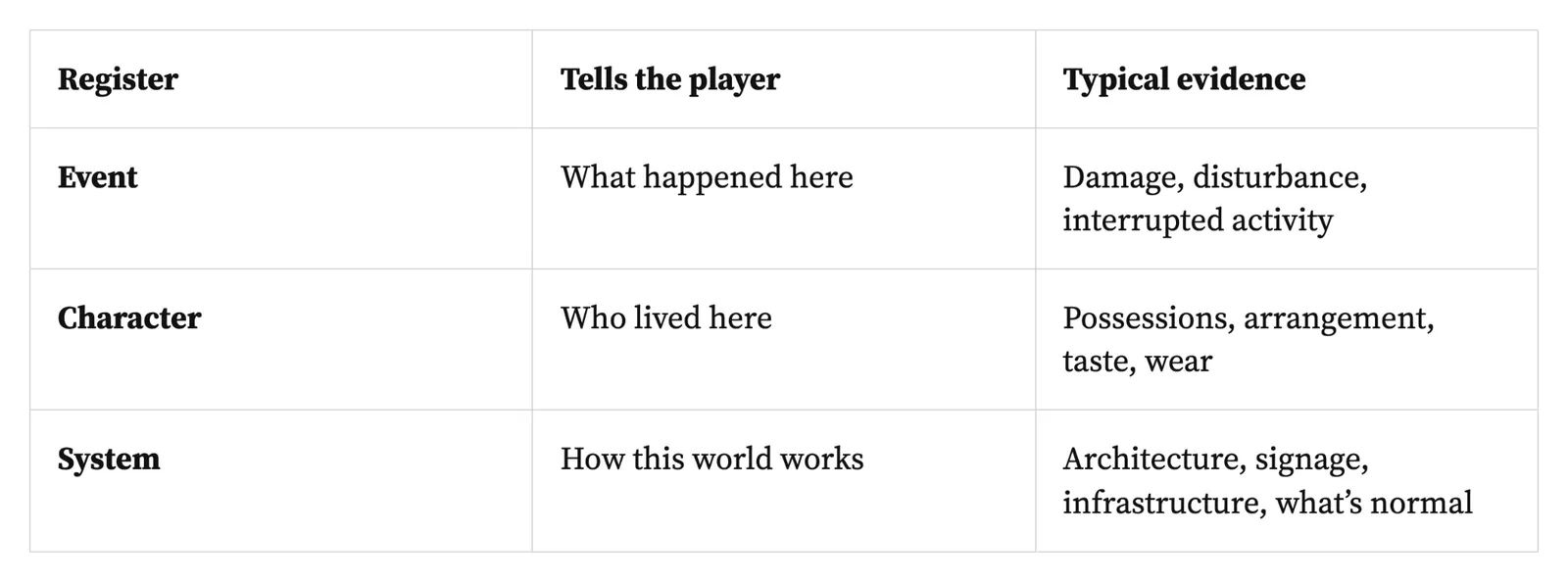
Event is the most used and the most exhausted. A struggle, a barricade, a meal abandoned mid-course. It works, and it’s what produces the skeleton-and-note cliché when it’s the only register in play.
Character is where environmental storytelling gets good. A room tells you who someone was through what they kept, what they arranged carefully, what they never fixed. Gone Home is essentially an entire game in this register, and it demonstrates that a house with no bodies in it can carry a complete narrative.
System is the most under-used and the most powerful for worldbuilding. What’s mundane in a world says more about it than what’s dramatic. A vending machine tells you there’s an economy, a currency, a company, a set of things people want at 3am. Signage tells you what’s forbidden often enough to need a sign - which tells you it happens.
The practical prompt: for any space, write one line in each register. Most environments in most games have an event line and nothing else, and adding the other two costs almost no art.
The toolkit
Nine techniques, roughly from most to least used.
Spatial arrangement. What’s near what. Two chairs pulled close, a bed dragged against a door.
Wear and damage. Time made visible - a path worn into a floor, a repair done badly and then done again.
Absence. Covered below; the strongest of the set.
Scale and architecture. Ceiling height, corridor width, whether the space was built for these people or repurposed by them.
Signage and in-world text. Notices, graffiti, labels. Cheap, high-density, and easy to overuse.
Light and sound. Not the writer’s department, but specifiable - a room lit by one working fixture reads differently from the same room lit evenly.
Item descriptions. Opt-in depth for players who look. Free to skip, which is their advantage.
Repetition with a break. Three identical rooms and a fourth that isn’t. The pattern establishes the rule; the exception is the story.
Remains. Bodies, corpses, skeletons. Effective and heavily worn - worth reserving rather than defaulting to.
Absence is the strongest tool
The technique almost nobody teaches, and the one that produces the strongest reactions.
A missing thing is more eloquent than a present one, because a present object states and a missing one asks.
An empty crib in a furnished nursery
A row of coat hooks with one bare
A table set for five with four chairs
A photograph with someone cut out of it
A door that’s been boarded from the inside
Each of these implies an event, a character and a decision without depicting any of them. And crucially, absence is nearly free in production terms - you’re specifying the removal of an asset rather than the creation of one.
The design rule: absence only reads if the pattern is established first. A missing coat means nothing unless the player has seen the other hooks full. Set the norm, then break it.
Detail as a lure
One technique from Carson’s original article has aged particularly well, and it solves the problem of beats nobody sees.
Don’t distribute detail evenly. Save it for where you want the player to go. A corridor cluttered with ornament teaches players that detail is meaningless. A plain corridor with one richly detailed element at the far end pulls them down it - and arrives them at your beat facing the right way.
Visual complexity is a budget, and spending it uniformly wastes it. Concentrating it turns environment art into wayfinding, which is what gets your evidence looked at in the first place.
The writer’s deliverable is a spec, not prose
An important practical adjustment for writers arriving from other media.
You do not build environmental storytelling. Level artists and designers do. What you produce is a specification they can build from - which means the output is a document, not a passage of description, and its quality is judged on whether it can be executed rather than on how it reads.
That changes what good looks like. Atmospheric prose describing a room is useless to an artist. A list of placeable evidence with a stated intent is actionable.
It also means this work runs through other disciplines constantly, and the requirements have to be expressed in terms they can build against - Working with Game Designers: Aligning Story Beats with Mechanical Systems covers that negotiation.
How to write an environmental beat
A working template. One per space that carries narrative.
LOCATION: [space name / level ID]
REGISTER: Event / Character / System
INTENT: What the player should come away believing.
One sentence. Not what happened - what they conclude.
EVIDENCE: The placeable items, in priority order.
1. [object] - [what it implies]
2. [object] - [what it implies]
3. [object] - [what it implies]
MUST STAY AMBIGUOUS:
What the player must NOT be able to settle.
MUST NOT CONCLUDE:
Misreadings that would break the story elsewhere.
PRIOR KNOWLEDGE:
What the player must already know for this to parse.
If the answer is anything, this beat is order-dependent -
flag it.
CUT PRIORITY: Which pieces of evidence can be dropped if the space
gets rescoped. There will be a rescope.
Three fields there do unusual work.
Must stay ambiguous is the one that keeps the beat a story rather than a caption, and it’s the field that stops a well-meaning artist adding a clarifying prop.
Prior knowledge catches order-dependence - the constraint that catches every writer arriving from linear media, since a player may reach this room at any point.
Cut priority exists because environments get rescoped constantly, and a beat with no stated priority gets stripped arbitrarily.
Item and lore text
The readable layer inside the environment, and it follows different rules.
It’s opt-in, which is its advantage. A player who reads item descriptions has volunteered, so this is the one channel where depth costs nothing - nobody is being held up.
Write it in the world’s voice, not the game’s. An item description written by someone inside the fiction - a catalogue, an inventory clerk, a previous owner - carries worldbuilding that neutral description can’t.
Don’t put critical information here. Anything the player must know cannot live in an optional channel.
Keep it short and dense. Two sentences that imply a decade beat a paragraph that explains a year.
The lore itself needs to stay consistent across hundreds of these, which is a documentation problem rather than a writing one - World Bibles for Game Studios: Documenting Lore at Scale covers it.
Testing: what did they think happened?
The only test that matters, and it’s cheap.
Walk a playtester through the space and ask what they think happened here. Don’t prompt, don’t explain, don’t react.
Three possible results:
They tell you your intent. The beat works.
They tell you something else, and it’s interesting. Usually a win. If their reading doesn’t contradict anything elsewhere, consider leaving it - a space that supports two coherent readings is richer than one that supports one.
They tell you nothing, or describe the props. The beat failed. Either the evidence is too subtle, or there’s no gap for them to cross, or they lack prior knowledge the beat assumed.
The diagnostic question when it fails: did they not notice, or did they notice and not infer? The first is an art and lighting problem. The second is yours.
The cheapest fix for the first is a companion line. One reaction on proximity roughly doubles the notice rate on a beat, and it costs a single bark - a discipline covered in Barks and Ambient Dialogue: Writing Lines for Repeated Triggers. Getting the beat built the way you specified it is a cross-discipline problem, handled in Working with Game Designers: Aligning Story Beats with Mechanical Systems, and keeping a space consistent with established canon belongs to World Bibles for Game Studios: Documenting Lore at Scale.
Where it goes wrong
The explaining note. A document in the room that resolves the tableau it’s sitting in.
Clutter without meaning. Detail that signals nothing. Players learn quickly whether a game’s environments reward attention, and once they decide they don’t, they stop looking everywhere.
Over-signalling. Evidence lit, framed and colour-coded until inference isn’t required.
Order-dependent beats. A room that only parses if the player already knows something they may not.
One register only. Event after event after event.
Default remains. Reaching for a body because it’s the shorthand.
Specifying the unbuildable. A beat that requires an asset nobody is making. The spec has to survive contact with a schedule.
Keeping evidence and reference together
Environmental beats are unusual among writing deliverables in being half visual. A beat is a short piece of text plus a set of references - photographs, layout sketches, mood images, the thing you saw that started it - and those two halves almost always live in different applications. The spec goes into a document, the reference goes into a folder, and the artist gets one of them.
Skrib keeps them in one place. The Plan is a canvas that takes file uploads alongside documents and notes, so a beat can sit as a card with its reference images attached and its neighbouring spaces mapped around it - which is how you notice that three rooms in a row are all telling event-register stories. The Draft sits beside it for the text, and the Library keeps every version searchable when a level gets rebuilt.
What this doesn’t do is place anything in a level. Skrib isn’t an engine or an editor, doesn’t connect to one, and doesn’t replace the tools that build the space. It’s where the beat is designed before it’s handed over. You can start free.
Frequently asked questions
What is environmental storytelling in games? Narrative delivered through the arrangement of space, objects and physical evidence rather than dialogue or cutscenes. The player infers what happened, and that act of inference is the mechanism - the story is assembled in their head rather than stated by the level.
How do you write environmental storytelling? As a specification rather than prose. Level artists build the space, so the writer’s deliverable lists the evidence to be placed, states what the player should conclude, and - critically - states what must remain ambiguous so the beat stays a story rather than a caption.
Why do environmental stories feel obvious or flat? Usually over-specification. If a space resolves to exactly one reading, the player has received information rather than discovered anything. The gap between what’s visible and what it implies is the content, and an explanatory note in the room closes it.
What’s the strongest environmental storytelling technique? Absence. A missing object asks a question where a present one states a fact - an empty crib, a bare hook in a row of full ones, a place set for someone who isn’t there. It only reads if the pattern is established first, and it costs almost nothing to produce.
Should important information go in item descriptions? No. Item and lore text is an opt-in channel, which makes it ideal for depth and unsuitable for anything the player must know. Critical information needs to live somewhere every player will encounter it.
How do you test environmental storytelling? Walk a playtester through the space and ask what they think happened, without prompting. If they describe the props rather than an event, ask whether they didn’t notice or noticed and didn’t infer - the first is a lighting and art problem, the second is a writing one.