Narrative Design vs. Game Writing: Where the Roles Split
Job titles are unreliable; deliverables are not. The three axes that define each role, what neither owns, adjacent titles and how to read a job listing.
Ask five people in the industry to define the difference and you’ll get five answers, all of them offered with confidence and none of them wrong.
That’s not because the field is careless about language. Both terms are recent, and the recognition of narrative design as a specialism is recent enough that definitions still vary significantly from one studio to another. A narrative designer at one company writes no dialogue at all. At another, they write most of it.
So the question what’s the difference has no stable answer. A better question does: what will I actually be doing all day? - and that’s answerable, from any job listing, in about ninety seconds.
The wider discipline is mapped in our video game writer’s handbook.
What is narrative design?
Narrative design is the discipline of determining how a game’s story is expressed through its structure and systems - when story reaches the player, which channels carry it, and how it holds together across player choice. It’s a sub-discipline of game design rather than of writing: a narrative designer is a designer first, and may have input on plot and characters without ever authoring the storyline.
What is game writing?
Game writing is the authoring of a game’s text: dialogue, barks, item and lore descriptions, cutscene scripts, character material and tutorial copy. The game writer is responsible for the words and the characters within the world, working from a structure that narrative design has usually already established.
The most quoted formulation of the split comes from a 2018 GDC talk by writer-designer duo Molly Maloney and Eric Stirpe: the writer focuses on the characters within the game, while the designer focuses on the player’s experience of the story.
It’s the cleanest one-line version. It also won’t tell you which job a specific listing is describing.
The titles are unreliable. The deliverables aren’t.
Here’s the shift that makes this navigable.
These aren’t two jobs. They’re one spectrum, and every real role sits somewhere along it as a ratio. A posting titled Narrative Designer might be 70% writing. A posting titled Game Writer might require you to implement everything you write in a proprietary editor, which is design work by any reasonable definition.
Stop reading the title. Read what the role ships.
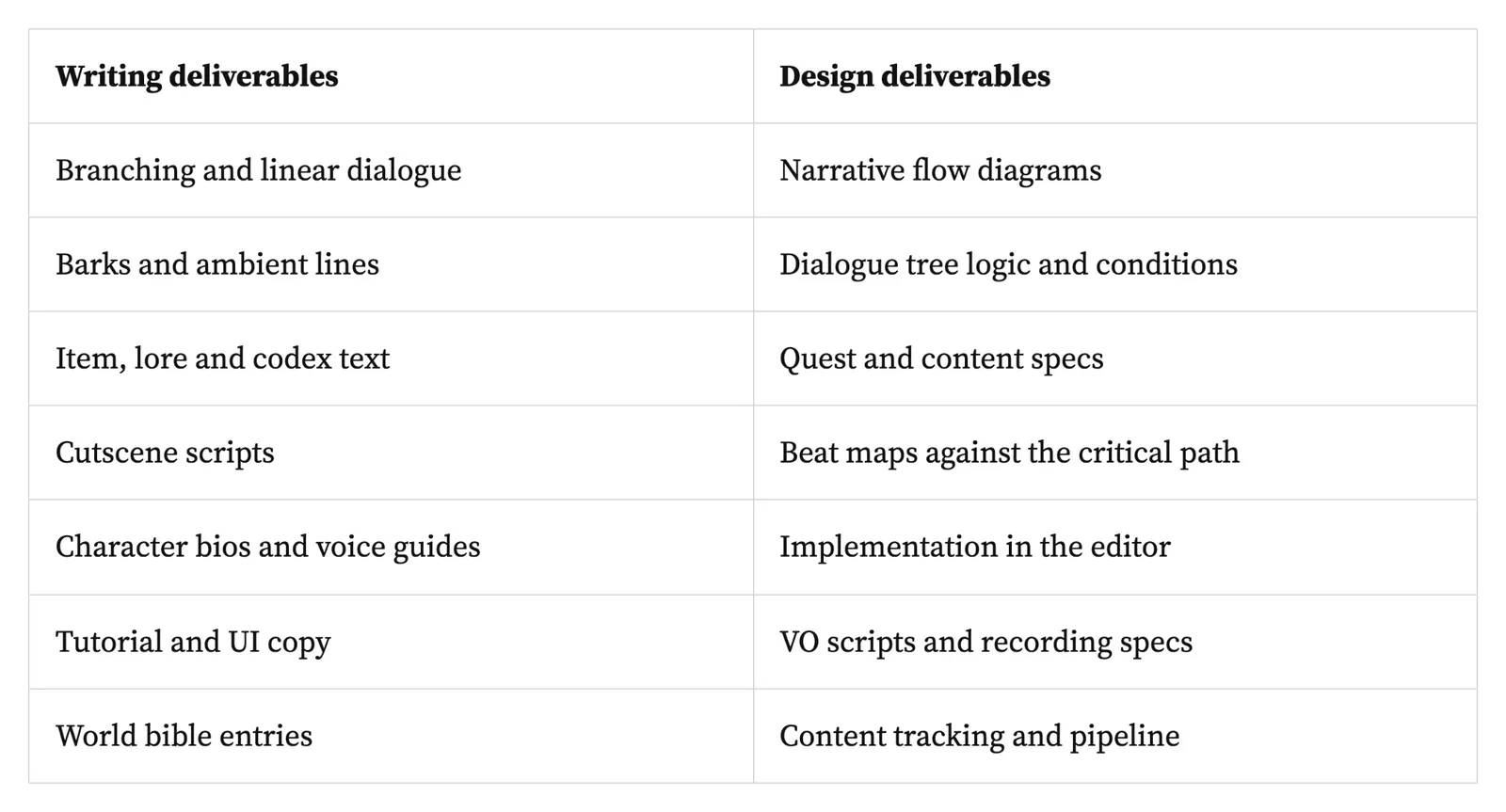
Count the columns in any listing. Most land at something like 60/40 in one direction. That ratio is the job, and it predicts your week far more accurately than the word on your contract.
Three axes that determine the job
The ratio is set by three things, and they matter roughly in this order.
Studio size
The single biggest determinant, and the one people underweight.
Small studios and indies: one narrative person does everything. World, quests, dialogue, barks, UI strings, VO direction, and often quest implementation. The title is whatever fits the org chart.
Mid-sized: two to four narrative people, with a lead who owns structure and writers who own text. The split starts to be real, and it’s still permeable.
AAA: genuinely specialised. You might write dialogue for one character for eight months, or own the conditional logic for one system across a whole game and write almost nothing.
Neither end is better and they aren’t the same career. Small-studio work builds breadth fast and gives you shipped credits across every discipline. AAA builds depth, pays more, and can be narrow enough that a year passes without you writing a scene.
Seniority
The split is sharpest at the junior end and converges as you go up.
Junior writers write dialogue to fit a story someone else has structured. Junior narrative designers set up how that dialogue is delivered and build the interactive sequences around it.
Move up and both roles converge on structure. Senior writers work on major beats, character identities and world architecture. Senior narrative designers do the same from the systems side. At the director level the distinction largely dissolves - a narrative director is accountable for the whole story experience regardless of which discipline they came from.
Genre
A narrative RPG needs branching specialists and world documentation. A linear action-adventure needs cutscene writers and something close to screenwriting. An immersive sim needs environmental and item text and very few cutscenes. A live-service game needs people who can write seasonal content forever without contradicting six years of canon.
The channel a genre relies on determines which half of the spectrum it hires for.
What neither role owns
Worth stating plainly, because it surprises people arriving from other media.
Narrative usually doesn’t own the premise. The game’s concept, pillars and direction typically belong to a creative director or game director, and the narrative team builds within them. A writer who joins expecting to originate the story is often disappointed; a narrative designer who expects to is often ignored.
Narrative doesn’t own the mechanics, which are the loudest storytelling channel the game has. What the player does says more than anything they’re told, and that’s authored by design. Getting story requirements expressed in design terms is the highest-leverage work available to a narrative person - Working with Game Designers: Aligning Story Beats with Mechanical Systems covers that negotiation.
Narrative rarely owns the schedule. Story content is comparatively cheap to cut at a milestone, because cutting a system breaks the build and cutting a quest doesn’t.
Adjacent titles you’ll be confused with
The field uses several near-synonyms and a few genuinely different roles that sound identical.
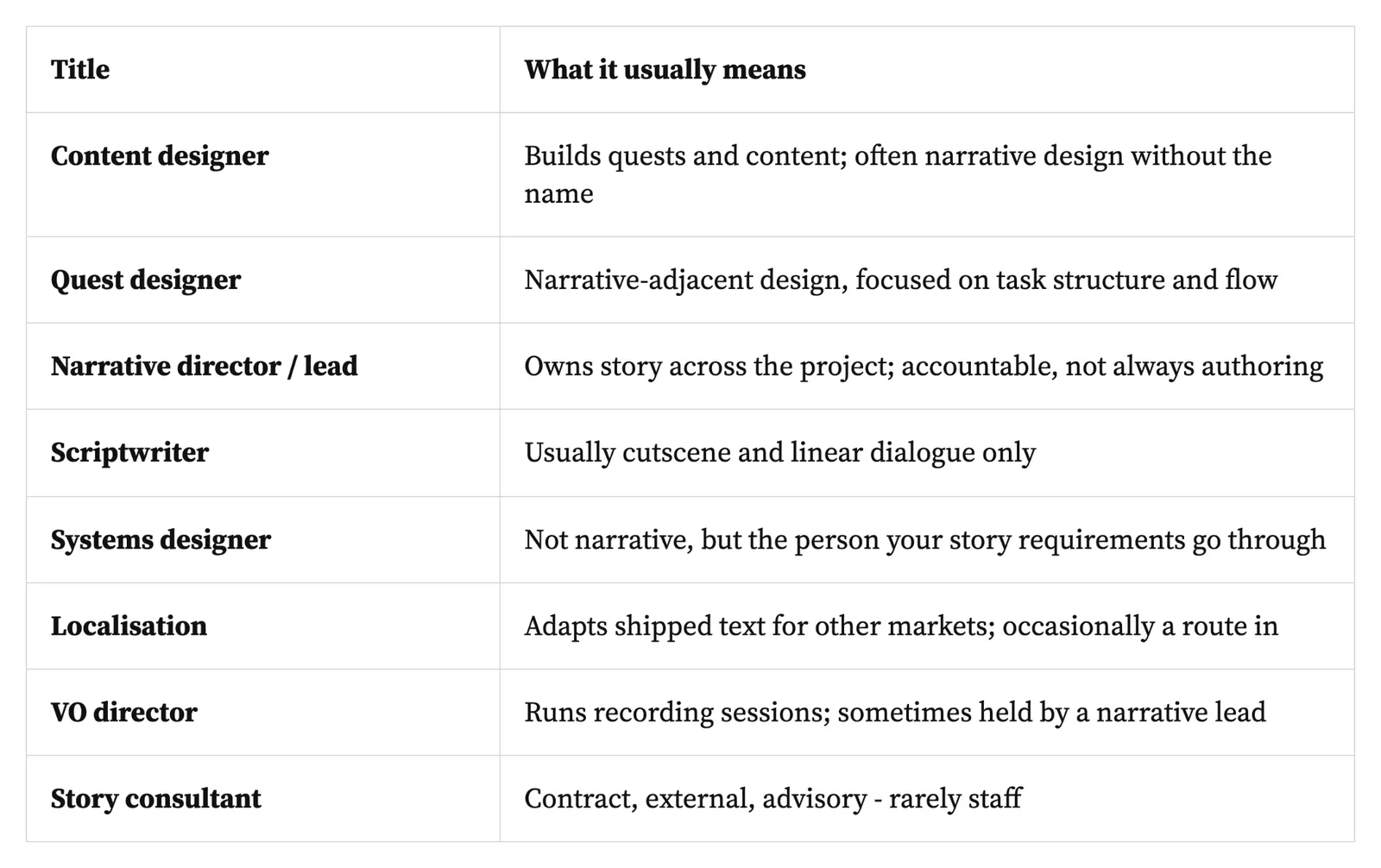
Quest and content design are worth watching specifically. They’re frequently the most accessible narrative-adjacent postings, sometimes asking for as little as a year of relevant experience, and a great deal of a game’s storytelling actually happens there.
How to read a job listing
A short decoding procedure that resolves almost every case.
1. Ignore the title. Read the responsibilities list. Count writing deliverables against design deliverables.
2. Look for the word “implement.” If the role implements dialogue in an editor or engine, it’s design work regardless of what the posting is called. Many listings specify a proprietary engine and expect you to work in it directly.
3. Look for “documentation.” Quest docs, specs and flow diagrams mean design. Bibles and character material mean writing.
4. Check who they report to. Reporting into design is a different job from reporting into a narrative director, even with identical responsibilities.
5. Check the shipped-title requirement. Senior postings at large studios commonly ask for around five years of development experience and one or two shipped titles in a relevant role - which tells you the role’s actual seniority regardless of the label.
6. Note the language requirement. Some roles specify native-level fluency in a particular language, which usually indicates the writing load is heavy.
Which should you aim for?
The useful version of this question isn’t about titles either.
Aim at writing if: you want to spend your day on prose, character and voice; you’re strongest at dialogue; you’d rather be given a structure than build one.
Aim at design if: you like systems and conditions as much as sentences; you’re comfortable with flags, gates and logic; you want influence over how the story is delivered rather than only what it says.
A practical note that cuts across both. Narrative design is a sub-discipline of game design, so if you’re aiming that way, understanding game design generally matters more than writing craft does. Writers arriving from film or fiction usually have the second and lack the first, and closing that gap is the real work.
Most people end up doing both anyway, especially early, and especially outside AAA. Breadth is not a failure to specialise; at small studios it’s the job.
The community and job board run by the IGDA’s Game Writing SIG is the most focused place to watch how these roles are actually advertised - reading a few dozen live listings teaches the distinction faster than any definition. What to build and how to present it belongs to Breaking Into the Game Writing Industry: Portfolio and Sample Scripts.
Where the two halves meet
Whichever side you sit on, the work has the same awkward shape: a structure that behaves like a graph and text that behaves like a document, usually living in different applications and drifting apart from the first week. That’s true whether you’re building the tree or writing the lines that go in it - and if you’re at a small studio doing both, it’s your entire problem.
Skrib keeps them adjacent. On the Plan, a dialogue tree, a quest flow or a beat map sits as connected cards while you draft beside it. The Library makes every project and imported file searchable, which is what turns a canon check into a search. Dialogue tables and string lists move in and out as .csv and .xlsx, matching how production text actually travels.
To be clear about what it isn’t: Skrib doesn’t compile, branch or integrate with an engine, and it isn’t a substitute for Twine, Ink or your studio’s pipeline tooling. It’s the layer before and alongside those. You can start free.
Frequently asked questions
What is the difference between a narrative designer and a game writer? Broadly, the writer authors the text and the characters while the narrative designer determines how the story is delivered through the game’s structure and systems. In practice both terms are used inconsistently between studios, so the deliverables listed in a specific job posting are a far better guide than the title.
Is narrative design a writing job or a design job? Design. Narrative design is a sub-discipline of game design, which means a narrative designer is a game designer first. Some narrative designers write substantial amounts of dialogue and some write almost none, depending on the studio.
Do game writers need to understand game design? Yes, more than most writers arriving from other media expect. Even in a text-focused role, the constraints that shape your work - branching limits, conditions, pipeline, VO budgets - are design constraints, and not understanding them makes a writer harder to work with.
Which role writes the dialogue? Usually the writer, but not always. At small studios one person does both. At some larger studios narrative designers produce placeholder dialogue that writers later replace, and at others narrative designers write final lines directly.
Which role is easier to get hired into? Neither reliably, though quest and content design postings sometimes ask for less experience than senior writing roles and are a common way in. Most people arrive laterally rather than being hired straight into a named narrative position.
Do narrative designers own the story? Rarely in full. The premise and direction usually belong to a creative or game director, and narrative teams build within them. A narrative director owns the story experience across a project, but that’s a level above both roles discussed here.