Writing Monologues That Reveal Character and Move the Plot
A monologue is a scene with one visible participant. Who is being addressed, how the play earns it, the turn, workable length and what actors need from it.
The monologue is the most powerful device the stage has and the one most reliably misused, and both facts have the same cause.
Theatre cannot do a close-up. There’s no way to make three hundred people look at one face at one instant - except this. A monologue is the only moment in a play when the audience has nowhere else to look, which makes it the form’s single route to direct interiority.
That’s also why it gets abused. A writer with something the audience needs to know reaches for the one device that guarantees attention, and hands a character three pages of history.
The correction is a shift in category. A monologue isn’t a speech. It’s a scene with one visible participant - and everything that makes a scene work has to be present, or it isn’t one.
It’s one device inside the wider craft covered in our complete playwright’s guide.
What is a monologue?
A monologue is an extended, uninterrupted speech by a single character within a play. It differs from a soliloquy, which is specifically a character speaking their thoughts aloud while alone on stage; a monologue may be addressed to another character, to an absent person, or directly to the audience. It differs from a one-person play, in which a single actor performs the entire piece.
In practice, contemporary writing uses monologue for all of these, and the distinctions matter less than the question of who’s being spoken to.
A scene with one visible participant
Every functioning scene has three things. A monologue needs all three or it becomes a character talking.
An objective. The speaker wants something from this speech. Not to express - to achieve. Forgiveness, permission, a confession accepted, someone stopped from leaving, themselves convinced.
A listener. Specific, and specific matters more than present. A silent character, a dead one, a jury, a god, the audience. An actor handed a monologue with no defined listener has nothing to do, and it shows within four lines.
An obstacle. Something making it hard. The listener’s resistance, the speaker’s shame, the risk of saying it, the fact that saying it changes everything. A monologue with no obstacle is a monologue at room temperature.
The test: state your monologue’s objective, listener and obstacle in one sentence each. If any of the three won’t come, that’s the fault - not the writing.
Who is being spoken to?
Four addressees, four different forms.
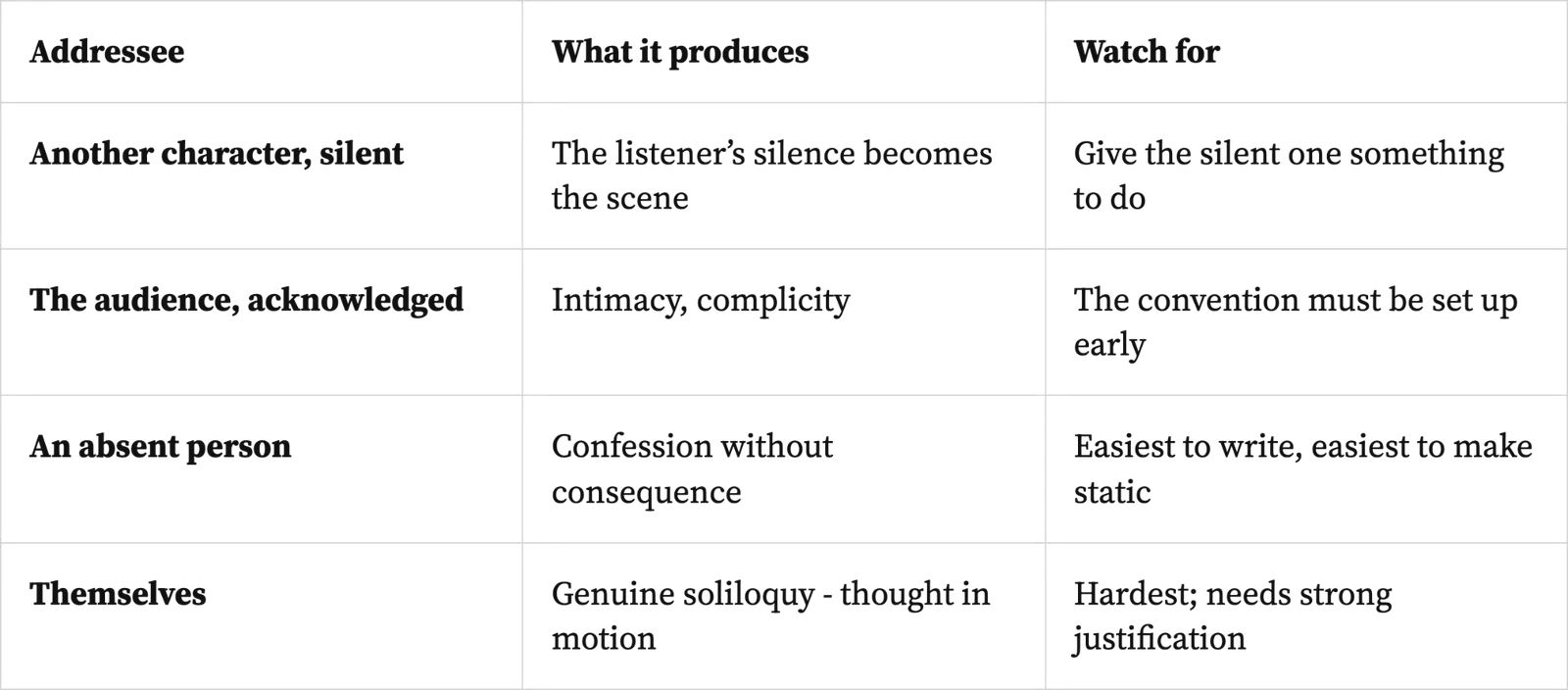
Speaking to a silent character on stage is the most dramatic option and the most under-used. Nothing raises stakes like a listener who could respond and doesn’t. It also solves the attention problem elegantly - half the audience will watch the listener, and that’s not a leak, it’s the scene.
Direct address requires a contract. If a character speaks to the audience in act two and nobody has all evening, it reads as a rupture. Establish it early - The Glass Menagerie does it in the opening minutes and never has to explain itself again.
Absent addressees - letters, graves, phones, prayers - are the most common in contemporary work because they license total honesty. Their weakness is stasis: nothing can push back, so the writer must supply the obstacle internally.
True soliloquy is the hardest, because a person alone has no reason to speak aloud. The convention carries it, but the speech has to be genuinely in motion - thought arriving, not thought reported.
The play has to earn it
The single most useful test, and it fails a lot of drafts.
Could this character have said this in scene one?
If yes, it isn’t a monologue. It’s information, and it’s been placed here because the writer needed the audience to have it.
A monologue should be enabled by the play. Something must have built to the point where this speech becomes possible - or unavoidable. The pressure is the play’s job; the monologue is the release.
That’s why monologues so often fail as backstory delivery. The character isn’t under pressure to say it, so the speech has no reason to exist beyond the audience’s need to know - and audiences feel that reversal precisely. Our guide to backstory dumps and earned reveals covers the underlying principle: information lands when the audience is already carrying the question.
A second test. Ask what would happen if the character couldn’t speak - if they were interrupted, or stopped themselves. If the answer is nothing much, the speech isn’t load-bearing.
The turn
What separates a monologue from a rant.
A monologue must not travel in a straight line. A character who begins angry, is angry throughout, and ends angry has delivered a paragraph at length. Something has to move.
The most reliable device: the speaker says something they didn’t intend to say.
They set out to justify themselves and admit something instead. They begin an apology and find it becoming an accusation. They start explaining and hear how it sounds.
That turn does three things at once - it surprises the audience, it gives the actor a genuine event to play, and it makes the speech happen rather than be recited.
Other shapes that turn:
Tactic change. Reason fails, so they beg. Begging fails, so they threaten.
Discovery. They work something out mid-sentence and can’t unknow it.
Interruption from within. They stop, go back, correct themselves. On the page this looks like a mess and in performance it’s the most human thing available.
The refusal. They approach the real thing and swerve - and the swerve is the content.
One structural note. A monologue is usually where a play’s subtext thins, because the character is finally saying it. That’s legitimate and it’s a resource you’re spending - the plain statement lands because of everything indirect before it. Subtext in dialogue covers why the floor matters.
What a monologue must accomplish
Two things, and most drafts deliver only the first.
Reveal. The audience knows something about this person they didn’t. Not a fact about their past - an understanding of how they work.
Move. The play is in a different position afterwards. A decision has been made, a relationship has changed, a threshold has been crossed.
A monologue that reveals without moving is a portrait, and audiences tolerate one per play at most. A monologue that moves without revealing is exposition with the lights dimmed.
The practical version: write the scene that follows before you finalise the monologue. If that scene would be identical without the speech, the speech hasn’t moved anything.
Where they belong
Structurally, monologues cluster in predictable places, and the reasons are sound.
Immediately after a shock, when ordinary speech has failed
Before an exit, when a character has one chance
At an act end, where the speech and the interval do complementary work
At the opening, as a framing device that establishes the direct-address contract
Late in act two, when everything that could be avoided has been
Where they don’t belong: anywhere the audience is still assembling basic information, and anywhere two characters could have the same exchange between them. If a monologue could be a scene, make it a scene - dialogue is almost always more dramatic than address.
In a two-hander, a monologue is expensive, because the play stops being a relationship for its duration and the stage empties of the thing the audience came for. Our two-hander guide covers when the alone stage earns itself.
Length
Almost every monologue in almost every draft is too long, and the excess is in a predictable place.
The last third usually goes. Writers reach the real thing and then keep writing - restating it, landing it, making sure. The speech has already landed; the tail is insurance.
Find the line where the audience understands, and end within a few lines of it.
Signs of over-length:
The speech restates its own point in different words
A summarising sentence at the end
The turn happens two-thirds through and nothing follows it
An actor’s energy visibly drops in a read-through
That last one is the reliable measure. A timed reading tells you what a page count can’t - our table read guide covers what to listen for.
What actors need
A monologue is either a gift or a punishment, and the difference is specific.
They need: a defined listener, a clear objective, an obstacle worth playing, and at least one genuine turn. Give them those and a five-minute speech is playable.
They resent: emotional plateau with no change, an unnamed addressee, stage directions telling them how to feel, and speeches whose meaning depends on emphasis they can’t locate. Instruction inside the speech is a particular problem - our stage directions guide covers why (bitterly) takes away more than it gives.
One thing worth writing in: something to do. A character with hands occupied - packing, cooking, sorting - can play against the speech rather than illustrating it, and that tension is usually where the performance lives.
Direct address and the fourth wall
Worth its own note because contemporary writing uses it heavily.
Direct address is a contract, not an effect. It establishes that this character can see us, which changes everything about how the audience sits in the room. Set it up in the first minutes or don’t use it.
Decide what the audience is. Confidants? A jury? A crowd the character is performing to? Strangers on a train? The choice changes the entire register, and vagueness here is why so much direct address feels arbitrary.
Decide whether other characters know. A play where one character addresses us and others don’t is a different play from one where everybody can.
On screen it mostly breaks - the camera reaches interiority faster, so address has to be the grammar of the piece rather than an inheritance. Our guides to stage versus screen and adapting a play cover what survives the move.
Why most monologues fail
Backstory in costume. Information delivery with the lights changed.
No listener. The actor has nobody to play to.
No turn. A straight line at length.
Unearned. It could have been said at any point.
The play stops. Reveal without movement.
It’s the writer’s prose. Beautiful, in a voice the character doesn’t have. The test is whether anyone else in the play could deliver it unaltered - if they could, it belongs to you rather than to them. What a character can and can’t articulate follows from how they’re built, which our character architecture guide covers.
Too long. Nearly universal. Cut the last third.
Finding where the pressure builds
Monologues are structural rather than local - a speech works because of what the play did in the twenty minutes before it, and that’s the part you can’t see while writing the speech itself. It’s also why monologues are so often revised in isolation and remain flat.
Skrib helps by keeping the shape beside the page. The Board is a canvas where you can map what the audience knows and how the pressure accumulates toward each speech - the setup work that determines whether a monologue is earned. The Draft sits next to it holding stage formatting steady, and the Library keeps every version searchable, which matters with monologues specifically: they get cut and restored more than any other element, and the version from three drafts ago is frequently the better one.
Whether a monologue is playable is something an actor tells you in one read-through. Nothing substitutes for hearing it. What a studio changes is that the pressure map and the speech aren’t in different applications. You can start free.
Frequently asked questions
What is the difference between a monologue and a soliloquy? A soliloquy is a character speaking their thoughts aloud while alone on stage. A monologue is any extended uninterrupted speech, which may be addressed to another character, an absent person, or the audience. Contemporary usage tends to use monologue for all of them.
How do you write a good monologue? Treat it as a scene rather than a speech. It needs an objective the speaker is trying to achieve, a specific listener even if that listener is silent or absent, an obstacle making it difficult, and at least one turn where something changes mid-speech.
How long should a monologue be? Shorter than your draft. The excess is almost always in the final third, where writers restate a point the speech has already landed. Find the line at which the audience understands and end within a few lines of it.
How do you stop a monologue feeling like an info dump? Make sure the play has earned it. If the character could have delivered the same speech in scene one, it’s information rather than a monologue - something must have built to the point where saying it becomes possible or unavoidable.
Who should a character address in a monologue? Anyone specific: another character who stays silent, an absent person, the audience, or themselves. The choice shapes the whole speech, and speaking to a silent character on stage is the most dramatic and least used of the four.
Where can I find monologues for an audition? That’s a different search from this one - actors generally want existing published speeches rather than guidance on writing them, and most are found through monologue anthologies, licensing publishers’ catalogues and drama bookshops. If you’re writing an original piece for audition use, everything above applies, with one addition: it has to work with no context at all.