Devised Theatre and Collaborative Playwriting Structures
Material first, structure second. Five devising structures, the five roles somebody has to fill, the under-assigned scribe and how credit and rights work.
Most descriptions of devised theatre say what it isn’t. No playwright arriving with a finished script. No text preceding the room. Work generated by the company, from a stimulus, through improvisation.
All true, and it leaves a writer with the impression that devising is theatre without a writer’s job in it.
It isn’t. The job moves.
In conventional playwriting, structure comes first and material fills it - you decide what the play is, then write the scenes. In devising, material comes first and structure is imposed on it afterwards. Somebody still shapes, cuts, sequences and decides what the thing means. That work is identical. It just happens at a different point in the process, in front of other people, under different politics.
Understanding that inversion is what separates devising companies that finish things from companies that generate wonderful material for eight weeks and never make a play.
Everything here assumes the fundamentals in our complete playwright’s guide.
What is devised theatre?
Devised theatre is performance created collaboratively by a company - through improvisation, research, physical work or documentary material - rather than from a script written in advance by a single playwright. The text, where there is one, emerges from the process instead of preceding it. Both devised theatre and devised theater refer to the same practice.
It’s a method rather than a genre. Devised work can be text-heavy or almost wordless, documentary or abstract, comic or formal.
Material first, structure second
The inversion has consequences that catch writers off guard.
You cannot outline your way in. A structure decided in week one usually gets abandoned by week three, because the material the company generates will be better and stranger than the plan.
Generation and selection are separate activities, and running them at the same time kills both. A room that critiques while it improvises stops producing anything; a room that never critiques produces everything and keeps none of it.
The shape arrives late, and it arrives suddenly. Devised pieces tend to be formless for a long time and then resolve quickly, which is unnerving if you’re used to a draft that gets steadily better. Companies that panic at week four and impose a shape prematurely usually impose a conventional one, and end up with a worse version of a play they could have written alone.
The abundance problem
Here’s what actually goes wrong, and it’s the opposite of what new companies expect.
Devised work does not fail from a shortage of material. It fails from too much of it.
Four weeks of good improvisation produces hours of usable content, dozens of images, several possible endings, and three different pieces trying to be the same one. Every fragment has an advocate - usually the person who made it, which is what makes cutting political rather than editorial.
The bottleneck is selection, and selection requires somebody empowered to decide. When no one is, the group defaults to consensus, and consensus in a devising room reliably produces one of two outcomes: everything stays and the piece is shapeless, or only uncontroversial material survives and the piece is bland.
This is the writer’s real function in a devised process. Not generating - the company does that better collectively. Choosing, sequencing, and being the person who can say a beautiful thing doesn’t belong.
Five functions somebody has to perform
Devised work doesn’t remove roles; it distributes them and then, frequently, forgets to assign them. Naming them out loud in week one prevents most of the trouble.
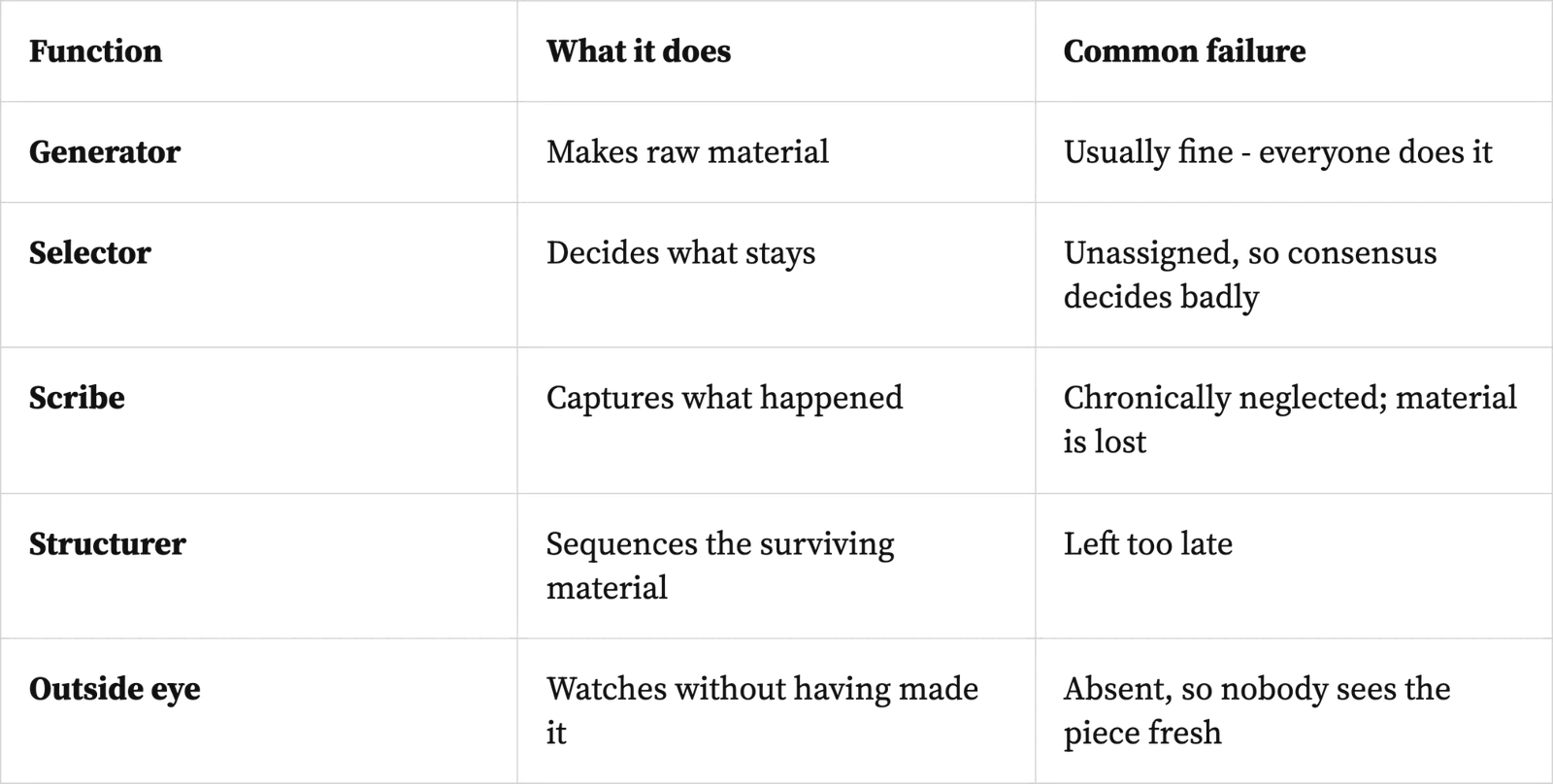
The selector is the hard one, because the role is inherently unpopular and the person holding it needs explicit permission. Companies that work well usually agree in advance who has final say, and agree it before anyone is attached to anything.
The outside eye is the cheapest fix available. Someone who wasn’t in the room, watching a run-through, will tell you in ten minutes what four weeks of proximity has hidden.
The scribe: the most under-assigned role
If you take one practical thing from this article, take this.
Improvised material that isn’t captured is gone. Not diminished - gone. The best version of a scene often happens once, in week two, when nobody was writing it down, and what gets performed in week six is a reconstruction that everyone quietly knows is worse.
What actually needs capturing:
The words, when actors have generated dialogue worth keeping. Their exact phrasing matters and paraphrase loses it.
The physical, which is harder - sequences of movement, images, staging that emerged.
The circumstances. What the exercise was, what the prompt was, who was in it. Material makes no sense out of context three weeks later.
The date and version, because devised text mutates constantly and two versions of the same scene will otherwise be indistinguishable.
Recording sessions helps and doesn’t solve it. Video captures everything and is unsearchable - nobody watches back eleven hours of rehearsal. What works is video plus a written index of what’s on it and when.
The scribe role is where a writer in a devising company earns their place fastest, and it’s usually available because nobody else wants it.
Five devising structures
Methodologies vary widely. These are the recurring shapes.
Stimulus-based. The company starts from a shared provocation - an image, a text, an object, a question - and generates responses. The most common approach in training and education, and the most open-ended.
Task-based physical devising. Movement and physical sequences are generated through set tasks, then text is layered onto or against them. Frantic Assembly’s building-blocks approach is the best-documented version, and it produces work where the physical vocabulary comes first.
Verbatim and documentary. Interviews, transcripts and found text become the source material, and the devising work is selection, arrangement and juxtaposition rather than invention. The Laramie Project is the canonical example, built by Tectonic Theater Project from interviews using a documented moment-based method.
Long-form improvisation toward a text. The company improvises scenes repeatedly, and a text is transcribed and refined out of what recurs.
Writer in the room. A hybrid: a playwright attends sessions, takes the material away, and returns with written scenes that the company then works on. Black Watch was built this way, with a writer working alongside a company and a director.
The hybrid is what most professional devised work actually is. Pure company-generated text is more common in training contexts than in production.
The writer in the room
If you’re a playwright joining a devising process, the adjustments are specific.
You are not there to write it down and take it home. You’re there to make things with everyone else, and then to do the writing between sessions.
Your authority is granted, not assumed. A playwright who arrives behaving like the author of the piece will be resisted, correctly. A playwright who earns the selector role by being demonstrably good at it will be handed it within a fortnight.
Bring back less than you were given. The value you add is compression. Returning with everything reworded is not editing.
Preserve actors’ phrasings where they’re good. An improvised line in someone’s own rhythm is often better than the polished version, and rewriting it into your voice is the fastest way to lose a room. Where a company is generating multiple characters, keeping those voices genuinely distinct is its own problem - our ensemble casts guide covers it.
Write structure, not just scenes. The company can generate scenes. What they usually can’t do collectively is decide the order.
Authorship, credit and rights
The part companies postpone and shouldn’t.
Devised work creates genuine ambiguity about authorship. If an actor improvised a monologue that survives into the production, what is their claim? If a company generates a piece over eight weeks and one person writes the final text, who is credited, and who receives royalties when it’s licensed?
None of this is difficult to settle in week one and all of it is difficult to settle in week nine, after a hit, with money involved and relationships at stake.
Agree in writing, before you start:
Who is credited, and in what form - devised by the company, written by X, devised by the company, text by X
Who owns the resulting work
How income is split if it’s licensed or transfers
What happens if someone leaves the process
Whether individual contributors can reuse their own material elsewhere
The Dramatists Guild publishes general guidance on collaboration agreements, and it’s worth reading before the first session rather than after the first disagreement. Anything specific belongs with your own representation.
One practical note on the aftermath: devised work is harder to submit than conventional plays, because much of it doesn’t read on the page and submission processes assume a single-author script. If you intend the piece to have a life beyond its original company, the text needs to be readable by someone who never saw it - which is a real writing task, not a transcription task. Our submissions guide covers what literary offices actually do with a script.
When devising is the wrong choice
An honest section, because the method is sometimes chosen for the wrong reasons.
When you have a short deadline. Devising is slow. A process that would take a playwright six weeks alone takes a company twelve, and the twelve are more expensive.
When one person already has the vision. If someone in the room knows what the piece is, devising becomes an elaborate way of getting there while diluting it. Write it.
When nobody can be the selector. A company without an agreed decision-maker will produce material and not a piece. This is the most common reason devised work stalls.
When it’s chosen for ideology rather than fit. Collaborative creation isn’t inherently more democratic or more truthful than single authorship - it’s a different tool with different strengths, and it has its own hierarchies whether or not they’re acknowledged.
When the company is inexperienced and unsupported. Devising demands more of a room than staging a script does, and a group without a facilitator often generates anxiety rather than material.
Where devised work fails
Nothing gets cut. The abundance problem, unresolved.
Structure imposed too early, usually a conventional one, out of panic.
Material lost. No scribe, no index, no versions.
No outside eye. Everyone in the room has stopped seeing it.
Credit unresolved, discovered after success.
Generation and selection running simultaneously, so the room neither produces nor decides.
A text nobody can read. The piece works in performance and is incomprehensible on the page, which limits it to the company that made it.
Holding a text that keeps moving
Devising produces a specific documentation problem that conventional writing doesn’t: dozens of fragments, in multiple versions, generated by different people on different days, none of which makes sense without the context it came from - and all of which has to be assembled into something with a shape.
Skrib is well suited to that shape of work. The Board is a canvas with no page edge, so fragments can sit as individual cards - a scene, an image, a transcript, a photograph from the room - and be moved, grouped and sequenced spatially before any of it becomes a document. That’s the selection and structuring work, done where you can see everything at once.
The Library keeps every version searchable, which is what makes week two’s material recoverable in week six. Uploads mean reference images and session photographs live alongside the text rather than in someone’s phone. The Draft takes over when the shape resolves, holding stage formatting steady through the fast rewriting that follows.
What no tool will do is decide what to cut. That’s the selector’s job, and it’s the reason the role has to be assigned to a person. You can start free.
Frequently asked questions
What is devised theatre? Performance created collaboratively by a company - through improvisation, research, physical work or documentary material - rather than from a script written in advance. It’s a method rather than a genre, and devised work can be text-heavy or nearly wordless.
Does devised theatre have a writer? Usually yes, though the role changes. Instead of supplying structure before the material exists, the writer shapes, selects and sequences material the company generates. Most professional devised work is a hybrid, with a writer attending sessions and returning with written scenes.
How do you start devising a piece of theatre? Most processes begin from a shared stimulus - an image, a text, an object or a question - and generate responses before any structure is decided. The critical early decisions are procedural rather than creative: who selects, who captures material, and who watches from outside.
Why does devised work often fail to come together? Almost always because of too much material rather than too little, combined with nobody being empowered to cut. Consensus in a devising room tends to keep everything or keep only what’s uncontroversial, and both produce a shapeless piece.
Who owns a devised play? It depends entirely on what the company agreed, which is why agreeing in writing before the first session matters. Credit, ownership, income splits and whether contributors can reuse their own material are all straightforward to settle at the start and painful to settle after a success.
What’s the difference between devised theatre and improvisation? Improvisation is a technique used during the process; devising is the whole method of making a piece. Improvised material in devised work is captured, selected and fixed, so the finished performance is repeatable rather than generated fresh each night.