The Table Read: Revising a Play After a Reading | Skrib
What a reading actually measures, why the stumble matters, five kinds of reading, how to run one well and how to triage which notes are worth acting on.
Every playwright is told to get the play read aloud, and almost nobody is told what to do with the two hours afterwards.
So the reading happens, everyone is generous, three people offer contradictory suggestions, and the writer goes home with a page of notes that don’t agree and a vague sense that something in act two isn’t working.
The problem is a misunderstanding about what a reading produces. The notes are not the data. The reaction is the data.
A note is somebody’s interpretation of an experience they had - and the interpretation is usually a guess at a solution, which is your job rather than theirs. The experience itself is real and reliable. Where the room laughed, where it went still, where it drifted, where an actor stumbled: none of that is opinion.
Listen to the room. Decode the notes afterwards. This sits under our complete playwright’s guide.
What is a table read?
A table read is a seated reading of a play by actors, without staging or memorisation, held so the writer can hear the script performed. It’s the primary development tool in theatre - a play that hasn’t been read aloud hasn’t been tested, because the text is an instrument and the performance is the work.
Readings range from an informal cold read among friends to a rehearsed public reading with an audience, and each measures something different.
What a reading actually measures
Knowing what you’re listening for is most of the skill. Six things, in rough order of reliability.
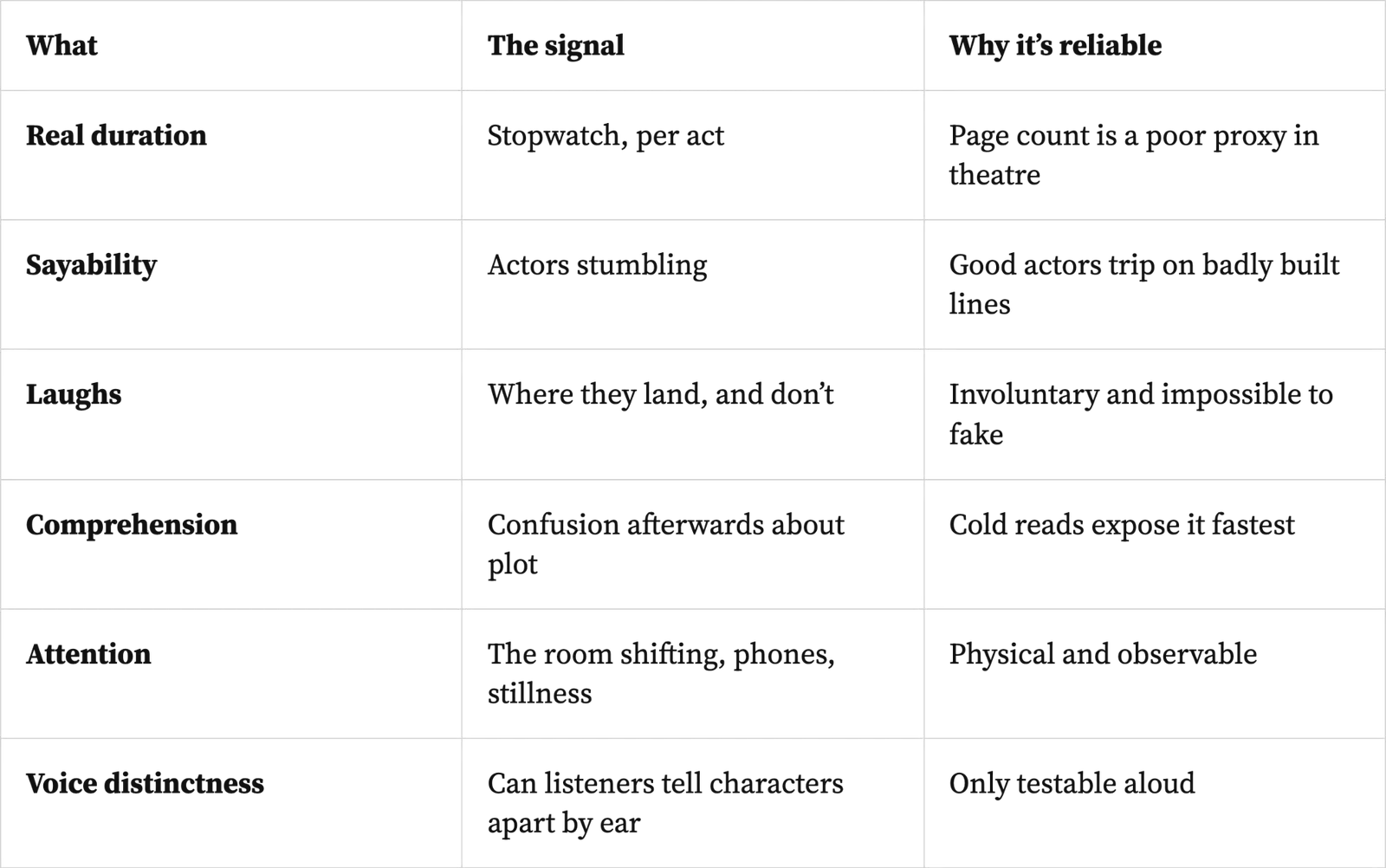
Time each act separately and note where you thought you were. Writers are routinely wrong by fifteen minutes, and it’s the single most actionable number a reading produces - it tells you whether you have the form you think you have, which our one-act vs. full-length guide covers.
Mark laughs on your script as they happen. Not afterwards from memory. The gap between where you expected laughs and where they arrived is a map of what the play is actually doing.
The stumble
The most underrated signal in the room, and close to a law.
When a competent actor trips on the same line three times, the line has a problem. Not the actor. Something in its rhythm, its logic, or the thought underneath it is built wrong, and the actor’s mouth is finding what your eye missed.
Common causes:
A thought that doesn’t complete the way the sentence is shaped
Consonant clusters that read fine and speak badly
A line whose meaning depends on emphasis the actor can’t locate
A logical jump the character makes that the writer filled in mentally
You don’t need to diagnose it in the room. Circle it and move on. Almost every circled line turns out to be worth rewriting.
The same applies to actors asking what a line means. If a trained reader can’t parse it in performance, an audience hearing it once has no chance.
Five kinds of reading
Different tools for different questions. Most writers only know about the third.
1. Reading it aloud yourself, alone. Every line, out loud. Catches roughly half of what a full reading catches, costs nothing, and has no social consequences. Skipping this and going straight to actors wastes other people’s time on problems you could have found in an afternoon.
2. The cold read. Actors seeing it for the first time, unprepared. The best test of comprehension - if trained readers can’t follow the plot cold, an audience getting one pass certainly can’t. Weak on performance quality, which is fine, because that isn’t what you’re measuring.
3. The prepared table read. Actors have read it in advance. Better for subtext, tone, and whether performances can find layers you intended - subtext in dialogue is the element most reliably exposed here, because actors either find the second layer or they don’t.
4. The public reading with an audience. Now you can measure attention and laughs at scale. Also political: people who might produce your play may be present, so it’s a showcase as well as a test. Don’t use a public reading to find out whether act two works.
5. The workshop or lab. Days rather than hours, with a director, usually rewriting in between. The most valuable and the hardest to arrange.
Musicals need the score in the room. A book read without music tests almost nothing, because the seams between speech and song are the thing most in question - our musical book writing guide covers why.
How to run one
Cast as well as you can. A weak reader makes you rewrite good lines. If you can only get four decent actors, cut roles or double them rather than filling seats.
Send the script in advance for a prepared read; don’t for a cold one. Decide which question you’re asking.
Handle the stage directions deliberately. A narrator reading every direction aloud produces a different experience from the play - it slows everything and hands the audience information a real audience would receive visually and instantly. The usual convention is to read only what’s needed for comprehension: entrances, exits, essential action. Everything else stays on the page. Which directions those are is a question our stage directions guide covers directly.
Sit where you can see faces. Not the readers’ - the listeners’. You are watching the room, not the script.
Don’t read a part yourself. You’ll be acting instead of observing, and you already know what everything means.
Have someone time it. You will forget.
Don’t stop. Whatever goes wrong, run it through. A reading interrupted for explanations stops being a reading.
The questions to ask
The discussion afterwards can do more harm than good if it’s unmanaged. Three failure modes recur: the first speaker anchors everyone, people propose solutions instead of reporting experience, and politeness suppresses the useful thing.
Ask for experience, not diagnosis:
Where did you get confused, and at what point exactly?
Where did your attention go?
What did you think was going to happen, and were you right?
Whose play did you think it was?
What did you think it was about, in a sentence?
Don’t ask:
Did you like it? - nobody says no
What would you change? - invites people to write your play
Was the ending clear? - leading, and you’ll get reassurance
Two rules for the writer in the room. Don’t defend, and don’t explain. Every sentence you spend explaining what you intended is a sentence someone isn’t spending telling you what they got - and what they got is the only thing you came for.
Write down what people say, not what you think they mean. The decoding happens later, when you’re not defensive.
Triage: which notes to act on
The part that determines whether the reading was worth having.
The governing rule: look for convergence on the where, ignore convergence on the why.
If four people flag the same moment with four different explanations, that moment is a real problem and none of the four explanations is necessarily right. If four people offer the same fix for a moment nobody actually stumbled over, be suspicious - that’s often a fashionable note rather than a felt one.
A working sort:
Act on immediately: anything the room physically demonstrated - a laugh that didn’t come, drift at a known point, a runtime you didn’t expect, a line three actors stumbled on.
Investigate: moments flagged by multiple people, especially if you already privately suspected them. A note that confirms your own quiet doubt is almost always right.
Hold: single notes from one person, however articulate, on a moment nothing else flagged.
Discard: solutions. Someone else’s fix is a description of the play they’d have written.
Wait a few days. The strongest impulse after a reading is to rewrite immediately, usually in the direction of the last thing said. The notes will look different on Wednesday, and the ones that still bother you then are the real ones.
One caution. A reading measures a reading. Comedy plays differently to twelve people in a rehearsal room than to two hundred in a theatre, and a slow scene can be a pacing problem or can be twelve tired people at 9pm on a Thursday. Weight the evidence accordingly.
When to read, and how often
Not too early. A reading of an incomplete draft mostly tells you it’s incomplete, and it spends goodwill you’ll want later. Have a full shape first.
More than once. Different readings answer different questions, and a play that’s been read once has been tested once. A common working rhythm is a solo read-aloud, then a cold read for comprehension, then a prepared read after the resulting revision.
Not with the same people every time. After two readings, a group knows the play and stops being able to encounter it. Fresh listeners for comprehension questions, familiar ones for whether a fix worked.
Never as a substitute for deciding. A reading gives you evidence, not permission. The judgment stays yours.
Capturing the reading without losing it
The practical problem with readings is that the useful material is time-stamped and perishable. A laugh at page 34, a stumble at 51, the moment the room went quiet - all of it needs attaching to a specific place in the script, in real time, while you’re also watching faces. Two days later, half of it is gone.
Skrib makes that easier to hold. The Board is a canvas beside the script where a reading’s observations can sit as cards keyed to pages - what happened where, who flagged it, and which of your own suspicions it confirmed - so triage a week later works from a record rather than from memory. The Library keeps every draft searchable, which is how you check whether a moment that read badly was also there in the draft that read well.
The Draft holds stage formatting steady through the rewriting that follows, and exports clean to .docx and .pdf for the next reading’s scripts.
None of this replaces the room. A reading is the instrument, and software only keeps what it tells you from evaporating by Wednesday. You can start free.
Frequently asked questions
What is a table read? A seated reading of a play by actors, without staging or memorisation, held so the writer can hear the script performed. It’s theatre’s primary development tool - the text is an instrument and the performance is the work, so a play that hasn’t been read aloud hasn’t been tested.
How do you run a table read for a play? Cast the best readers you can get, decide whether you want a cold read or a prepared one, read only the stage directions needed for comprehension, sit where you can watch listeners rather than readers, have someone time each act, and don’t read a part yourself.
What should you listen for at a play reading? Real running time against your expectation, where laughs land, lines actors stumble on, where the room’s attention drifts, and whether listeners could follow the plot. These are observable and involuntary, which makes them more reliable than anything said in the discussion afterwards.
How do you handle feedback after a reading? Look for agreement about where a problem is rather than about what causes it. Several people flagging one moment with different explanations means the moment is real; a shared proposed fix for a moment nobody reacted to usually isn’t. Wait a few days before rewriting.
Should the writer speak during the discussion? As little as possible, and never to defend or explain. Every sentence spent describing your intentions is a sentence someone isn’t spending telling you what they actually experienced, which is the only thing worth collecting.
How many times should a play be read before submitting? At least twice, answering different questions - typically a cold read to test comprehension, then a prepared read after revision to test tone and subtext. Use fresh listeners for comprehension, since anyone who has heard the play before can no longer encounter it.