Musical Book Writing: Structuring Story Around Songs
The book is what you cannot sing. What a number does, the test for whether a song earns its place, reprises, getting in and out and who owns what.
The received wisdom is that a character sings when emotion becomes too large for speech. It’s a lovely formulation and it’s misleading, because a great many of the best numbers in the form aren’t emotional overflow at all. They’re arguments, decisions, jokes, transactions, transformations.
It also encourages a working method that doesn’t hold up: write the scenes, then find the moments where feeling peaks and put songs there.
The book isn’t the connective tissue between numbers. It’s the machine that makes the numbers necessary - and the writer’s job is closer to subtraction than addition.
Here’s the working principle. The book is what you cannot sing. Anything a song can carry belongs to the song. What’s left for the book is what music genuinely can’t do, plus the runway that makes each number land.
The wider craft sits in our complete playwright’s guide.
What is the book of a musical?
The book of a musical is everything that isn’t sung: the dialogue, the plot structure, the characters, and the sequence in which songs occur. The book writer is usually a separate collaborator from the composer and lyricist, and is credited separately. Libretto is the older term and in contemporary usage generally refers to opera or to the whole text of a sung-through work.
The book writer is responsible for the show’s architecture even when they’ve written comparatively few of its words.
The book is what you can’t sing
The note musicals get in development is almost always the book is too long. It is essentially never the book is too short.
That’s not a coincidence - it’s structural. Songs are why an audience came, and every minute of dialogue is a minute they’re waiting. A book writer who understands this writes toward the numbers rather than around them.
What only the book can do:
Move time and place. Songs stop the clock; scenes advance it.
Deliver plot mechanics that would be tedious sung - who owes what to whom, what the deadline is.
Set up the number. Every song needs a runway, and building it is the book writer’s most underrated task.
Land the consequence. What the song changed, made concrete in the world.
What the book should hand over: feeling, decision, argument, seduction, comedy, community, transformation. If a scene is doing any of those at length, it’s probably a number that hasn’t been written yet.
The practical discipline: after each draft, go through the book scenes and ask of every page whether a song could do this better. The answer is yes more often than writers expect.
What a number actually does
The “too big for speech” idea covers one of these. Numbers do at least eight distinct jobs.
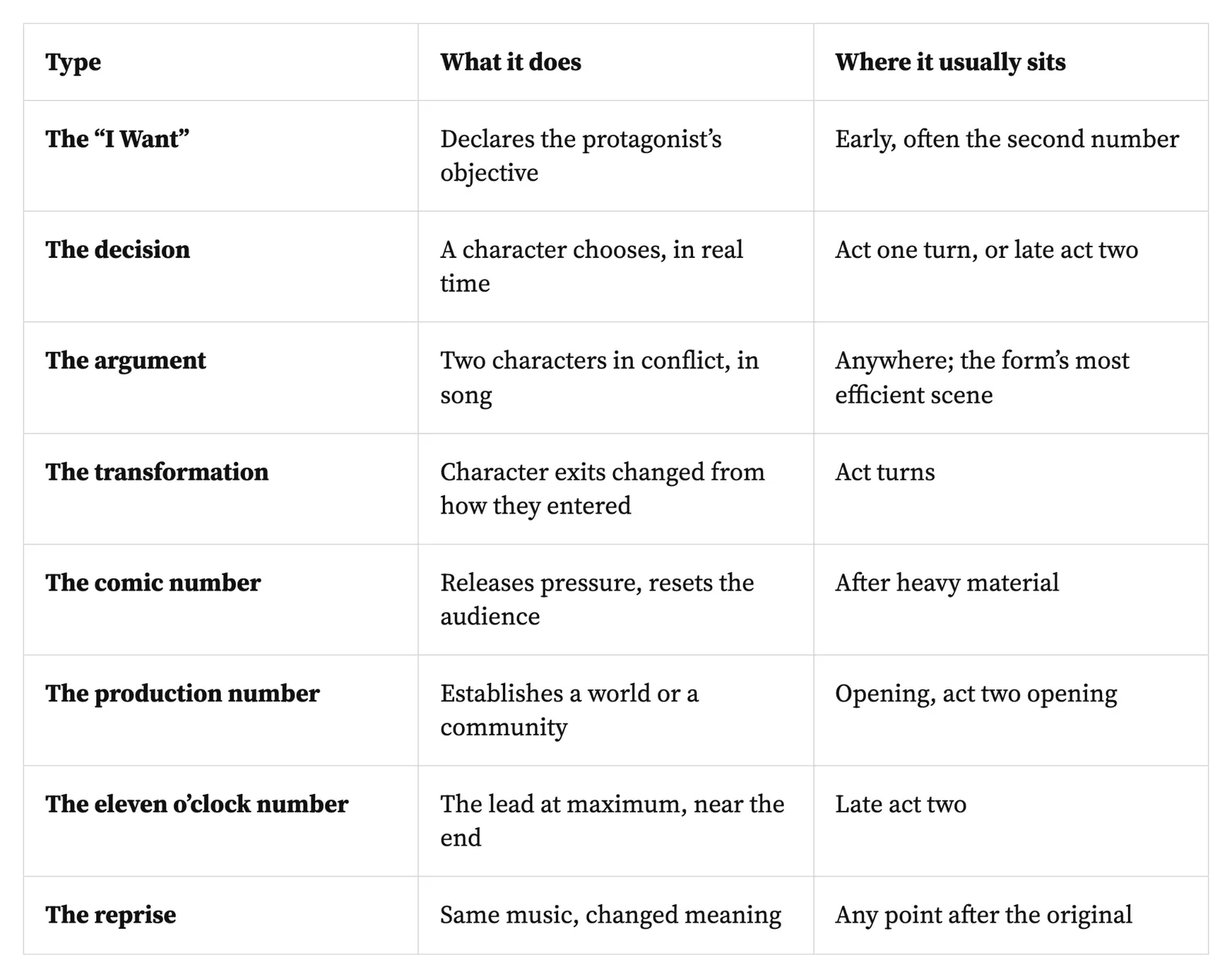
The “I Want” is the structural spine. A protagonist declaring an objective early is the convention because it gives the audience something to measure the whole evening against - it’s the want in want-versus-need, delivered at song scale. Our want vs. need framework covers the underlying mechanics, including why the want must be concrete enough to be pursued and costly enough to matter.
The book writer’s job around it: make the want inevitable before it’s sung. A character who declares a longing the audience hasn’t yet felt the pressure of is singing into a vacuum.
The test: is the character different?
One question settles whether a number belongs.
Does the character exit the song in a different state from the one they entered?
Different means: has decided something, has admitted something, has been changed by hearing something, has lost or gained a position. If a character sings for three minutes about how they feel, and at the end feels exactly the same, the number is a stall - beautiful, possibly, and structurally inert.
This applies to comedy numbers too. The change may be in the audience’s understanding rather than the character’s, but something has to move.
The corollary for the book: if a song changed a character, the scene after cannot proceed as though it didn’t. The most common book error is a scene that restates what the number just accomplished, which makes the song retroactively unnecessary.
The reprise
Worth its own section, because it’s the form’s genuinely unique device.
A reprise plays the same music, and often close to the same words, and means the opposite. Nothing in spoken theatre or film can do this. A line of dialogue repeated is a callback; a melody returned to is a comparison the audience makes involuntarily, against their memory of the first hearing.
It works on information asymmetry - the audience knows what this music meant an hour ago, and the character may not. That’s the same mechanism that drives subtext in dialogue, operating on melody instead of speech.
What a reprise can accomplish:
Irony. A hopeful song returned to after the hope is gone.
Cost. The same aspiration, sung by someone who now knows the price.
Inversion. A song given to a different character, which recontextualises both.
Completion. The number finished properly, having been interrupted earlier.
The book writer’s role is placement. A reprise needs the intervening events to have changed the meaning, and arranging those events is architecture, not lyric writing. A reprise that arrives before anything has changed is repetition.
Getting in and out
The hardest craft in the form, and the least discussed.
The way in. The last line of dialogue before a number should make the song feel inevitable rather than announced. The failure mode is the cue line - dialogue that visibly hands off, so the audience sees the machinery and braces.
Two things help: arrive at the emotional pitch before the music starts, so the song begins at temperature rather than climbing to it, and avoid stating the song’s subject in the dialogue immediately preceding it. If a character says they’ve never felt like this before and then sings about never having felt like this before, the number has been spoilered by its own runway.
The way out. Harder. A song ends at a peak, and the scene that follows has to pick up from a height without deflating it.
Cut later than feels natural. Book scenes after big numbers are almost always too long.
Change the configuration. Bring someone on, take someone off - the shift in who’s present carries the transition for you.
Don’t discuss the song. Characters processing in dialogue what they just processed in music is the single most common deflation.
Structure at the level of the song list
A musical’s architecture is legible from its song list in a way a play’s is not from its scene list. Experienced book writers work at that level early.
What a song list shows you:
Distribution. Which characters sing, how often, and where. A supporting character with three numbers and a lead with two is telling you something about whose show it is.
Pacing. Long gaps between numbers are where audiences report a show dragging, almost regardless of how good the dialogue is.
Variety. Six ballads in a row is a problem visible on a list and invisible in a draft.
Act shape. Act one and act two need different rhythms; act two is shorter and usually more compressed.
The exercise: write the song list before the book. Titles, singers, function, one line on what changes. If the story doesn’t read from that list alone, the structure isn’t there yet, and dialogue won’t supply it.
How much book is there, anyway?
The book/sung-through spectrum is wider than most guides acknowledge.
Traditional book musicals alternate scenes and numbers, and the book carries substantial weight - plot, comedy, character texture.
Sung-through shows have little or no spoken dialogue. This does not mean there is no book work; it means the structural job is embedded in the lyrics rather than separated from them. Somebody still decided the sequence, the act break, who wants what and when the audience learns it. That’s book writing whether or not there’s a credit for it.
In between sits most contemporary work - sparse dialogue, heavy score, and a book writer whose main contribution is architecture rather than lines.
The implication for a new writer: don’t measure your contribution in pages of dialogue. Measure it in whether the show holds.
Collaboration: who owns what
Musicals are usually written by three people, and the working relationships have real consequences.
The conventional division: book writer owns structure and dialogue; lyricist owns what’s sung; composer owns the music. In practice the boundaries blur constantly, and the structure conversation involves everyone.
Two practical points.
Agree terms in writing before you start. Musical theatre collaborations create jointly owned work, and rights, splits and what happens if one collaborator leaves are far easier to settle at the beginning than after a workshop. The Dramatists Guild publishes guidance on collaboration agreements, and it’s worth reading before the first meeting rather than after the first disagreement.
Expect to be blamed. There’s a durable industry saying that when a musical fails, it’s the book. It’s partly unfair and partly structural - the book is the load-bearing element, and when a show doesn’t hold, the architecture is usually where it gave.
Where books fail
Too long. The default failure. Dialogue doing work a song could do better.
Songs that don’t change anything. Numbers as mood, not as event.
Restating after the number. The scene that undoes the song by processing it in speech.
No “I Want,” or an unearned one. The audience has nothing to measure the evening against.
Cue lines. Dialogue visibly handing off to music.
Flat song distribution. Every character singing equally, so nobody’s show it is.
Act two problems. Almost universal, and almost always because act one resolved too much. Act two is shorter, faster, and needs a genuinely new proposition rather than a continuation.
Development without readings. Musicals are more dependent on hearing the material than plays are, because timing and the seams between speech and song can’t be assessed on the page. The Table Read for Playwrights covers the principles; musicals additionally need the score in the room.
Keeping the book and the song list together
A musical is several documents that must stay synchronised: the book, the song list, the lyrics, notes from every reading, and a structural map that changes every time a number moves. Numbers get cut, reordered and reassigned constantly in development, and each move ripples through scenes that were written to set them up.
Skrib keeps them in one place. The Board is a canvas beside the writing where the song list can live as cards - title, singer, function, what changes - so moving a number is something you do on a map rather than reconstruct from memory. The Draft holds stage formatting steady through the restructuring that follows, and the Library keeps every version searchable, which matters when a number returns three drafts after it was cut.
No tool hears the show. Musicals are assessed in a room with a piano, and nothing substitutes for that. What a studio changes is that the architecture and the pages are in the same window when a song moves. You can start free.
Frequently asked questions
What is the book of a musical? Everything that isn’t sung - the dialogue, the plot, the characters, and the order in which songs occur. The book writer is credited separately from the composer and lyricist and is responsible for the show’s architecture, even when they’ve written relatively few of its words.
What’s the difference between a book and a libretto? In contemporary musical theatre usage, book means the spoken text and structure while lyrics are credited separately. Libretto is the older term, generally used for opera or for the complete text of a sung-through work including its lyrics.
When should a character sing instead of speak? The common answer - when emotion outgrows speech - covers only one kind of number. More usefully, a song should occur wherever a character will exit in a different state from the one they entered: having decided, admitted, lost or won something. A number that leaves a character unchanged is a stall.
How long should the book of a musical be? Shorter than your draft. The standard development note is that the book is too long, essentially never that it’s too short. A useful discipline is to review each book page and ask whether a song could do the same work better.
Do sung-through musicals have a book writer? Often not as a separate credit, but the book work still exists - sequence, act structure, who wants what, when the audience learns it. In sung-through shows that architecture is embedded in the lyrics rather than separated from them.
Why do people say it’s always the book’s fault? Because the book is the load-bearing element. When a musical doesn’t hold, the failure is usually structural - pacing, act shape, songs that don’t change anything - and structure is the book writer’s responsibility even when the words being sung belong to someone else.