How to Write Stage Directions Directors Follow | Skrib
The five kinds of stage direction and which survive rehearsal: what directors actually need, what actors resent and six rules that hold up in the room.
The advice comes in two flavours and they contradict each other. Keep directions minimal - don’t direct the play from the page. Or: write them vividly, because a literary manager reading your script needs to see the world.
Both are positions in a real argument, and most guides pick one and present it as settled.
There’s a better question than how many, and it comes from something specific to theatre. A screenplay is a blueprint for one film. A play will be staged by people you will never meet, in rooms you’ve never seen, for as long as anyone wants to produce it.
So the test isn’t whether this production would follow a direction. It’s this: would it still be true in every production of the play?
Write what’s true of the play. Leave what’s true of a production to the production. Almost everything else follows.
This covers what directions should say. Where they go on the page, how they’re typed and italicised, is a separate question handled in our play format guide, and this sits under the complete playwright’s guide.
What are stage directions?
Stage directions are the non-dialogue text in a playscript: instructions and descriptions covering entrances and exits, physical action, setting, and sometimes atmosphere or timing. They’re written in present tense and third person, and unlike screenplay description, they must serve an unlimited number of future productions rather than a single one.
The five kinds, and which survive
Sort every direction in your draft into one of these. The sorting does most of the work.
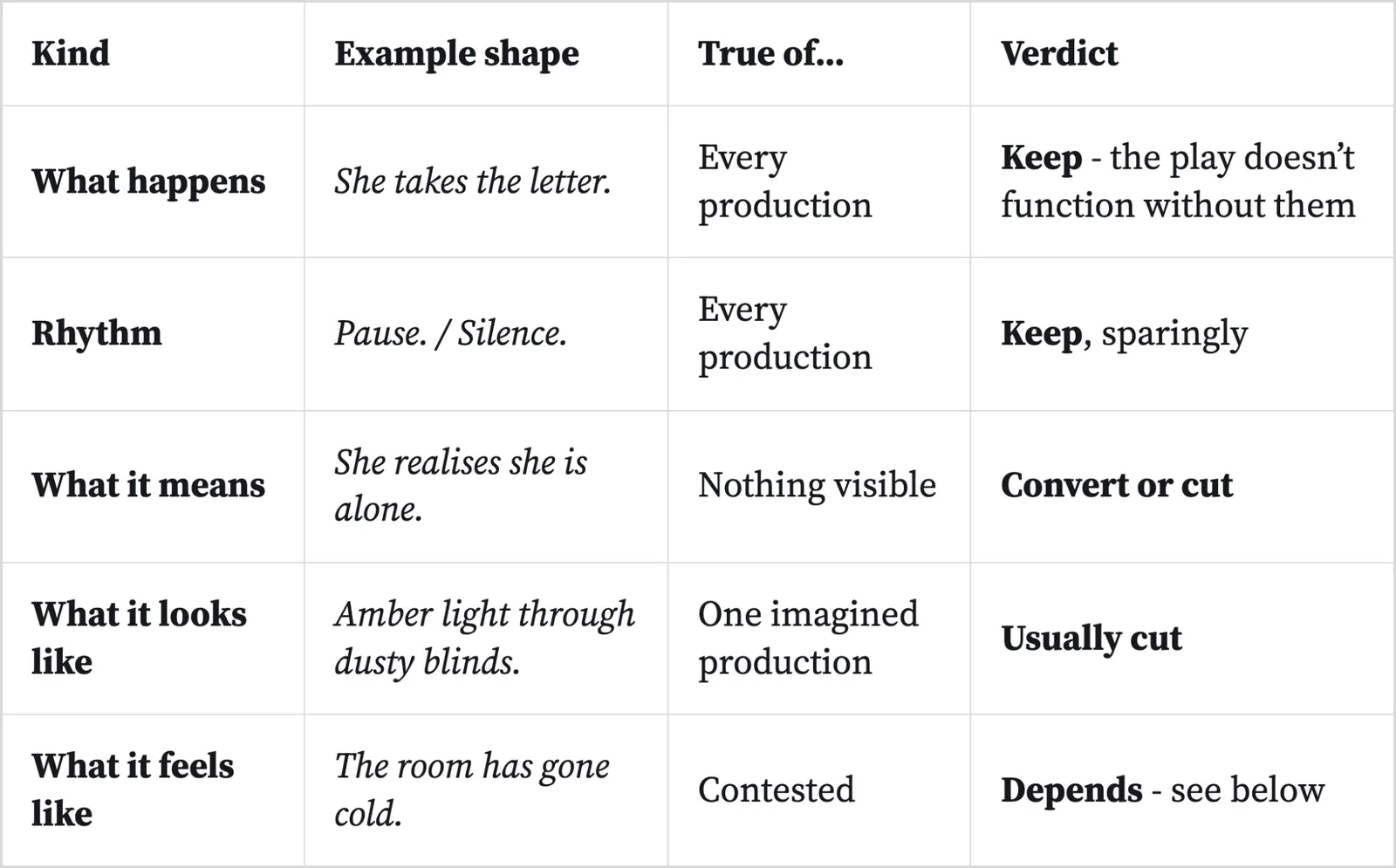
Rows one and two are the playwright’s job and nobody disputes them. A director needs to know who is on stage and what physically occurs, and rhythm - where the silences fall and how long they run - is genuinely the writer’s territory, because it’s part of the text in the way punctuation is.
Row three is unenforceable and gets its own section below.
Row four is where most friction lives. A designer’s job is to decide what the room looks like. A direction specifying it either gets ignored, or gets followed and constrains a production that would have solved it better. Neither outcome helps your play.
Row five is the genuinely arguable one. Atmosphere directions sometimes tell a production what the scene is in a way no factual direction can, and sometimes they’re mood-writing for a reader. The test in the next section separates them.
The unenforceable direction
The most common error, and it’s diagnosable in one pass.
(She realises she has always been alone.)
An audience cannot see a realisation. They can see a woman stop moving, or put a glass down, or fail to answer. If a direction describes something no audience member could perceive, it isn’t in the play - it’s in your notes.
The test: could someone in row H tell that this happened?
Directions that fail it usually name an interior state - she understands, he regrets it, the mood shifts. The repair is to convert the interior into the visible thing that produces it, or to trust the dialogue.
Two things worth noticing. First, an actor who reads she realises she is alone now has to play a result rather than find an action, which is the single most common complaint actors have about directions. Second, if the moment only works because the direction explained it, the scene has a subtext problem rather than a direction problem - subtext in dialogue covers what to do about that.
What directors actually need
Directors are not looking to be left alone. They’re looking to be told the things only you know.
They need:
Who is on stage, and when that changes. Entrances and exits are the structural spine of a play and cannot be inferred.
Physical action that the dialogue depends on. If a line only makes sense because someone has just handed over a glass, write the glass.
Rhythm. Where the play breathes, and how long. Beckett’s precision here is famous and it’s precision about duration, not about décor.
Anything genuinely counterintuitive. If a character says something warm while doing something cruel, say so. A director cannot guess against the text.
Constraints the play cannot survive losing. If the door must be visible for the ending to work, that’s a fact about the play.
They don’t need blocking, emotional instruction, design specification, or a description of a set they’ll be building differently anyway.
A useful frame: you’re writing to a collaborator who will bring things you didn’t imagine. The directions worth writing are the ones that protect the play from being misread. The ones worth cutting are the ones that protect it from being interpreted.
What actors resent
Distinct from directors, and more specific.
Adverbs of feeling. (Angrily.) (Sadly.) An actor’s job is to find why, and an adverb hands them a result with no cause attached. It also collapses a range of choices into one, usually the most obvious.
Blocking they haven’t found yet. (She crosses to the window, then back to the table.) Movement discovered in rehearsal is movement that means something. Movement dictated on page 12 is choreography.
Directions that contradict the line. If the direction says (Coldly.) and the line is warm, the actor has to choose, and they’ll choose the line.
Being told the outcome. (The apology lands.) Whether it lands is what the scene is for.
The rule most working playwrights converge on: write what the character does, not how they feel while doing it. The doing is text; the feeling is performance.
Two readerships, opposite needs
The tension that makes this genuinely hard.
A literary manager reads your script as literature. They’re deciding whether to spend more time on it, alone, with no production in their head. For that reader, sparse directions can read as thin, and a script that gives them nothing to see is at a disadvantage against one that does.
A production team reads it as a working document. They want the facts and resent the surplus, because every superfluous direction is either an argument or an instruction they’ll quietly disregard.
The resolution is not to split the difference. It’s to notice that the submission reader is served by clarity, not decoration - a direction that tells them precisely what happens is more gripping than one that tells them what colour the light is. Write for the production, and the reader gets a cleaner script than a decorated one would have been.
The screen equivalent of this problem - how much physical specification belongs in a script - runs on similar logic with one difference: a screenplay serves one production, so the calculation is much simpler. Our guide to physical description in screenplays covers that side.
The literary tradition
An honest exception, because a rule this tidy would misrepresent the form.
Some playwrights write directions that are literature in their own right, and some write directions that are impossible on purpose. Shaw’s are novelistic and extensive. Kushner’s Angels in America famously instructs that the wires should show. Sarah Ruhl and Caryl Churchill both write directions that read as provocations rather than instructions.
This works when the impossibility is the point. A direction that cannot be executed literally, offered to a director as a problem to solve, is a different object from a direction that simply can’t be staged and hasn’t noticed.
The distinction is intent and clarity. An angel crashes through the ceiling is a demand a production must answer, and answering it is where the theatre happens. She realises she has always been alone is a sentence that thinks it’s an instruction.
If you write in this mode, know that you’re doing it, and be prepared for a wide range of solutions.
The authority question
Playwrights hold unusual control over their text compared with screenwriters - the Dramatists Guild is the reference point for US practice - in US practice, a play’s text is generally not altered without the writer’s permission, and stage directions are part of that text. Beckett’s estate is the best-known enforcer of it.
In practice, though, directions are interpreted rather than executed. A director who finds a direction unhelpful will find a way around it, and a direction that fights the production usually loses quietly.
Two practical notes:
Published acting editions sometimes include the original production’s blocking, added after the fact. Later directors aren’t obliged to follow it, and many find it confusing that it’s there at all. If your play reaches publication, it’s worth knowing what’s being baked in.
Every technical requirement you specify is one a theatre must meet. A direction calling for rain is a budget item - our economics of staging guide covers what those asks cost.
Six rules that survive a rehearsal room
1. Write what happens. The visible, audible, physical event.
2. Cut what it means. If the audience can’t perceive it, it isn’t in the play.
3. Cut what it looks like unless the play breaks without it.
4. Keep rhythm, use it sparingly. Pause and Silence are conventionally different lengths and directors read them that way. Overused, both stop meaning anything.
5. Specify only what the play cannot survive losing. Ask of every direction: if a production did this differently, would the play still work? If yes, cut it.
6. Never let a direction do the dialogue’s job. A scene that only works because a direction explained it doesn’t work.
Where directions go wrong
Interior states. The unenforceable direction, in all its forms.
Blocking the whole play. Movement dictated page by page, most of which will be discarded within a week of rehearsals starting.
Design specification. Wall colours, furniture periods, light temperatures. Written for an imagined production, inherited by every other one.
Adverbs. (Bitterly.) One choice imposed where several were available.
Directions arguing with the text. If the dialogue and the direction disagree, the direction is redundant or the dialogue is wrong.
Accumulation. The quiet one. A direction added in draft three to solve a problem, still present in draft nine, constraining productions forever because nobody revisited it.
Watching what you’ve specified
That last failure is worth taking seriously, because it’s structural rather than a matter of judgment. Directions accumulate. Each one is added to solve a local problem - a moment that wasn’t reading, a note from a reading - and almost none are ever removed, because they’re invisible in a linear draft in a way dialogue isn’t.
Skrib makes them visible. The Library keeps every draft searchable, so comparing what you specified in draft three against draft nine takes a search rather than a reread - which is the only reliable way to find directions that solved a problem you’ve since fixed another way. The Board sits beside the writing as a canvas for the things that genuinely are constraints, so a requirement the play can’t survive losing is recorded deliberately rather than buried in a parenthesis.
The Draft holds stage formatting steady through revision, so cutting directions doesn’t reshuffle the layout around them.
Which directions a director will resent is not something software can tell you. A rehearsal room finds that in a morning, and a table read gets you most of the way. What a studio changes is that you can see what you’ve asked for. You can start free.
Frequently asked questions
What are stage directions in a play? The non-dialogue text: entrances and exits, physical action, setting, and sometimes timing or atmosphere. Written in present tense and third person, they differ from screenplay description in one important way - they have to serve every future production rather than a single one.
How many stage directions should a playwright write? Fewer than most drafts contain, but the useful question is what kind rather than how many. Directions stating what physically happens and where the silences fall are the playwright’s job. Directions specifying how the set looks or what a character feels belong to a designer and an actor.
Should stage directions describe emotions? No. An audience can’t perceive an emotion, only the behaviour that produces it, and an actor handed (angrily) is being given a result with no cause to play. Write what the character does; let the feeling be performance.
Do directors have to follow stage directions? Playwrights hold more control over their text than screenwriters do, and directions are part of that text. In practice they’re interpreted rather than executed, and a direction that fights a production tends to lose quietly regardless of what the contract says.
What’s the test for whether a stage direction should stay? Ask whether it would still be true in every production of the play. Facts about what happens survive that test. Descriptions of a set, a light state or an interior feeling are true of one imagined production and constrain all the others.
Can stage directions be literary? Yes, and there’s a real tradition of it - some playwrights write directions that read as provocations rather than instructions, including ones that can’t be staged literally. That works when the impossibility is deliberately offered to a production as a problem to solve, rather than a sentence that mistakes itself for an instruction.