Submitting Plays: What Literary Managers Want | Skrib
New plays are eliminated in stages, not judged whole. The five screening stages, what belongs in a submission packet and how to build a submission calendar.
Most advice on this subject is a list of competitions with deadlines attached. Lists go stale within a year - prizes fold, windows move, new ones open - and a list teaches you nothing about what happens to your script after you send it.
Here’s the thing worth understanding instead. Your play is not read and judged. It is eliminated in stages, and the stages happen in a fixed order.
Most of them have nothing to do with the quality of your writing. Most writers put all their effort into the stage that comes third, and lose at the first.
This covers the process. The craft is the rest of this cluster, and it sits under our complete playwright’s guide.
How do new plays actually get produced?
Most new plays reach the stage through a combination of open submission windows, competitions, development programmes, festivals, and relationships with theatres - not from unsolicited scripts arriving cold. A theatre may receive hundreds or thousands of submissions and produce two or three new plays a season, so the arithmetic favours writers who use several routes rather than one.
Eliminated in stages, not judged as a whole
This is roughly how a script moves through a literary office. The order matters more than anything else in this article.
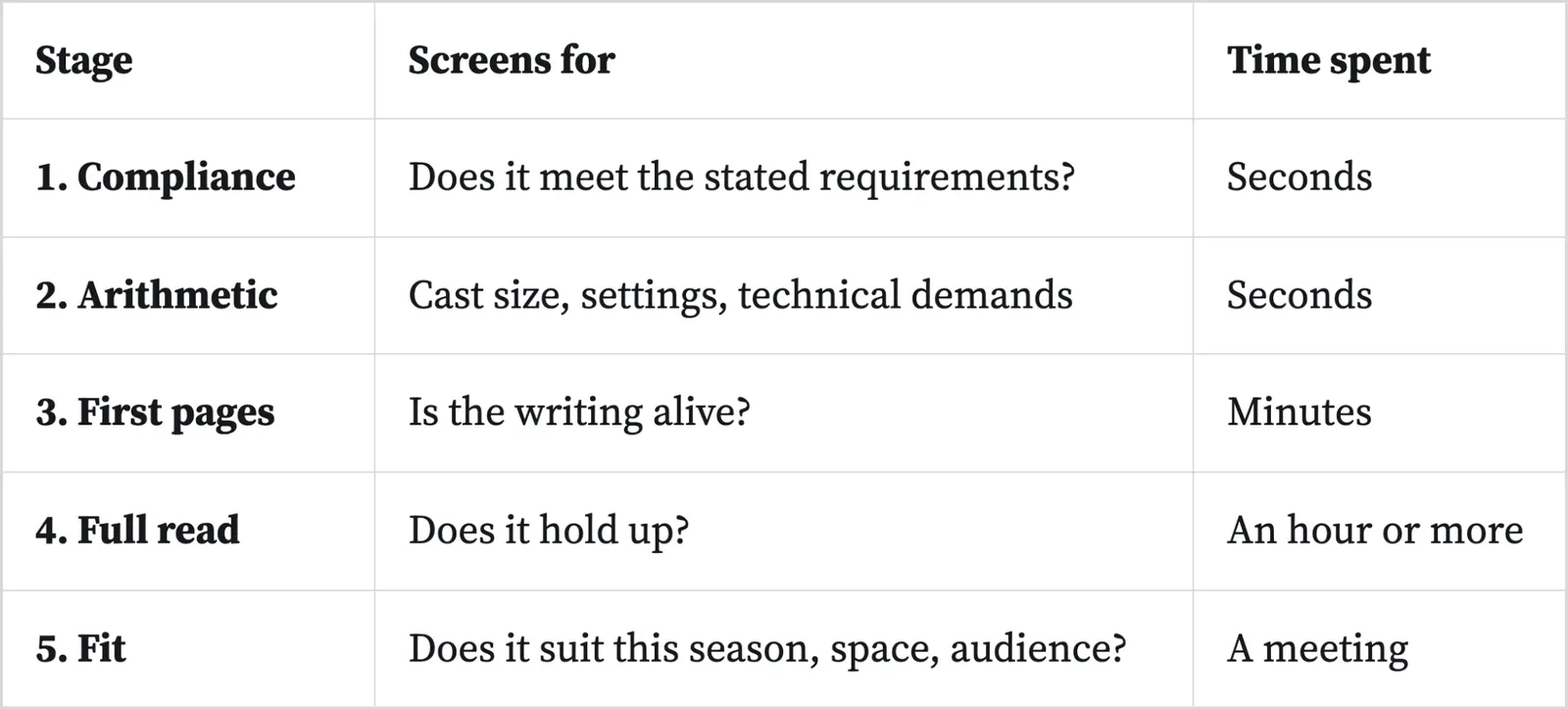
Stages 1 and 2 are mechanical and they eliminate the majority. Nobody forms an opinion about your play at either. A script can be excellent and be gone in eleven seconds.
Stage 5 has nothing to do with quality at all - and it’s where most scripts that survive the full read are actually declined.
Which means the effort most writers spend polishing page one is spent on stage 3, the only one where writing quality is the deciding factor, and it never gets reached if stages 1 and 2 haven’t been passed.
Stage 1: compliance
The stage that eliminates the most scripts and takes the least skill to survive.
Every submission call states requirements, and they’re used as a filter. Page limits, cast limits, anonymisation, file format, eligibility, whether the play may have been produced before. These are not preferences.
The requirements are often very specific. A single festival call might ask that plays run no more than ten minutes, that cast size falls between two and four actors, and that page one carry a cover sheet with title, name, contact details and pronouns. A full-length competition might set a floor as well as a ceiling - no shorter than 60 and no longer than 150 pages, original and unproduced, no adaptations or translations - and charge a submission fee to boot.
The anonymisation trap. Many calls read blind. When one asks for no identifying information, that includes:
The title page
Every page header
The file name
The document properties, which writers almost never check
A file called Smith_TheLongWinter_Draft7.pdf is not anonymous, however clean the title page is.
The practical rule: read the call, then read it again with a checklist. This is boring and it is the single highest-return activity in the entire process, because it costs nothing and it is where most scripts die.
Note also that different calls specify different formats - some ask for .docx, most want PDF, and one may point you at a specific published standard. Our play format guide covers the conventions; the call overrides all of them.
Stage 2: the arithmetic
Cast size, number of settings, technical demands. Checked in seconds, usually from your character page.
A theatre knows what it can afford before it knows whether it likes your play. A nine-actor script arriving at a company that stages four-handers is not being rejected on merit - it’s being filed under something they can’t do.
Two things follow:
State your doubling. If nine characters can be played by five actors, say so on the character page. Without that line, someone counts names and moves on. This is the cheapest win available to a writer with a large cast.
Know the theatre’s scale before submitting. Their recent seasons are public. A company whose last six shows had casts of three to five is telling you something.
Our economics of staging guide covers the underlying arithmetic and where the cost thresholds fall.
Stage 3: the first pages
Now, finally, someone is reading.
They’re reading fast, and they’ve read a lot today. The question isn’t whether the play is good - it’s whether to keep going. What earns that is usually some combination of a distinct voice, a situation with pressure in it, and the sense that the writer knows what they’re doing.
What loses it: a slow opening establishing who everyone is, dialogue that sounds generic, formatting errors that suggest inexperience, and - very commonly - nothing happening yet.
That’s craft, and the rest of this cluster covers it. The relevant submission point is narrower: the opening pages do disproportionate work, and they’re worth more revision passes than the middle of your play.
Stage 4 and 5: the full read, and fit
If your script gets a full read, you are already in a small minority. Take that seriously - it’s a real result even when the answer is no.
Stage 5 is where most surviving scripts are declined, and it isn’t about you.
A literary manager recommending a play to a season meeting has to answer: does this fit alongside the other four shows? Can our audience be brought to it? Do we have the space for it? Did we do something similar two years ago? Is there a rights issue? Does it need an actor we can’t cast locally?
None of those are judgments about the writing. A play can be the best thing on the desk and still lose to a programming consideration.
This is worth internalising, because it changes strategy: if fit is decisive, then researching theatres is a higher-return activity than polishing a script that’s already good. Read seasons. Notice what a company actually stages. Submit where you fit.
The submission packet
What to send, when the call doesn’t specify.
Cover letter. Short - three paragraphs. Why this theatre specifically (one specific, genuine reason; not flattery). What the play is, in two or three sentences. Who you are, briefly. No pitch language, no comparisons to hit shows, no explanation of your themes.
Synopsis. One page, present tense, and it must include the ending. A synopsis that withholds the ending to preserve suspense is a synopsis that failed to do its job - the reader needs to know where it goes.
Character page. Names, brief identifiers, cast size, and the doubling scheme. Note the total actor count prominently.
The script. PDF unless told otherwise. Word files re-paginate on other machines and can arrive looking broken.
Sample versus full. Many calls ask for the first 10 to 20 pages rather than the whole play. Send exactly what’s asked. Sending more is a compliance failure at stage 1.
Bio. 50 to 100 words, third person. Relevant credits only.
Development history. Readings, workshops, previous productions. Include it - it signals that other people have found the play worth spending time on. If there isn’t any, leave the section out rather than apologising for it.
Where to find current opportunities
Because deadlines change constantly, the durable answer is a set of places to look rather than a list of dates.
The New Play Exchange. A National New Play Network project and the largest digital library of scripts by living writers, launched in 2015 and now holding more than 24,000 scripts by over 6,000 authors. Writers pay a small annual fee to host a profile and upload work; producers and directors search it filtered by cast size, subject matter and identity criteria, and every listing carries contact details for the author, agent or publisher.
It’s the resource most under-used by writers who are submitting hard, because it inverts the direction - instead of sending scripts out, you become findable by people already looking.
The Dramatists Guild. The US professional organisation for playwrights, and the usual reference point for script formatting standards and contract guidance.
Free listing sites. NYCPlaywrights publishes open calls continuously and costs nothing.
Paid listing services. Play Submissions Helper and comparable services aggregate opportunities monthly; some maintain databases of several hundred theatres accepting new work. Worth the subscription if you’re submitting at volume.
Theatres’ own pages. The most reliable source for any specific company, and the only one guaranteed current.
Always verify against the theatre’s own site before submitting. Aggregators lag, and a deadline that moved is a wasted submission.
The route most writers overlook
Open submissions are the visible route. They are not where most produced new work comes from.
Development programmes, festivals and residencies put your play in a room with actors and a director, and they generate relationships. A theatre that has spent a week on your script in a lab knows you in a way no cold submission achieves.
Rolling World Premieres. Worth knowing about specifically. The National New Play Network runs a model in which three or more member theatres each mount the same new play within a twelve-month period, with the playwright involved throughout and revising between productions. The network has produced over 85 of them, totalling more than 275 productions. For a new play, three productions is a materially different outcome from one.
Showcases. NNPN also runs an annual showcase of unproduced plays, attended by artistic leaders, literary managers, agents, publishers and independent producers. Being read in front of that room is a different proposition from being ninth on a pile.
The strategic point: submitting is one channel. Being findable, being developed, and being in rooms are three others, and they compound. A writer doing only the first is working the hardest route.
Building a calendar
The practical system, which takes an afternoon to set up.
1. Build a list once a year. Every call you’re eligible for, with its window, requirements and fee. Twenty entries is a working list.
2. Sort by deadline, not by prestige.
3. Note the requirements against each, so preparing a submission is assembly rather than research.
4. Track what you sent where, and when. Duplicate submissions to the same theatre are embarrassing and avoidable, and many calls forbid simultaneous submission - which you can only honour if you know what’s out.
5. Set a volume target rather than an outcome target. You control how many you send. You control nothing after that.
6. Budget for fees. Many competitions charge. Decide annually what you’ll spend and stop there.
What rejection actually means
Given the funnel, a rejection carries almost no information. It could mean the file name wasn’t anonymous, the cast was one actor too large, the reader was on script 200 that week, or the season already had a play set in a kitchen.
Almost none of those are about the writing, and none of them are communicated. Most theatres send a form response, if they respond at all.
What actually signals progress: a personal note, a request for another play, a reader passing you to a second stage, a longlisting, an invitation to a reading. These are real, and they’re the only feedback most writers get. Track them separately from the outright noes - a year with four personal responses and no productions is a year that went well.
Managing submissions without losing the thread
Submitting at volume creates an administrative problem that has nothing to do with writing: multiple drafts in circulation, different versions cut to different page limits, anonymised copies alongside credited ones, and a record of what went where and when.
Skrib keeps that in one place. The Library holds every project and draft, searchable, so the anonymised 20-page sample you cut for one competition is findable rather than rebuilt. The Board sits beside the writing as a canvas where a submission calendar, requirement checklists and a record of what’s out can live with the play rather than in a separate spreadsheet.
The Draft holds stage formatting steady while you produce the versions each call demands, and exports clean to .docx and .pdf - which is what almost every theatre asks for.
Nothing here reads the submission call for you - and the call is where most scripts are lost. That’s a checklist and ten minutes of attention. What a studio changes is that the versions and the record of them aren’t scattered across a desktop. You can start free.
Frequently asked questions
How do you submit a play to a theatre? Through the theatre’s own open submission window, following its stated requirements exactly. Those requirements - page limits, cast limits, anonymisation, file format - are used as a first-pass filter, so a script that ignores one is often not read regardless of quality.
What do literary managers look for in a play? In order: whether it complies with the call, whether the theatre can afford to stage it, whether the opening pages are alive, whether the full script holds, and whether it fits the season. Only the middle stage is a judgment about writing quality, and most scripts are eliminated before or after it.
Do playwriting competitions charge submission fees? Many do, commonly in the range of a few tens of dollars, though plenty of theatre submission windows are free. It’s worth setting an annual budget for fees and treating it as a fixed cost rather than deciding case by case.
What should a play submission include? Usually a cover letter, a one-page synopsis that includes the ending, a character page stating cast size and any doubling, and the script as a PDF. Send exactly what the call asks for - sending the full play when a 20-page sample was requested is a compliance failure.
How long does it take to hear back from a theatre? Frequently months, and many theatres don’t respond at all unless they’re interested. Assume no news is a no after roughly six months, keep submitting elsewhere in the meantime, and check whether the call permits simultaneous submissions before you do.
What is the New Play Exchange? A National New Play Network database of scripts by living writers, where playwrights host a profile for a small annual fee and producers search by criteria including cast size and subject matter. It works in the opposite direction to submitting - instead of sending your play out, you make it findable by people already looking for new work.