Adapting a Play for Film or Television | Skrib
Trade confinement for proximity. Eight things that break on camera, the absent character problem, three adaptation strategies and how to cut stage dialogue.
The standard instruction for adapting a play is to open it out. Add locations. Get the characters outside. Stop it feeling stagey.
It’s also the standard way adaptations fail.
A play that works is usually working because people cannot leave. The confinement is the pressure system - it’s why the argument escalates instead of being postponed, why the thing gets said, why nobody can walk away from the conversation. Take those characters to a park and you have released the pressure and gained a park.
The useful question isn’t where to add space. It’s what the camera should do with the space you already have.
This covers converting an existing play. If you’re deciding which form to write something in from the start, our stage vs. screen guide covers that instead, and this sits under the complete playwright’s guide.
What does adapting a play involve?
Adapting a play means rebuilding it for a medium that delivers information differently - replacing the stage’s real-time, shared-attention delivery with a camera that directs attention absolutely and compresses time through editing. It typically involves cutting dialogue substantially, converting spoken exposition into visible behaviour, and deciding whether to retain the play’s original setting or restructure around new ones.
Trade confinement for proximity
Here’s the exchange the good adaptations make.
The stage produces pressure spatially. People share a space in real time and cannot escape each other. Everything the form does with tension comes from that.
Film produces pressure optically. It gets close enough that you can watch someone decide to lie. A face at that magnification is an event no theatre seat can deliver.
A working adaptation trades one for the other. It doesn’t need more rooms - it needs a lens. The scene stays where it was; the camera does what the stage couldn’t, which is choose exactly what you look at and for exactly how long.
The films that hold up as adaptations mostly did this. 12 Angry Men stays in one room and is relentless. Who’s Afraid of Virginia Woolf barely leaves the house. Carnage keeps its apartment. Glengarry Glen Ross opens out very little and gains almost nothing from what it does add.
The test before you add a location: what does this scene get from being outside that it doesn’t get from being close? If the answer is variety, that’s a director’s problem and not a writer’s, and variety is the cheapest possible reason to dismantle a pressure system.
Eight things that break on camera
The practical inventory. Each one works on stage because of a convention the camera doesn’t share.
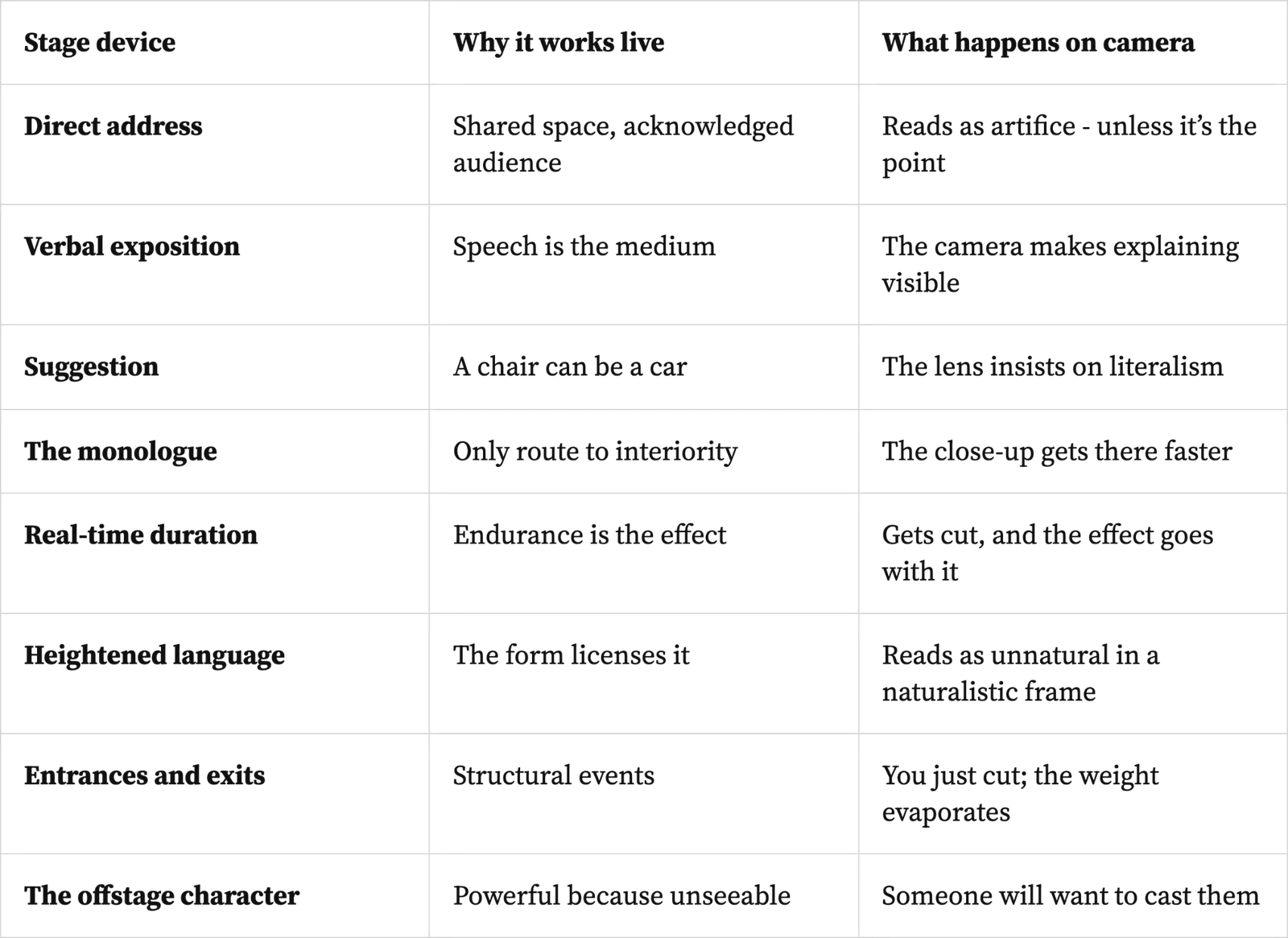
Direct address deserves the nuance. It doesn’t break automatically - it breaks when it’s a leftover. Fleabag began as a one-woman stage play and kept its address to camera, making it the whole grammar of the show. That works because the adaptation decided the device was load-bearing and built around it, rather than inheriting it.
The rule underneath all eight: every stage device survives if it’s re-chosen deliberately. They break when they’re carried over by default.
The absent character problem
Worth separating out, because it’s where adaptations do the most avoidable damage.
Many of the strongest plays are built around someone who never appears - a dead spouse, an unseen employer, a child upstairs, an institution. The absence is the point. The character exists as pure pressure, shaped entirely by what the people onstage say about them, and no two audience members picture the same person.
Film’s instinct is to cast them, because film can. A flashback, a scene at the office, a face for the name.
This usually destroys the play, and specifically it destroys the ambiguity. The moment the audience sees the absent figure, that figure stops being what everyone in the room needs them to be and becomes one actor making one set of choices.
The discipline: if the play worked because someone wasn’t there, they still aren’t there. If you cast them, be certain you’re gaining more than the ambiguity you’re spending.
What you actually gain
Adaptation isn’t only subtraction. Four things become available.
The close-up. The single largest gain. Everything a monologue was doing can potentially be done by a face, in silence, in seconds - which is why so much stage dialogue is cuttable.
Point of view. A camera can align with one character, see what they see, withhold what they don’t. Theatre has no equivalent; the stage is neutral. This is a genuine structural tool the play never had.
Compression. The cut moves through time for free. Scenes that existed on stage to bridge time can go entirely.
Silence without cost. A ten-second silence on stage costs ten seconds of your play. On film it costs whatever the edit gives it, and can be held on a face.
Three strategies, chosen deliberately
Most adaptation problems come from doing one of these while intending another.
1. The filmed play. Keep the setting, keep most of the structure, and let the camera do the work. Best for plays whose pressure comes from confinement - two-handers especially, where the whole architecture is two people who can’t leave. Our two-hander guide covers why that structure is so camera-friendly.
2. The opened-out adaptation. Genuinely restructure - new scenes, new locations, material the play didn’t contain. Amadeus and A Streetcar Named Desire both did this substantially. It works when the play’s world is bigger than its staging allowed, and fails when the staging was the point.
3. The reconceived work. The play as source material for something different. Legitimate, and it should be a decision rather than a drift.
Decide before you start. An adaptation that begins as a filmed play and acquires locations under pressure ends up as neither.
Television is a different problem
Adapting to television is not a longer version of adapting to film.
A play doesn’t contain enough story for a series. A full-length runs roughly ninety minutes and resolves. Six episodes need six times the material, and stretching a play across them produces the classic problem of a first episode that’s excellent and a third that’s marking time.
What works instead is treating the play as a pilot’s worth of world. The characters, the situation and the central relationship become the premise; almost all of the story is new. That’s a commission for original writing that happens to have a play behind it, and it’s worth being honest with yourself about which one you’re doing.
The arc problem is real. Television requires change distributed across episodes and seasons, and a play’s arc completes in one sitting. Our guide to character growth across episodes and series covers why change nests rather than stretches, and writing a TV pilot covers the structural shapes.
The exception worth noting: limited series. A play with a large world and a compressed timeline can sometimes support three or four episodes without inventing a second season’s worth of material.
The dialogue cut
Expect to lose a great deal, and expect it to feel wrong.
Stage dialogue carries more because it has to. There’s no close-up doing emotional work in parallel, so speech does the whole job - which means on camera, a substantial proportion of it is now redundant with the image.
Where the cuts usually are:
Lines that state what a face will show. The largest category by far.
Exposition. Much of it becomes visible instead - a room, an object, a wedding ring.
The second half of speeches. Stage speeches often complete a thought the camera can leave incomplete.
Everything after the point is made. Theatre tolerates the extra beat; film doesn’t.
What to protect: the lines whose meaning depends on being said rather than known. Everything running on the gap between what’s stated and what’s meant survives translation intact - see subtext in dialogue, which works identically in both media because it runs on the audience’s knowledge rather than on delivery.
Screen formatting is its own set of conventions - our spec script formatting guide covers the layout, and the screenwriting structure guide covers the shape.
Where adaptations fail
Opening out reflexively. Locations added to avoid looking stagey, at the cost of the pressure.
Keeping all the dialogue. The most common single failure. A filmed play with a full stage script is a recording, not an adaptation.
Casting the absent character.
Inherited devices. Direct address, monologues and heightened language carried over because they were there, not because they were chosen.
Losing the reason it existed. The hardest one to see. Every adaptation should be able to state what the play was for in a sentence, and check that the film still does it.
Treating the stage version as sacred. A faithful adaptation that doesn’t work isn’t faithful to anything that matters. The play still exists; it’s fine.
Rights and permissions
Briefly, because it’s easy to assume and expensive to be wrong.
If you wrote the play, you generally control the adaptation rights - but publishing and licensing agreements can carry provisions about subsidiary rights, and a commissioning theatre may have negotiated a participation in future income. Check what you signed.
If you didn’t write it, you need permission, and adaptation rights are a distinct thing from performance rights.
This is territory for your own representation rather than an article. The Dramatists Guild publishes general guidance for US practice, and reading it before a conversation with a producer is time well spent.
Working in two forms at once
Adaptation means running two versions of the same story in different formats - the play, which still exists and may still be produced, and a screenplay with entirely different conventions. Most writers end up with the two in separate applications, and the play stops getting updated the moment the adaptation starts.
Skrib holds both. The Draft handles stage formatting that stays put and screen formatting with scene numbers locked through revisions - the same editor, the right conventions for whichever version you’re in. The Board sits beside it as a canvas where you can map what’s being cut, what’s being kept and where the pressure has moved, with both versions in view.
Export runs both ways: .docx and .pdf for the play, .fdx and .fountain for anyone downstream working in Final Draft.
Whether the pressure survived the move is not something a tool can tell you. That’s a read-through, and ideally a reader who doesn’t know the play. You can start free.
Frequently asked questions
How do you adapt a play into a film? By replacing the stage’s pressure system rather than removing it. A play generates tension through confinement and real time; film generates it through proximity and the cut. Keep the setting where the confinement is doing the work, cut dialogue heavily, and let the camera carry what speech was carrying.
Should you open out a play when adapting it? Usually less than instinct suggests. Adding locations to avoid looking stagey often releases the pressure that made the play work. The test is whether a scene gains something specific from being elsewhere - variety alone isn’t a reason.
How much dialogue gets cut adapting a play to screen? A great deal. Stage dialogue carries more because there’s no close-up doing emotional work in parallel, so on camera much of it becomes redundant with the image. The largest category of cuts is lines that state what a face will already show.
Can a play become a TV series? Rarely as a direct adaptation, because a full-length play doesn’t contain enough story for multiple episodes. What works more often is treating the play as the premise - its characters, situation and central relationship - with most of the story written new.
Do stage monologues work on film? Only when re-chosen deliberately. The camera reaches interiority faster through a close-up, so a monologue has to justify itself against that. Where direct address becomes the grammar of the piece rather than a leftover, it can work - Fleabag moved from stage to screen and kept it as the show’s signature.
Do you need permission to adapt a play? Yes, unless you wrote it - and adaptation rights are separate from performance rights. Even your own play may be affected by provisions in publishing or licensing agreements, so it’s worth checking what you signed and taking advice before negotiating.