Video Game Writing: A Complete Handbook | Skrib
How game writing actually works: the channels narrative travels through, branching, quests and world systems, writing for production and how to get in.
A novelist decides what happens on page 200. A screenwriter decides what the audience sees at minute forty. Both control the order of events absolutely, and every craft technique they use assumes it.
Game writers don’t have that. The player controls the order, and they will get it wrong, skip things, do them backwards, and spend six hours on a side activity you wrote in an afternoon.
That single fact reorganises the discipline. If you can’t control sequence, you can’t write scenes in the way other media mean it. What you write instead is a possibility space - a set of states, conditions and constraints within which anything the player does still produces something coherent.
The unit of craft is not the scene. It’s the constraint.
This handbook covers what the work actually involves, how narrative reaches a player, and how people get hired to do it.
What does a video game writer do?
A video game writer produces the text and story content of a game - dialogue, quest content, item and lore descriptions, cutscene scripts, barks and tutorial copy - while a narrative designer determines how that story is expressed through the game’s structure and systems. In smaller studios the two are the same person. In larger ones they’re distinct roles with different reporting lines.
Both titles are relatively recent and, as practitioners regularly point out, definitions vary meaningfully between studios - so job descriptions are a better guide than titles.
You don’t author the sequence
Three consequences follow, and they account for most of what feels strange about the discipline when you arrive from prose or screen.
You write states, not sequences
A scene assumes what came before it. A game can’t.
What you write instead is a state - a condition the world or a character is in, with entry rules and available content. The player may enter it from several directions, sit in it for thirty hours, or never reach it.
The demanding part: every state has to be a legitimate place to stop. Some players will finish the game inside your act-two configuration. If that state only makes sense as a waypoint, their experience is broken and they’ll never know why.
The companion-character version of this problem is covered in our guide to game companion characters, where a character has to stay coherent while their scene partner improvises.
Everything must work in any order
Order-independence is a constraint no other medium imposes.
If a player can reach the confrontation before the setup, one of three things must be true: the setup is gated, the confrontation is written to work without it, or the game is prepared to look broken. Deciding which, for every piece of content, is the job.
This is why game writers spend so much time on conditions rather than on prose. The line is often easy. The question of when it can fire, and what it must not contradict, is the work.
You write far more than anyone reads
A large branching RPG can ship several hundred thousand words, and a single playthrough might surface a small fraction of them.
That inverts the economics of writing. Effort spent perfecting a line seen by 8% of players is effort not spent on the trunk everyone traverses. Experienced writers triage ruthlessly: the critical path gets the polish, optional content gets to be good rather than perfect.
It also means volume is a genuine professional skill. Games need a lot of words, on schedule, at consistent quality.
What that looks like in practice
A concrete version, because the abstraction is easy to nod at and hard to apply.
The moment: the player reaches a locked door. There’s a body outside it.
In a screenplay this is one scene. You know who’s present, what they know, and what happens next. On a game team, that moment decomposes into a set of independent pieces, each of which has to work without assuming the others fired.
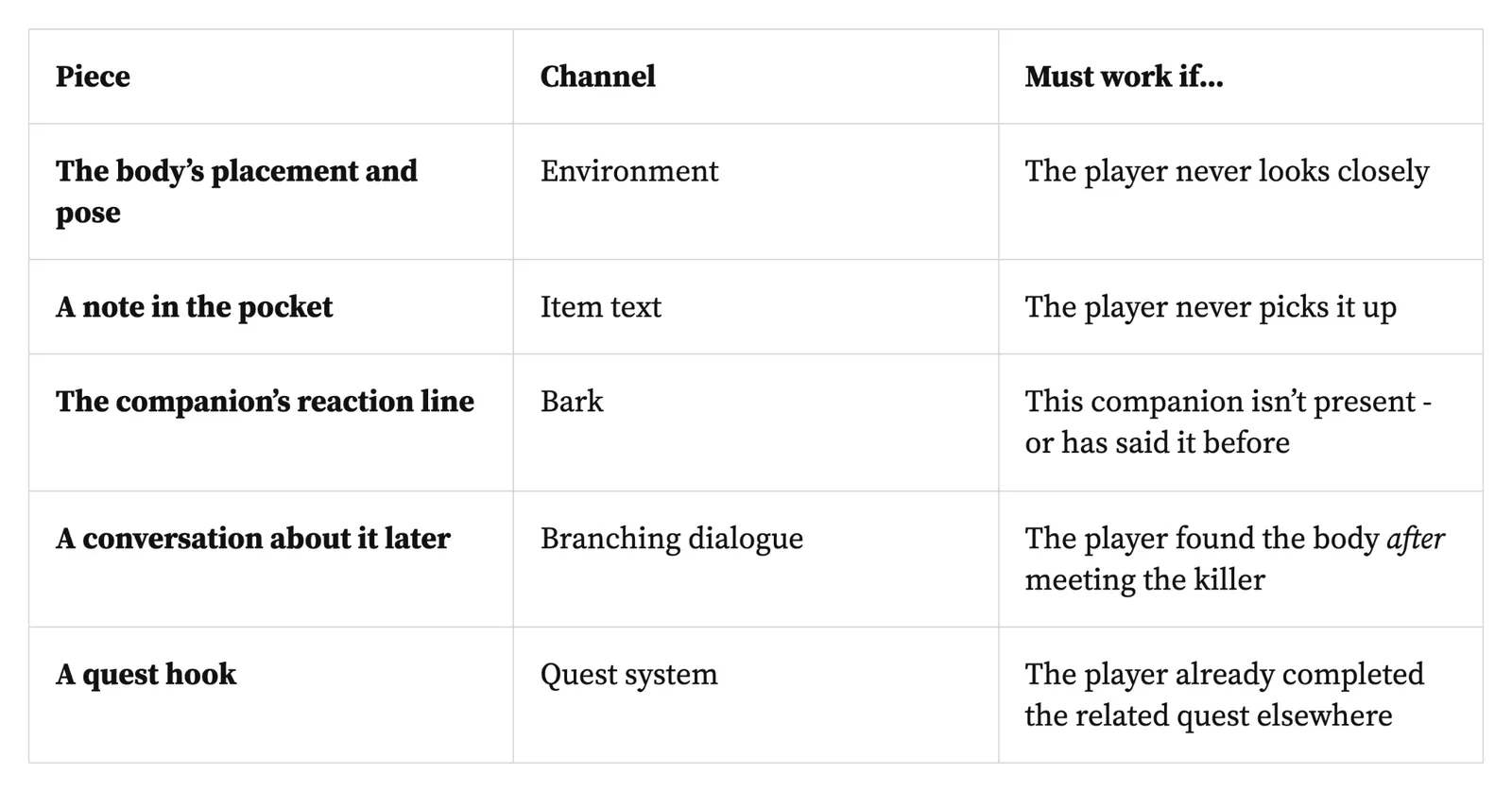
Now the constraint list, which is the actual writing task: