Character Arc: How to Write One, With 3 Examples Mapped Step by Step
What a character arc is, the three types (positive, flat, negative) and how to map one scene by scene. Three examples on a real Skrib board, plus a template.
Character Arc: How to Write One, With 3 Examples Mapped Step by Step
Readers forgive a slow chapter. They rarely forgive a main character who ends the book exactly as they started it, for no reason. That change, or the deliberate lack of it, is the character arc.
This guide explains the three types of character arc and shows you how to map one scene by scene. We mapped three arcs from one small novel, The Orchard, on a Three-Act Structure board in Skrib, so you can see each type beat by beat and copy the method.

What a character arc is
A character arc is the inner journey a character takes over a story. The plot is what happens to them. The arc is what happens inside them because of it. Most arcs are built from four parts:
- The lie: something the character believes that isn't true.
- The want: what they chase on the surface.
- The need: what they actually need, which the lie hides.
- The truth: the belief that would set them free.
The story puts pressure on the lie until the character has to choose. That choice decides the type of arc.
| Arc | Starts | Ends |
|---|---|---|
| Positive | Believes a lie | Lets it go and grows |
| Flat | Already knows the truth | Unchanged, but changes the world around them |
| Negative | Believes a lie | Chooses it, and loses |
The Orchard in one line: after her father dies, Mara comes home to save the family orchard before the bank takes it at harvest, while her brother Owen wants to sell and the old foreman Ruth refuses to let either of them forget what the land is for.
Example 1: A positive arc
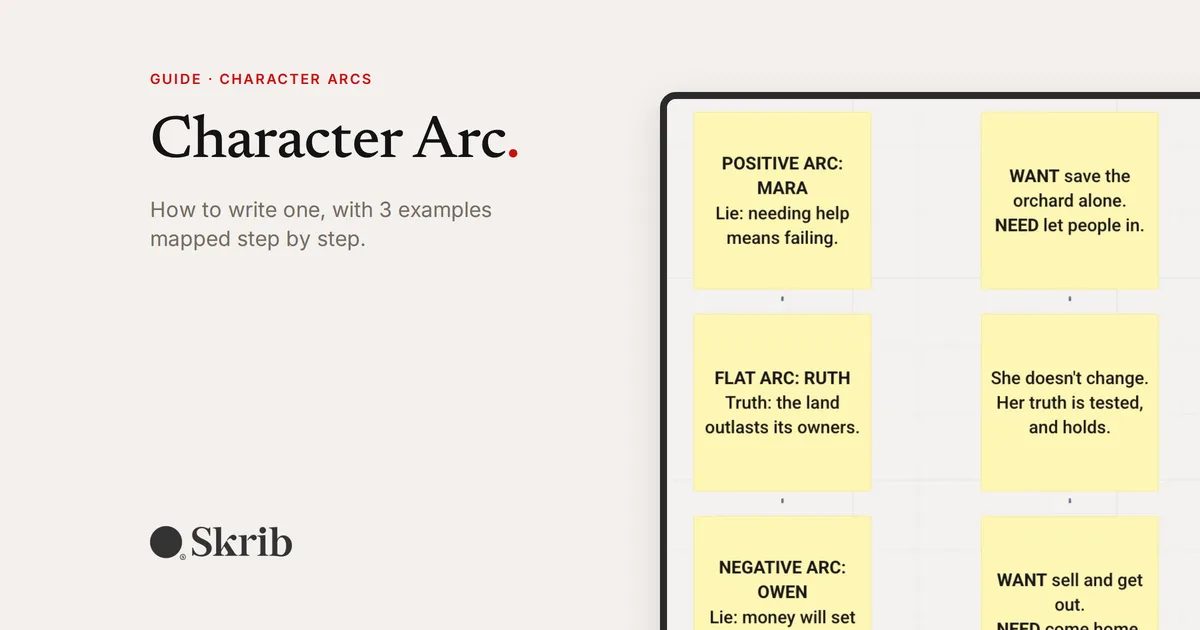
Mara's lie: if I need help, I have failed. She wants to save the orchard alone. She needs to let people in. Every beat of the three-act board gets a scene card with what happens, the value change and where she stands with the lie.

In Act I the lie holds and she refuses Ruth's help. At the midpoint the neighbours save the frost without being asked, her first glimpse of the truth. At the second turning point the lie costs her everything. Only then does she stand up and ask for help. A positive arc needs the character to pay for the lie before they drop it.
Do it in Skrib: give each main character their own copy of the three-act board. The three sticky notes at the top hold the whole arc, so you can check any scene against it in a second.
Example 2: A flat arc
Ruth already knows the truth: the land outlasts its owners. She doesn't change. Her truth is tested, and it changes everyone around her.

A flat arc still needs pressure. Ruth's big test is the developer's offer of a paid job clearing the old trees. She says no. If a flat-arc character is never tested, they are scenery.
Example 3: A negative arc
Owen's lie: money is freedom. He wants to sell. He needs to come home. In a negative arc the character is offered the truth and turns it down.

The same frost that shows Mara the truth shows it to Owen. He looks away. That choice is what makes a negative arc tragic rather than just sad.
How to map your own character arc in 5 steps
- Name the lie in the character's own words.
- Write the want, the need and the truth, one line each.
- Pick the arc type: accept the truth, already know it, or reject it.
- Put the arc on the beats. For each scene card write what happens, the value change and where the character stands with the lie.
- Read the last lines in order. If they don't tell a story on their own, the change isn't on the page yet.
Do it in Skrib: the value change and conflict lines are built into every scene card, so the arc is written as you plan, not bolted on later.
Common mistakes
- The change happens off the page. Every step of the arc needs a scene.
- The change comes too easily. The lie should cost something real before it goes.
- The want and the need are the same. Then there is no inner conflict.
- The negative arc has no choice in it. A character crushed by events is a victim, not an arc.
FAQ
Does every character need an arc? Your main character almost always does. Supporting characters can have small arcs or none.
Where does a character arc turn? At the same points as the plot: the inciting incident, the midpoint, the lowest point and the climax.
Map your character arc in Skrib
Pick your main character, write the lie in one sentence and put the arc on the nine beats. The board has the three acts, the sticky notes and the scene cards ready, and your draft opens in the same tab.
Copy the Three-Act Structure board
New to Skrib? Create your account and the board is ready in under a minute.