Writing for Player Agency: Choice, Consequence & Endings
The three requirements for real player agency, the consequence budget, kinds of false choice, ending architectures and why the epilogue is the best value.
Every game with choices in it claims they matter. Most of them are telling the truth, and players still complain.
That gap is the whole subject. A studio can track four hundred variables, branch a dozen quests on them, and ship a game that reviews as having shallow consequence - while a game that tracks a fraction of that reads as deeply reactive.
The difference isn’t how much the choices changed. It’s how much the player could tell they changed.
Agency is a perception problem, not a simulation problem. Consequence the player never observes is budget spent on nothing, and it is spent on nothing constantly.
Our video game writer’s handbook covers the wider constraint this sits inside.
What is player agency?
Player agency is a player’s sense that their decisions shape the game’s world, story and outcome in ways they can recognise. The operative word is recognise: agency is an experience the player has, not a property of the underlying simulation, and the two can diverge widely in either direction.
Structure and consequence are different problems
Worth separating, because they’re constantly conflated and they have unrelated fixes.
Structure is how a conversation branches and reconverges - node design, convergence, writing a line that reads naturally after several inputs. Our guide to branching dialogue trees covers it.
Consequence is what this article covers: whether a choice changes anything, whether the player can tell, and how outcomes are architected.
A flawlessly built dialogue tree can deliver choices that change nothing. A crude one can reshape a whole playthrough. Advising a writer with a branching problem to “make choices matter” is answering a different question.
The three requirements
For a consequence to register at all, three things must be true. Missing any one wastes the work.
1. Perceptible. The player observes the change. An NPC who would have appeared and doesn’t is invisible unless something points at the absence.
2. Attributable. The player connects the outcome to their decision. A consequence landing twenty hours later, with nothing linking it back, reads as random world-state rather than as their doing.
3. Costly. Something was foreclosed. If a choice gains you an ally and loses you nothing, you didn’t choose - you collected.
The third is the one writers under-serve. Games are generous by instinct, and generosity dissolves agency: a player who can eventually get every outcome has made no decisions, only chosen an order.
And attribution is the one production under-serves. Studios build consequence and then fail to surface the link, which is why the industry’s most-mocked device - a notification saying a character will remember something - is also one of its most effective. It’s crude, and it solves attribution outright.
The consequence budget
Here’s the contrarian production point, and it changes where the money goes.
You get more perceived agency from fifty small visible consequences than from four endings.
Endings are where studios spend most and players perceive least. A player sees one ending. They may watch others on video, but their felt experience of the game contains a single terminal outcome - arriving after fifty hours during which agency was either accumulating or wasn’t.
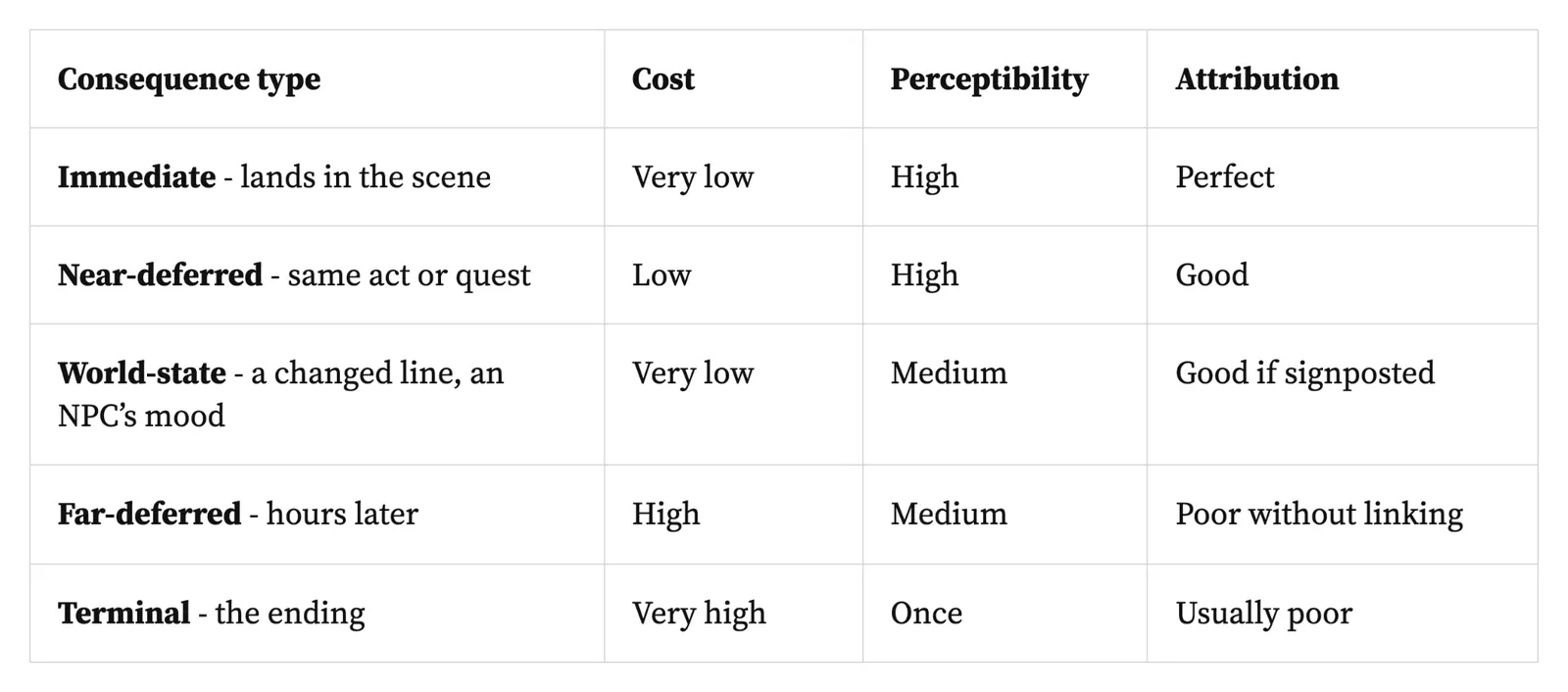
Spend top-heavy. The top three rows are where perceived reactivity is actually manufactured, and they’re cheap enough to do in volume. That’s not an argument against far-deferred consequence - the moment a decision from hour three detonates in hour thirty is among the most powerful things the medium does - it’s an argument that those moments need to be few, deliberate, and explicitly linked back.
The linking is the work. A character referencing the specific thing you did, by name, is what converts an expensive far-deferred consequence into a perceived one. Without it you have paid for a branch nobody attributes to themselves.
Kinds of false choice
Not all false choice is a failure, and treating it as one leads to expensive over-branching. Five varieties, with different verdicts.
Illusory choice. Options that lead to the same outcome. Verdict: acceptable, conditionally. It’s how most games afford choice at all, and players accept it as long as the options differ in tone, characterisation or immediate response. It becomes damaging only when a player discovers it and nothing else was different - which is a perceptibility failure, not a branching one.
Deferred convergence. Paths that genuinely differ, then rejoin. Verdict: fine. This is the standard, sustainable model.
The fake dilemma. One option is obviously correct. Verdict: bad. It costs a choice and buys nothing; the player isn’t deciding, they’re confirming.
The unknowable choice. The player has no basis on which to decide. Verdict: bad, with one exception. Random selection isn’t agency. The exception is when unknowability is the point - a game about acting under insufficient information can make this a subject rather than a flaw, provided it later shows the player what they couldn’t have known.
The no-win choice. Every option costs something real. Verdict: excellent. This is agency at its most concentrated, and it’s cheaper than it looks: two bad outcomes are two pieces of content, not a branching tree.
Ending architectures
Four common structures, with the trade-offs made explicit.
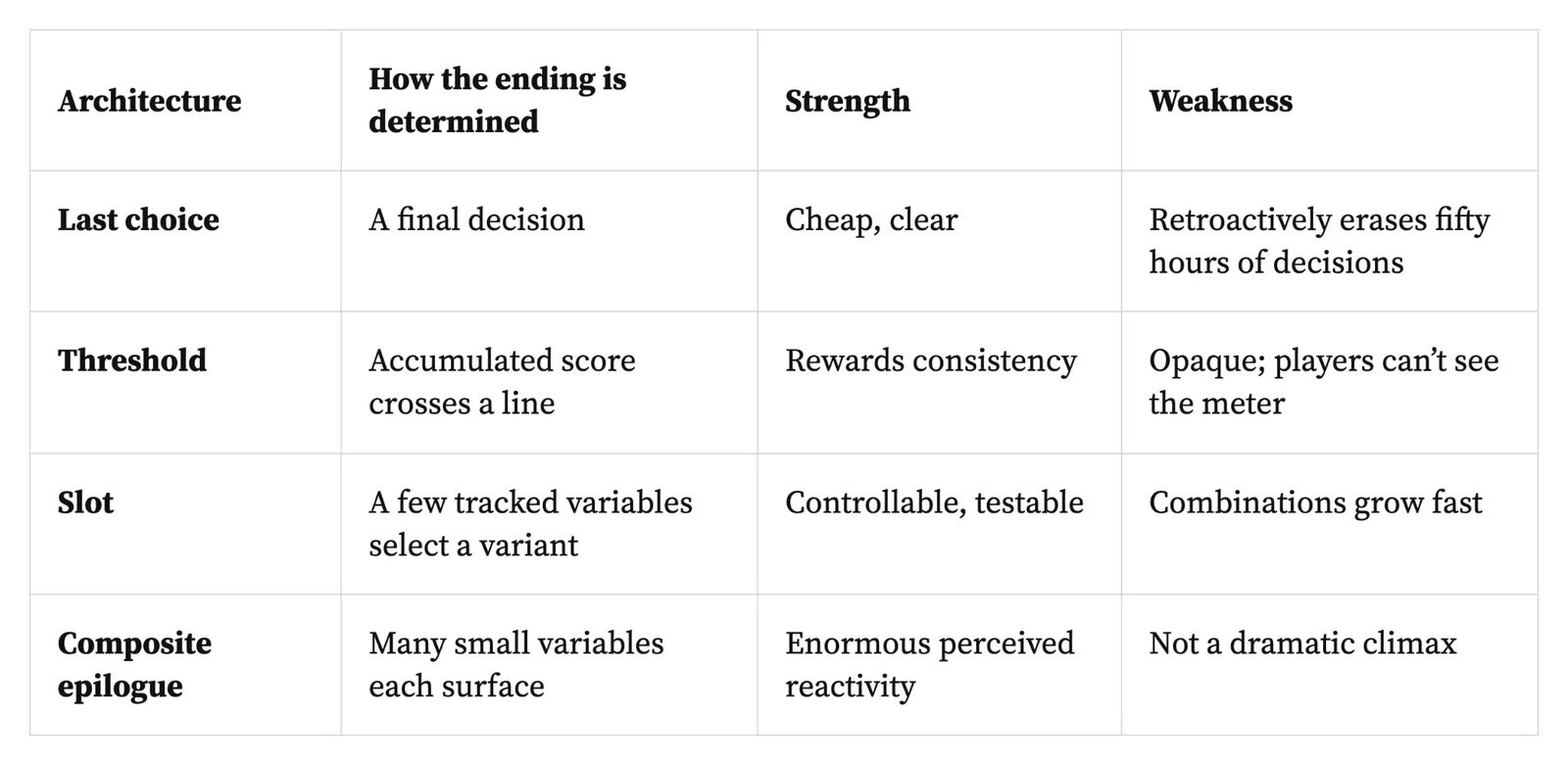
The last-choice ending is the most criticised for a reason. When a single decision at the end determines the outcome, everything before it is revealed as decoration. Players feel that as a betrayal specifically because they were paying attention.
The threshold ending has a hidden-meter problem. If the player can’t perceive the accumulation, they can’t play toward it, and the ending arrives as a verdict rather than a result. Some games solve this by surfacing the meter; others by having characters comment on the player’s drift.
The epilogue is the best value in the medium
Worth its own section, because the cost-to-perceived-agency ratio is unmatched.
A composite epilogue - a sequence of short outcome vignettes, each determined by one tracked variable - makes dozens of decisions visible at once. Each slide is a paragraph of text and an image. The player watches their own playthrough get summarised back to them, and every slide is an attribution event.
Fifty small choices that were individually barely perceptible become, in the final five minutes, a portrait of how this player played. Games built around faction outcomes and settlement fates have used this to enormous effect.
Two design notes. It works best when each slide maps to one legible decision rather than a composite score, and it does not substitute for a dramatic climax - it’s a coda, and a game that ends on epilogue slides alone tends to feel like it stopped rather than concluded.
Reloading, and whether it breaks anything
The honest problem. Players save before choices, see one outcome, reload, and see the other.
Three positions, all defensible.
Accept it. Most single-player games do. A player who reloads is choosing to trade the experience for information, and that’s their trade to make.
Design against it. Autosave-on-choice, single-save systems, or making consequences land far enough from their cause that reloading is impractical. Effective and it annoys a portion of the audience.
Make it a subject. A small number of games treat save-state as part of their fiction. Powerful, unrepeatable, and not available to most projects.
What matters for a writer: don’t spend heavily on a consequence whose entire value evaporates when a player sees both sides. The strongest choices are ones that remain interesting when you know the alternative - because they were about who your character is, not about which loot you get.
The wiki problem
Reloading is a player choosing to see behind the curtain. The last decade added something the writer has no control over at all.
Players compare playthroughs immediately and publicly. Within days of release, wikis and forums document which choices branch and which don’t, which flags are read, and which agonised decision changes precisely nothing. Illusory choice is no longer a private illusion - it’s a searchable fact.
Two consequences for how you design.
Don’t imply branching you didn’t build. The prominent on-screen notice that a character will remember something is a genuinely effective acknowledgment device, and it became a liability the moment players catalogued how often nothing followed. Acknowledge honestly; don’t promise. A quiet reference thirty hours later beats a loud notification that turns out to be decorative.
Consider showing the tree. A small number of games display a flowchart after each chapter, marking the paths taken and untaken. It’s a direct answer to the invisibility problem - rather than hoping players imagine the alternative, you show it to them. The cost is mystery; the return is unambiguous, verifiable proof of agency. Whether that’s a good trade is a game-by-game judgment, but it’s no longer an eccentric one.
The underlying shift: agency used to be something a game could suggest. It’s now something a game gets audited on, and the audit is published.
What to track
The state layer, kept practical.
Flags - did this happen, yes or no. The workhorse. Cheap to set, cheap to check, and the basis of nearly all attribution.
Counters - how many times. Useful for drift and pattern rather than for single events.
Relationships - how a character regards the player. Powerful and hazardous: once players understand a relationship value as a number, some will optimise it rather than choose in character, a tension covered in our guide to game companion characters.
The discipline: track more than you branch on. Recording a decision costs almost nothing; branching on it costs a lot. A rich flag layer lets you buy attribution cheaply later - a single line of dialogue referencing something the player did in hour two is worth more than a whole alternate scene they don’t connect to anything.
Which choices become quests, and how those quests structure consequence, is its own discipline - Quest Design and Narrative: Structuring Side Quests That Matter covers it. In games that continue after launch, consequence has to survive years of added content, which Writing for MMOs and Live-Service Games handles.
Where agency fails
Invisible consequence. Tracked, branched, never surfaced. The most expensive failure in the discipline.
Unattributed consequence. Real, perceptible, and the player thinks it’s just how the world is.
Costless choice. Every option gains, none forecloses.
The fake dilemma. An obvious right answer wearing a choice’s clothing.
Endings that overwrite the game. A last-choice architecture that retroactively voids fifty hours.
Over-promising. Marketing or UI implying reactivity the game doesn’t have. Players forgive a linear game; they don’t forgive a game that told them it wasn’t one.
Agency in the wrong currency. Letting players choose things they don’t care about - dialogue tone in a game about resource management - while the decisions they do care about are fixed.
Keeping the state map beside the writing
Consequence work is a bookkeeping discipline before it’s a writing one. Which flags exist, where each is set, where each is read, and whether anything ever surfaces it - that’s a table, and it lives somewhere other than the script, which is how consequences get built and never paid off.
Skrib helps hold both. The Plan holds a consequence map as connected cards - the decision, the flag it sets, and every later point that reads it - so an orphaned flag is visible rather than discovered in QA. State and dialogue tables move in and out as .csv and .xlsx, matching how this material actually travels, and the Library keeps every version searchable when a system gets rebuilt.
What it won’t do is validate any of it. Skrib doesn’t compile, execute conditions or connect to an engine, and it won’t tell you a flag is never read. That’s your pipeline’s job; this is where the design is written down and kept legible. You can start free.
Frequently asked questions
What is player agency in games? A player’s sense that their decisions shape the world, story and outcome in ways they can recognise. It’s an experience rather than a property of the underlying systems, which is why a game tracking hundreds of variables can feel less reactive than one tracking a handful and surfacing them well.
What makes a choice meaningful in a game? Three things together: the player perceives the change, they connect it to their decision, and something was genuinely foreclosed. Consequence that is real but invisible, or visible but unattributable, does not register as agency no matter how much it cost to build.
Are false choices always bad? No. Options that converge are how most games afford choice at all, and players accept them when the immediate response differs in tone or characterisation. The genuinely damaging kinds are the fake dilemma, where one option is obviously correct, and the unknowable choice, where the player has no basis to decide.
Should a game have multiple endings? Only if the budget doesn’t come out of the rest. Players experience one ending, so it’s usually more efficient to spend on many small visible consequences during play than on several terminal branches. A composite epilogue is often the better investment - it surfaces dozens of decisions at once.
How do you stop players from save-scumming choices? You can autosave on decision points or space consequences far from their causes, but both irritate some players. The more durable answer is to make choices that stay interesting when the alternative is known - decisions about who a character is rather than which reward they receive.
What’s the difference between branching dialogue and player agency? Branching is structure: how a conversation diverges and reconverges. Agency is consequence: whether decisions change anything the player can perceive. A perfectly built dialogue tree can deliver choices that change nothing at all.