Quest Design: Structuring Side Quests That Matter | Skrib
The turn is the form. Four questions every quest must answer, six narrative functions, the urgency problem and why tying it to the main plot is a trap.
The received advice is to avoid fetch quests. It’s the wrong target. Fetching something is a perfectly good task, and some of the best side content ever written is structurally a fetch quest.
What fails isn’t the task. It’s the wrapper.
A quest has two separable halves. The task is design - go there, kill that, carry this back. The wrapper is writing - who’s asking, why, and what it turns out to be about. Bad quests almost always have a serviceable task and a wrapper that never justified it.
And the wrappers that work share one thing, which is the most useful pattern in the form.
The quest presents as one thing and turns out to be another. You’re hired to kill the monster; the monster isn’t the problem. You’re asked to deliver a letter; the recipient has been dead for a year. A quest that delivers exactly what it promised is a task. A quest that turns is a story.
Everything here assumes the fundamentals in our video game writer’s handbook.
What is a quest, structurally?
A quest is a discrete unit of playable content consisting of a task, a fiction that motivates it, and a resolution - packaged so a player can accept it, track it, complete it and be rewarded. It’s the main container games use to deliver narrative in playable form, distinct from environmental storytelling, which requires no acceptance and no completion.
The turn is the form
Write the turn first. Reverse-engineer the task that gets the player there.
That inverts how quests usually get made - a designer needs a task in this region, a writer is asked to justify it - and it’s the difference between content that fills a map and content players remember years later.
What a turn can be:
The stated problem isn’t the problem. The wolves are attacking because something upstream displaced them.
The client is lying. Not maliciously, necessarily. People misrepresent their situations.
The target is sympathetic. You were sent to deal with someone who turns out to have a case.
Completing it makes things worse. The player succeeds and wishes they hadn’t.
The real story is adjacent. The task is trivial; the person asking is the content.
One caution: the turn must be discoverable, not mandatory. A player who does the task efficiently and leaves should get a complete experience. The turn rewards attention; it shouldn’t punish its absence.
The gold-standard example is the monster-contract structure used in the better fantasy RPGs, where a village reports a beast, and the investigation reveals a human cause - a crime, a curse, a debt. The task is unchanged. The wrapper does everything.
Four questions every quest must answer
Most quests answer the first and skip the rest, which is why so much side content feels generated rather than written.
1. Why does this need doing? The task’s justification in the world.
2. Why is this person asking me? The question most often skipped. A stranger handing a mercenary task to a passing hero needs a reason - desperation, no alternative, a specific capability. Without it, the player is a vending machine for errands.
3. Why now? Urgency doesn’t have to be dramatic, but something should have changed. Quests that could have been asked at any point for the last ten years feel like furniture.
4. What does the asker want that they aren’t saying? This is the turn, and it’s the same mechanism that drives character generally - a stated want concealing an actual need. Our want vs. need framework covers it, and quest givers are the most compressed possible application: one scene to establish both.
Six narrative functions
A more useful taxonomy than fetch/kill/escort, because it sorts by what the quest is for rather than what the player does.
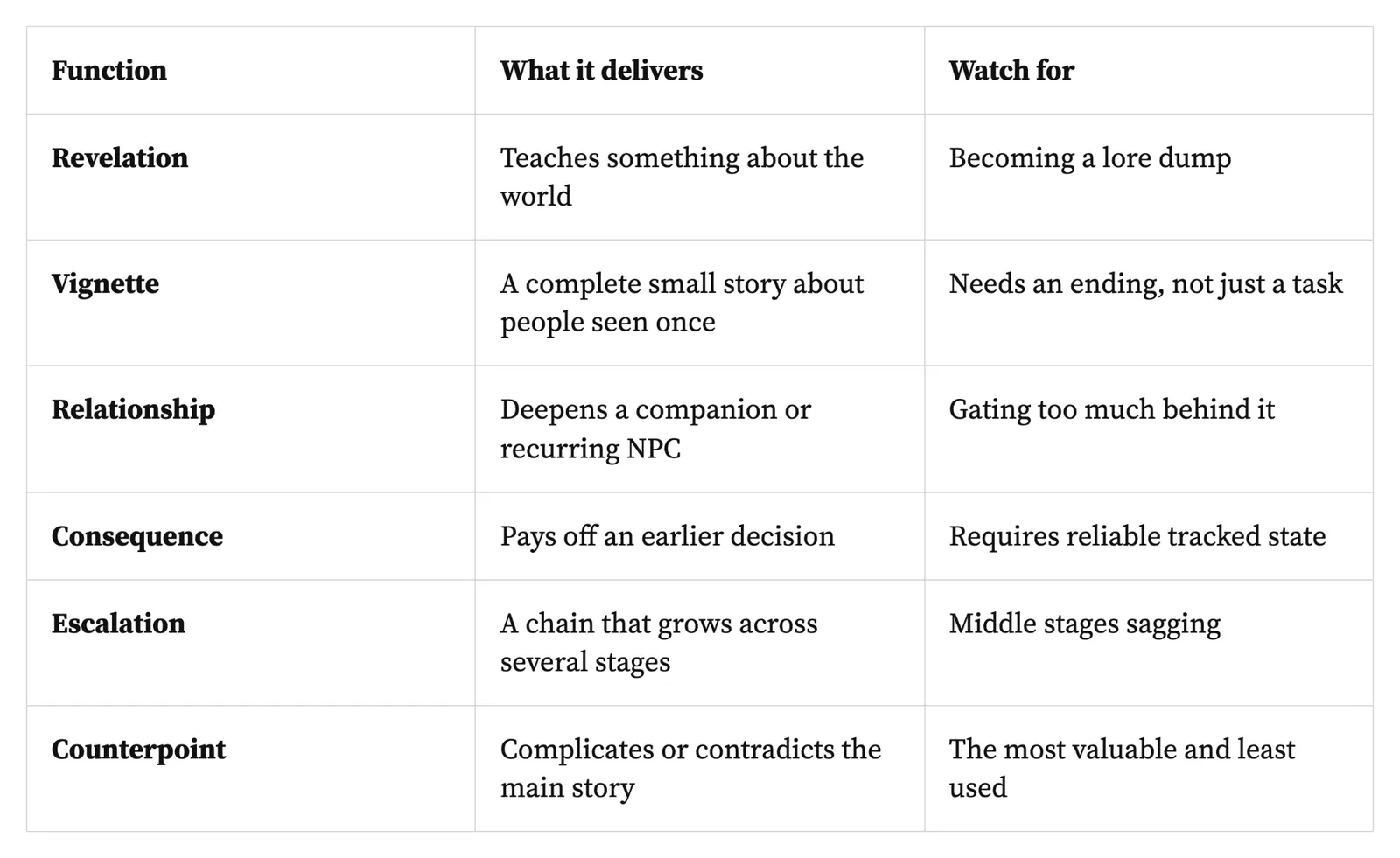
The vignette is the most under-appreciated. A self-contained story about people the player will never see again, with a beginning and a real ending, does more for a world than another thread tied to the protagonist. Games built substantially on them tend to be remembered for exactly that.
The counterpoint deserves specific attention. A side quest that argues against the main plot’s thesis - showing the cost of what the hero is doing, or a perspective the campaign has no room for - makes a world feel like it holds opinions. Most games never attempt one.
Consequence quests depend entirely on the state your game actually tracks, which is a design constraint before it’s a writing one - player agency covers what’s worth recording and what a payoff costs.
The “tie it to the main plot” trap
Common advice, and often actively harmful.
When every side quest connects to the main story, the world shrinks. Everything becomes about the player, every stranger turns out to be relevant, and the setting stops feeling like a place that existed before the protagonist arrived.
What makes a world feel large is content that doesn’t concern you. A dispute between two farmers that has nothing to do with the ancient prophecy. A merchant’s family problem. These aren’t distractions from the story; they’re the evidence that there is a world for the story to matter in.
The useful ratio isn’t fixed, but the instinct to justify every quest against the main plot should be resisted. Thematic resonance is enough - a quest can rhyme with the campaign’s concerns without being causally linked to them, and that’s usually the better connection anyway.
The urgency problem
A structural contradiction almost every game with a main quest has to live with.
The critical path says hurry. The side content says wander. The world is ending, and the player is spending nine hours helping a fisherman. Every writer notices this and most games do nothing about it.
Three workable responses:
Don’t manufacture urgency you can’t support. If the design wants an open world, a ticking clock in the main plot fights it. Threats that are severe but not immediate - a slow collapse, a gathering force - cost nothing and remove the contradiction.
Put the urgency in a container. Escalate hard during a chapter, then release. Players accept sequences where wandering is closed off if the game signals it.
Make the delay diegetic. A protagonist who has a reason to be moving through the world - gathering allies, funds, information - turns side content into preparation rather than procrastination.
What doesn’t work is stating extreme urgency and then leaving the world open indefinitely. Players don’t complain about it much, and it quietly costs the main story its weight.
Writing the quest text
The deliverables nobody discusses, all of which the player reads more carefully than your dialogue.
The offer. How the quest is proposed, usually in dialogue. This is where questions two, three and four get answered, and it’s the highest-value writing in the whole unit.
The journal entry. Decide the voice and hold it. Options are the protagonist’s first person, a neutral summary, or the quest giver’s framing. First person is warmer and dates badly if the character develops; neutral is safest at scale.
Objective text. Functional above all. It must be unambiguous about what and where, survive translation, and never depend on the player having read the journal. This is UI copy that happens to sit inside a story.
The update. When a quest turns, the journal has to acknowledge it without spoiling what’s coming. Under-written updates are why players lose the thread on long chains.
The completion summary. Frequently the last thing a player reads about a story you spent a week on. Worth more than five minutes.
One structural note: objective text and journal entries are among the most localisation-sensitive strings in a game, because they’re often assembled from variables. Localization-Friendly Writing: Formatting Game Scripts for Translation covers what breaks.
Rewards as narrative
A reward is the last beat of the quest, and treating it as pure economy wastes it.
A reward can characterise the giver. Someone poor who overpays. Someone wealthy who haggles. Someone who gives you something useless and personal.
A reward can be the turn. The player expects payment and receives information, or an obligation, or nothing at all with a good reason.
A reward can be denied meaningfully. A quest where the client cannot pay, and the player does it anyway, is a characterisation of the player - one of the few the medium can offer.
What undercuts a quest is a carefully written vignette about grief that concludes with a generic currency payout. If the fiction and the economy disagree, players believe the economy.
Where quests fail
No answer to “why me.” The player as errand vending machine.
No turn. Delivers exactly what it promised.
Turn required, not discoverable. Players who play efficiently get punished for it.
Everything tied to the main plot. A world that only exists in relation to the protagonist.
Urgency contradiction. Stated crisis, unlimited time.
Objective text that assumes context. The player has fourteen quests open and hasn’t read the journal.
Chains that sag. A five-stage quest where stages two through four are travel.
Reward mismatch. Emotional story, transactional payout.
Keeping quest lines visible while you write
A quest is a small graph attached to a piece of prose: stages, conditions, the state it requires, the state it sets, the journal strings, and the dialogue that frames it. Multiply that by two hundred and the shape of the whole becomes impossible to hold - which is how games end up with three quests in one region that all use the same turn, or a chain whose middle stage assumes something the player may not have done.
Skrib suits that shape. The Plan lets quest lines spread out as connected cards - stages, dependencies, the turn, what each one needs and sets - with the offer dialogue drafted beside them rather than in another application. Quest tables and string lists move in and out as .csv and .xlsx, and the Library keeps every version searchable when a chain gets restructured.
What it doesn’t do: Skrib isn’t a quest editor and doesn’t connect to an engine. It won’t validate a dependency or catch an unreachable stage - that belongs to your pipeline and to playtest. It’s where the design and the writing stay legible before they get there. You can start free.
Frequently asked questions
What makes a good side quest? A turn. The strongest side quests present as one kind of errand and reveal themselves to be about something else - the monster isn’t the problem, the client is lying, succeeding makes things worse. A quest that delivers exactly what it promised is a task rather than a story.
Are fetch quests bad? No. The task type isn’t the problem; the wrapper is. Fetching something is a perfectly serviceable structure, and plenty of memorable side content is structurally a fetch quest with a reason worth caring about attached to it.
Should side quests connect to the main story? Usually less than instinct suggests. When everything ties back to the main plot, the world shrinks and starts to feel like it exists only in relation to the player. Thematic rhyme is generally a better connection than causal linkage.
How do you handle urgency in the main quest when the game is open? Either don’t manufacture urgency the design can’t support, contain it within chapters where wandering is closed off, or give the protagonist a diegetic reason to be moving through the world - gathering allies, money or information - so side content reads as preparation.
What should a quest journal entry say? Enough to re-orient a player who has fourteen quests open and last touched this one three sessions ago. Pick a voice - protagonist first person, neutral summary, or the giver’s framing - and hold it consistently. Objective text especially must be unambiguous without the journal.
How long should a side quest be? Short enough that every stage does something. Multi-stage chains fail in the middle, where stages exist to extend length rather than to develop the story, and players feel travel time acutely when nothing is happening during it.