How to Outline a Book: Step by Step, With a Real Story Outline Example
Outline a book step by step: premise, structure, scenes and chapters. See a finished book outline example on a board and copy the free template.
How to Outline a Book: Step by Step, With a Real Story Outline Example
An outline is the difference between a book you start and a book you finish. It tells you what happens next on the days your imagination doesn't.
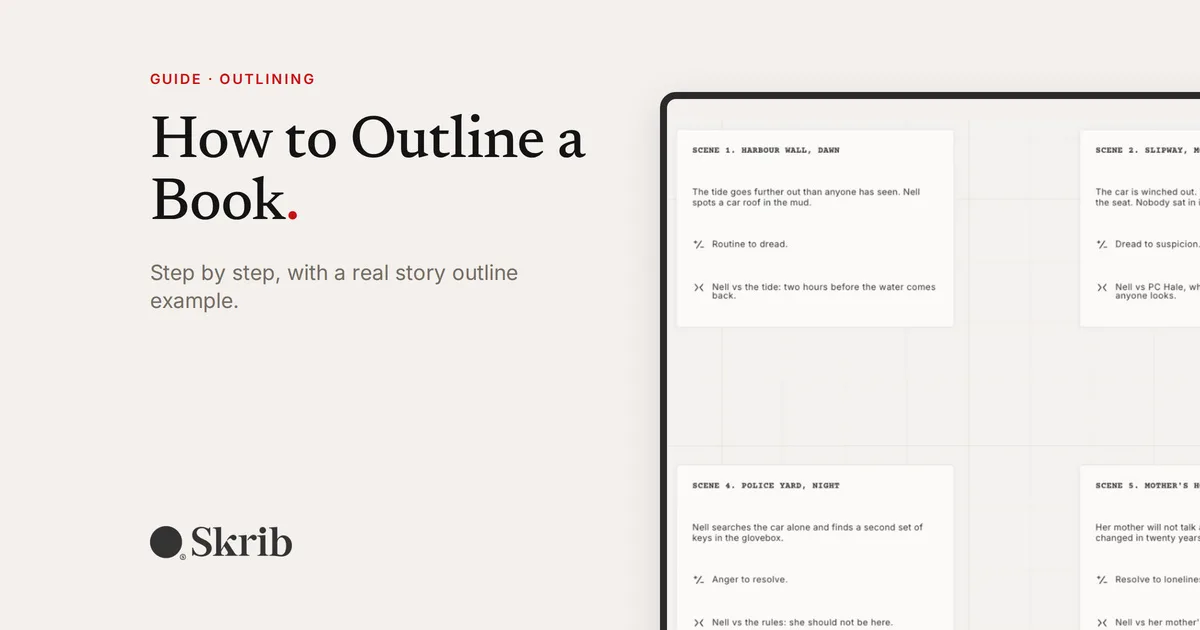
This guide shows you how to outline a book in six steps, from a one-sentence premise to a chapter-by-chapter plan. We outlined a small mystery novel, Low Water, on the free Story Outline & Research board in Skrib, where your outline, research and draft live in one tab.

Step 1: Write the logline
Write the book in one sentence: who, what they must do, and what happens if they fail. When the lowest tide in fifty years uncovers her brother's car, a harbourmaster must prove he wasn't driving before the town closes the case.

Do it in Skrib: the template starts with a sticky note for your logline, pinned right next to the outline.
Step 2: Pick a structure
Don't invent the shape of a novel. Pick one and fill it in. Three acts is the simplest: setup (about 25%), confrontation (50%) and resolution (25%). See our three-act structure example for every beat.
Step 3: Decide the turning points
A structure becomes a plot when you choose the moments where the story turns: the inciting incident, the first turning point, the midpoint, the lowest point, the climax and the resolution. One or two sentences each is plenty.

Do it in Skrib: pin the outline note as a tab at the top of your project, one click from your draft.
Step 4: Break them into scene cards
Give each scene a card with a heading, what happens, the value change and the conflict. If a scene starts and ends in the same emotional place, nothing happened, and it probably belongs inside another scene.

Step 5: Group scenes into chapters
Put the cards in columns, one per chapter, and give each a working title. Outline the first act in detail, then outline the next act when you get there. The draft will teach you things the outline couldn't.

Do it in Skrib: reordering the book is a drag, not a rewrite.
Step 6: Keep research beside the outline
Put a research note next to the outline, sorted by topic. In Low Water the tide table decides when chapter one can happen. Good research doesn't decorate the story. It gives it rules.

FAQ
How detailed should a novel outline be? Detailed enough that you know what the next chapter is for, loose enough that you are happy to change it.
Do I have to follow my outline? No. When the draft finds a better route, update the outline so the rest of the book still makes sense.
Outline your book in Skrib
Copy the board from this guide, replace Low Water with your story, and outline your first act tonight. The logline, outline note, research note and chapter columns are all ready, with your draft in the same tab. It is free to start.
Copy the Story Outline & Research board
New to Skrib? Create your account.