Plot Diagram Explained: The 5 Parts of a Story, With an Example
A plot diagram shows the 5 parts of a story: exposition, rising action, climax, falling action and resolution. See Macbeth mapped on a Skrib board, free template.
Plot Diagram Explained: The 5 Parts of a Story, With an Example
A plot diagram is a simple picture of a story's shape: things build up, peak and settle down. It is the version most of us met in school, and it is still one of the fastest ways to check whether a plot works.
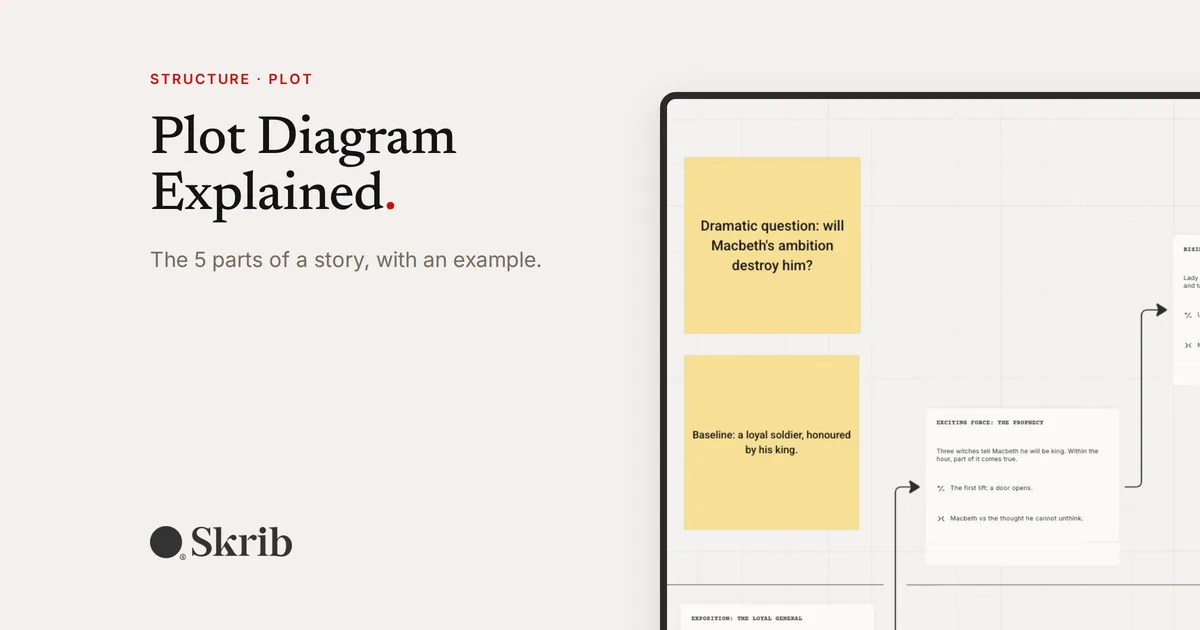
This guide explains the five parts of a plot diagram and shows Macbeth mapped on the free Freytag's Pyramid board in Skrib.

The 5 parts of a plot diagram
- Exposition: the world and the characters before the trouble starts.
- Rising action: a chain of events that raises the stakes.
- Climax: the turning point, where things can't get any higher.
- Falling action: the consequences play out.
- Resolution: the new normal, or in a tragedy, the catastrophe.
The diagram is often drawn as a triangle, which is why it is also called Freytag's Pyramid, after the German writer Gustav Freytag.
A plot diagram example: Macbeth
Exposition. Scotland is at war. Macbeth wins the battle for King Duncan and is the hero of the day.
Rising action. Three witches tell Macbeth he will be king. Lady Macbeth pushes him, he kills Duncan and takes the crown, and each murder needs another to hide it.

Climax. At the banquet, Banquo's ghost takes Macbeth's seat in front of the court. From here, Macbeth is no longer rising.
Falling action. Macbeth grows desperate. Macduff's family is murdered, and Lady Macbeth breaks down.
Resolution. Macduff kills Macbeth and order returns to Scotland.
Do it in Skrib: the board has a neutral line across the middle. Cards above it are rising tension, cards below are calm. Drag a card up or down and you can see your story's shape change.
How to make your own plot diagram
- Write your story's dramatic question on a sticky note (will Macbeth's ambition destroy him?).
- Put one card for the exposition on the left.
- Add three to five rising action cards, each higher than the last.
- Place the climax at the peak.
- Add one or two falling action cards and a resolution.
If the line is flat in the middle, your rising action needs a bigger turn.
Do it in Skrib: open your draft next to the diagram in the same tab and write each scene with its card in view.
Plot diagram vs other structures
The plot diagram puts the climax near the middle, which suits tragedy and classic drama. Most modern novels use the three-act structure, where the climax comes late. Short stories often use the Fichtean Curve.
FAQ
What are the 5 parts of a plot? Exposition, rising action, climax, falling action and resolution.
Is the climax always in the middle? On Freytag's diagram, yes. In most modern novels it comes near the end.
Map your plot in Skrib
Copy the Freytag's Pyramid board, write your dramatic question and fill in the five parts. It is free to start.
Copy the Freytag's Pyramid board
New to Skrib? Create your free account.