Skrib

Freytag's Pyramid For Novels

Map exposition to denouement without wrestling a static diagram. Skrib’s free Freytag’s Pyramid template plots all five acts on one visual board.

Skrib team23 elements69385
This template includes both a Plan and a Draft

Freytag's Pyramid: A Novelist's Template

Map your story's turning points before you draft. The curve rises to a climax, then falls. Fill each blank in your own words.

The Frame

Dramatic Question - The one question the whole story answers.

Emotional Baseline - What does ordinary feel like here?

The Neutral Line - The ordinary world, your starting equilibrium. It's the axis every stage is measured against: above it the character gains ground, below it they lose it. In this tragic shape the curve ends below the line, and the distance from your Exposition to your Catastrophe is the size of the fall.

The Reversal - Is the turn a choice, a consequence, or an irony?

Recognition - When does the character see the truth about themselves?

The Eight Stages

1. Exposition - The World Before It Breaks

The ordinary state. Establish what there is to lose.

What happens: The turn:

2. Exciting Force - The Balance Breaks

The event that ends the ordinary state.

What happens: The turn:

3. Rising Action - The Ascent

The character gains ground and gets what they wanted.

What happens: The turn:

4. Climax - The Turn

The peak, and the exact moment it reverses.

What happens: The turn:

5. Tragic Force - The Point of No Return

The first fall, and the one that makes the ending inevitable.

What happens: The turn:

6. Falling Action - The Collapse

Consequences play out. The character drops below the baseline.

What happens: The turn:

7. Final Suspense - The False Hope

A last glimmer of escape that isn't real.

What happens: The turn:

8. Catastrophe - The Fall

The ending. Show the changed world.

What happens: The turn:

Check

  • Does the ending sit below the baseline?

  • Is the reversal earned, not luck?

  • Could you cut any stage without the arc collapsing?
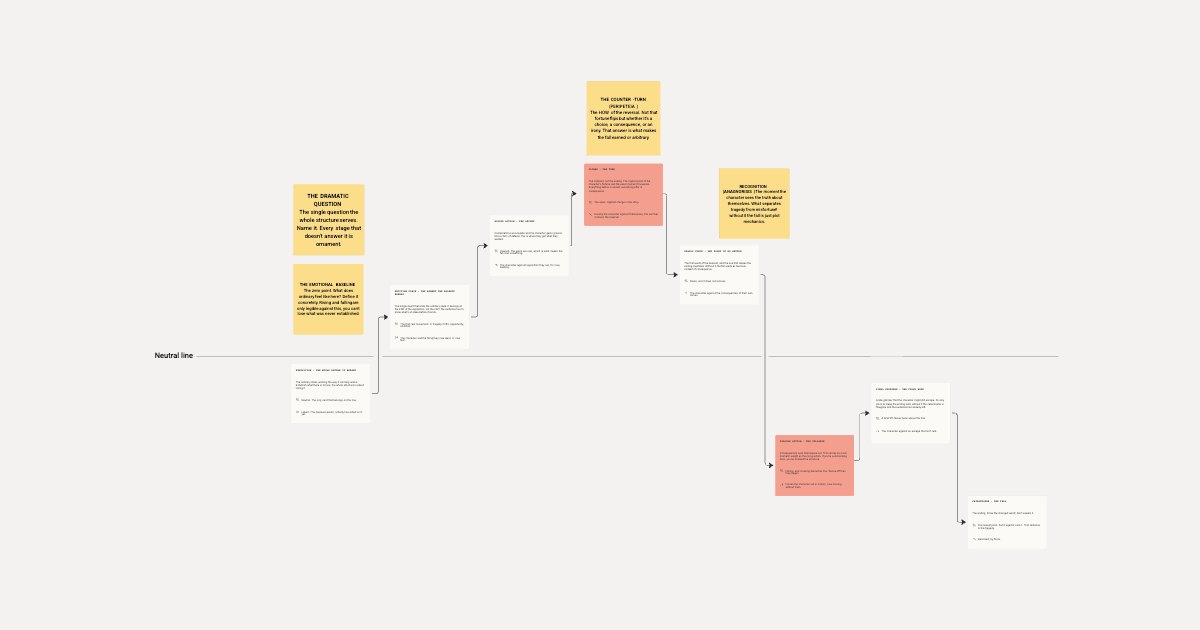
Freytag's Pyramid For Novels template

Freytag’s Pyramid Template

Your story has a shape. Most tools won’t let you see it.

Freytag’s Pyramid is the oldest working map of dramatic structure - exposition, rising action, climax, falling action, denouement - and it still explains why a tragedy lands or a third act sags. The problem is that every version you find online is a triangle drawn in a PDF. Skrib turns the pyramid into a live workspace: a Board where each act is a card you can write in, move, and connect to the scene it actually belongs to.

What’s in the Freytag’s Pyramid template

Five stages, laid out as editable cards on your Board, each with a prompt for what it should be doing to your reader.

• Exposition: World, cast and the ordinary state of things - with room for the detail you’ll need later.

• Inciting Incident & Rising Action: The disturbance, then the complications that stack pressure on your protagonist.

• Climax: The turn the whole arc has been building towards, pinned to a scene in your Draft.

• Falling Action: Consequence and unravelling - the stretch most templates give you no space for.

• Denouement: The new normal, and what your ending is actually saying.

• Beat cards under every stage: Break any act into scenes without leaving the pyramid.

Why plot Freytag’s Pyramid in Skrib?

A static diagram tells you what the five stages are. It doesn’t help you write them.

• Visual Story Mapping: Drag, link and reorder beats on an infinite Board as the plot shifts. Your pyramid stays legible when the story stops behaving.

• Tension & Pacing at a Glance: Colour-code the rise and fall, spot the flat stretch in your second act, and see exactly where the climax sits in your page count.

• Plan and Draft Side by Side: The Board sits next to your manuscript. Open a beat, write the scene, and never lose the thread between structure and prose.

• Nothing Gets Lost: Every outline, note and version stays in your Library, searchable months later. Freytag’s five-part arc gives you more room after the climax - the falling action and denouement that three-act models compress into a single resolution. That makes it the sharper tool for tragedy, literary fiction and slow-burn character work.

Who is this plot diagram template for?

• Novelists mapping a full dramatic arc before committing to a chapter plan.

• Screenwriters and Playwrights who want classical structure rather than a beat-by-beat formula.

• Students and Teachers using Freytag’s Pyramid for literary analysis, essays and coursework.

• Short Story Writers who need the whole arc visible on one screen.

Build your story arc in minutes

Drop the template on your Board, fill in what you know, and let the rest come as you write.

Open Freytag's Pyramid For Novels in your own studio

Free to start. Rename it, cut it, build on it — it is yours from the first click.

More templates

Eight Sequence Structure For Novels board previewPlanDraft
Structure & beats

Eight Sequence Structure For Novels

Break your script into eight mini-movies and beat the second-act sag. Skrib's free eight sequence structure template maps every sequence on one visual board.

Skrib team · 32 elements550113
Freytag's Pyramid For Screenplay board previewPlanDraft
Structure & beats

Freytag's Pyramid For Screenplay

Map exposition to denouement without wrestling a static diagram. Skrib’s free Freytag’s Pyramid template plots all five acts on one visual board.

Skrib team · 23 elements34884
Hero's Journey Template: All 12 Stages for Novels board previewPlanDraft
Structure & beats

Hero's Journey Template: All 12 Stages for Novels

Map all 12 stages of the Hero's Journey on a visual canvas, not a static PDF. Free to start - plan your monomyth in Skrib and draft it in the same place.

Skrib team · 20 elements40091