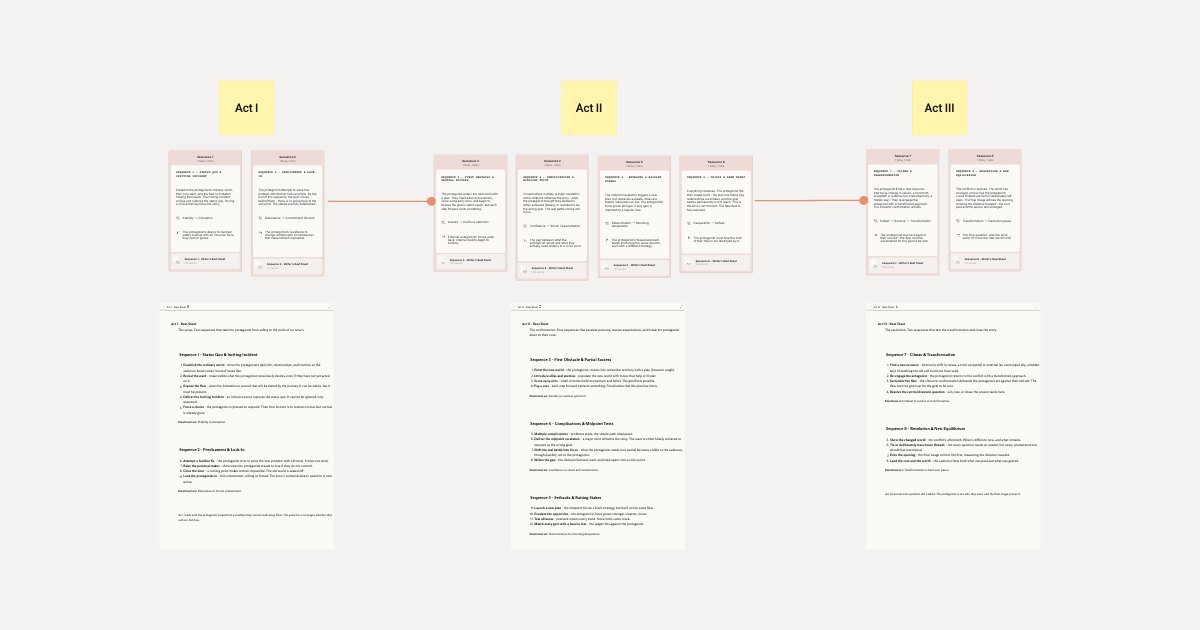
Act I
Sequence 1 - Status Quo & Inciting Incident
What to write: Establish the protagonist's ordinary world, their want, the flaw or limitation holding them back, then the Inciting Incident that ruptures the status quo and forces a choice.
What does the protagonist want before the story forces a want on them?
What does their ordinary world cost them, what are they already losing by standing still?
What is the specific, visible flaw operating in the opening scenes?
What is the Inciting Incident, and why can it not be ignored or postponed?
What is the last image of stability before disruption, and does it contrast sharply enough with what follows?
Emotional arc: Stability to Disruption. Ends when the Inciting Incident has landed and a choice must be made.
Sequence 2 - Predicament & Lock-In
What to write: The protagonist attempts to solve the problem with familiar tools and fails; a turning point closes the door on the old world; full commitment follows.
What familiar tool or strategy does the protagonist try first, and why does it fail here?
What is the specific moment the door closes? Can the reader feel it shut?
What are the stakes, stated or implied, by the end of this sequence?
Is the protagonist's reluctance rooted in character, or just plot convenience?
What forces the commitment, external pressure, internal choice, or both?
Emotional arc: Reluctance to Forced Commitment. Ends when there is no going back.
Act II
Sequence 3 - First Obstacle & Partial Success
What to write: The protagonist enters the new world with a plan, meets allies and enemies, scores early wins, but each step costs something.
What is the protagonist's plan entering this sequence, is it specific enough to test?
What early win do they score, and what does it cost them?
Who are the allies and enemies introduced here, and what does each want from the protagonist?
Is every step forward generating a new complication, or are scenes resolving too cleanly?
Where does the cautious optimism crack?
Emotional arc: Anxiety to Cautious Optimism. Ends when the new world's rules are established and the limits of the protagonist's approach begin to show.
Sequence 4 - Complications & Midpoint Twist
What to write: Complications multiply, then a midpoint revelation reframes the story, the want is falsely achieved or revealed as the wrong goal, the real battle comes into focus.
What is the midpoint revelation, and does it genuinely reframe what the story is about?
Is the false achievement or wrong-goal reversal visible to the reader even if not yet to the protagonist?
What assumption has the protagonist been operating under that this sequence destroys?
Do the complications feel like escalation, or repetition of earlier obstacles?
What is the real battle the midpoint reveals, and is it clearly different from the surface goal?
Emotional arc: Confidence to Shock and Reorientation. Ends when the midpoint twist has landed and the real conflict is in focus.
Sequence 5 - Setbacks & Raising Stakes
What to write: A new plan built on the same flaw, escalating opposition, strained alliances, every gain matched by a heavier loss.
What is the new plan triggered by the midpoint, and why is it riskier than everything before?
For every gain in this sequence, what is the heavier loss that follows it?
Which ally is tested or broken here, and does their failure cost something irreplaceable?
What resources, time, trust, options, are visibly thinning by the end of this sequence?
Is the protagonist's desperation earned through accumulated loss, or told rather than shown?
Emotional arc: Determination to Mounting Desperation. Ends when the protagonist's resources are nearly gone and the situation feels unwinnable.
Sequence 6 - Crisis & Dark Night
What to write: Total collapse, the fatal flaw is nakedly exposed, the protagonist faces the truth of who they are.
What is the specific All Is Lost moment, and is it the worst possible version of failure for this character?
How is the fatal flaw fully exposed here, not hinted at, but nakedly on display?
What must the protagonist face about themselves that they have been avoiding since Sequence 1?
Is the defeat external, internal, or both, and is the internal defeat the deeper wound?
What would it look like for the protagonist to be destroyed rather than transformed, and is that possibility real?
Emotional arc: Desperation to Defeat. Ends when the protagonist is at their lowest and the only way out is through transformation.
Act III
Sequence 7 - Climax & Transformation
What to write: The protagonist finds a new resource, internal or external, surrenders the flaw, and re-engages the antagonist transformed.
What is the new resource the protagonist discovers, is it genuinely new, or a re-use of an old tool?
What does the protagonist have to surrender, specifically and concretely, to move forward?
Is the transformed approach visibly different from how the protagonist would have acted in Sequence 1?
Does the climax require the protagonist to act, or does it allow them to be rescued?
Is the flaw addressed through choice under maximum pressure, or resolved by circumstance?
Emotional arc: Defeat to Resolve to Transformation. Ends when the central dramatic question is answered.
Sequence 8 - Resolution & New Equilibrium
What to write: The conflict resolves, the world and the protagonist have changed, loose threads are tied or deliberately left open, the final image echoes the opening.
What has changed in the world, visibly and concretely, that proves the story mattered?
What has changed in the protagonist, shown in behavior, not stated in dialogue?
Does the final image echo the opening, and does the contrast carry the theme without stating it?
What was the price, and does the story make the reader feel whether it was worth it?
Is there any unresolved thread that needs a beat here, or is the silence itself the answer?
Emotional arc: Transformation to Hard-Won Peace. Ends when the final image lands.