3-ACT STRUCTURE
A working scaffold for screenwriters
Written by [Your Name]
HOW TO USE THIS SCAFFOLD: Each act below carries its purpose. Each beat gives you the job it must do, the emotional change it should deliver, and a placeholder scene to write into. Delete the guidance notes as you fill each scene. Your manuscript lives here in the Draft; the Plan beside it holds this same structure as cards.
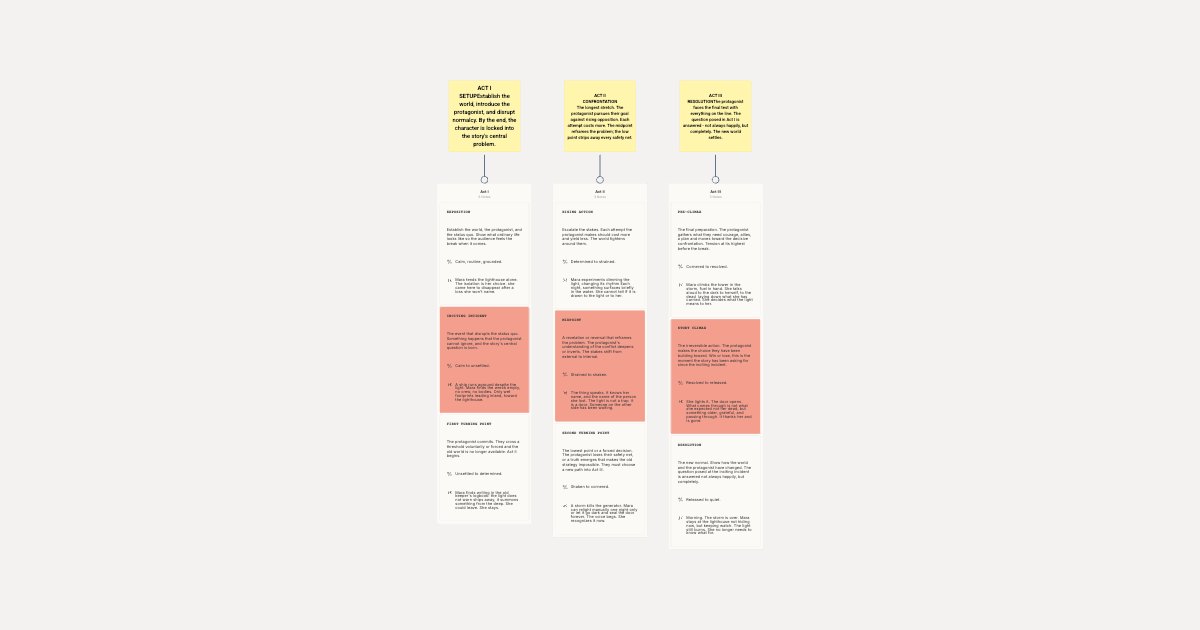
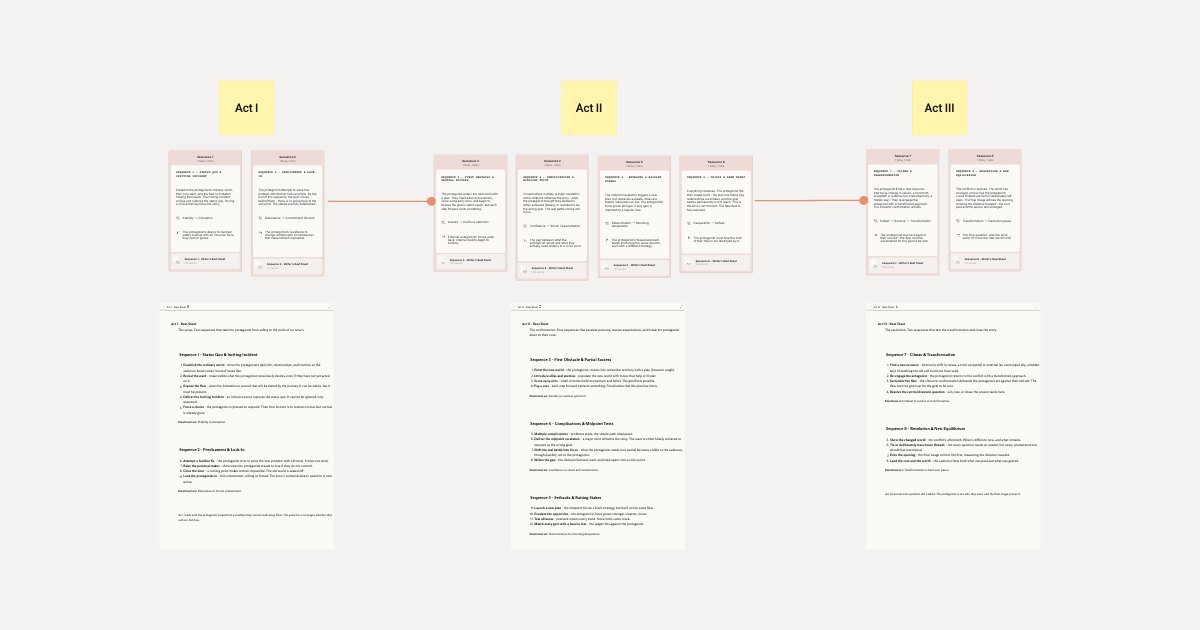
ACT I - SETUP:
PURPOSE: Establish the world, introduce the protagonist, and disrupt normalcy. By the end, the character is locked into the story's central problem.
NOTE - BEAT 1 - EXPOSITION
JOB: Establish the world, the protagonist, and the status quo. Show what ordinary life looks like so the audience feels the break when it comes. EMOTIONAL CHANGE TO AIM FOR: calm, routine, grounded.
INT. LOCATION - DAY
[Show ordinary life. Ground the audience in the protagonist's normal world before anything breaks.]
[CHARACTER NAME]
[Opening line that reveals who they are in their ordinary world.]
NOTE - BEAT 2 - INCITING INCIDENT
JOB: The event that disrupts the status quo. Something happens the protagonist cannot ignore, and the story's central question is born. EMOTIONAL CHANGE: calm to unsettled.
INT. LOCATION - DAY
[Something arrives, breaks, or is revealed that the protagonist cannot ignore. The central question is born here.]
[CHARACTER NAME]
[A line that registers the disruption. Something is wrong now.]
NOTE - BEAT 3 - FIRST TURNING POINT
JOB: The protagonist commits. They cross a threshold, voluntarily or forced, and the old world is no longer available. Act II begins. EMOTIONAL CHANGE: unsettled to determined.
EXT. LOCATION - DAY
[The protagonist crosses the threshold. The old world closes behind them.]
[CHARACTER NAME]
[The line of commitment. There is no going back.]
ACT II - CONFRONTATION:
PURPOSE: The longest stretch. The protagonist pursues their goal against rising opposition. Each attempt costs more. The midpoint reframes the problem; the low point strips away every safety net.
NOTE - BEAT 4 - RISING ACTION
JOB: Escalate the stakes. Each attempt the protagonist makes should cost more and yield less. The world tightens around them. EMOTIONAL CHANGE: determined to strained.
INT. LOCATION - DAY
[An attempt that costs more and yields less. Tighten the world around the protagonist.]
[CHARACTER NAME]
[A line under mounting pressure. The strain is showing.]
NOTE - BEAT 5 - MIDPOINT
JOB: A revelation or reversal that reframes the problem. The protagonist's understanding of the conflict deepens or inverts. The stakes shift from external to internal. EMOTIONAL CHANGE: strained to shaken.
INT. LOCATION - NIGHT
[The revelation or reversal. The problem is not what the protagonist thought it was.]
[CHARACTER NAME]
[A line that lands the new truth. Everything just changed shape.]
NOTE - BEAT 6 - SECOND TURNING POINT
JOB: The lowest point, or a forced decision. The protagonist loses their safety net, or a truth emerges that makes the old strategy impossible. They must choose a new path into Act III. EMOTIONAL CHANGE: shaken to cornered.
INT. LOCATION - NIGHT
[The safety net falls away. The old strategy is now impossible. A new path must be chosen.]
[CHARACTER NAME]
[A line spoken from the corner. There is only one way through now.]
ACT III - RESOLUTION:
PURPOSE: The protagonist faces the final test with everything on the line. The question posed in Act I is answered, not always happily, but completely. The new world settles.
NOTE - BEAT 7 - PRE-CLIMAX
JOB: The final preparation. The protagonist gathers what they need, courage, allies, a plan, and moves toward the decisive confrontation. Tension at its highest before the break. EMOTIONAL CHANGE: cornered to resolved.
EXT. LOCATION - NIGHT
[The protagonist gathers courage, allies, or a plan and moves toward the confrontation. Tension at its peak.]
[CHARACTER NAME]
[A line of resolve. They are ready for what comes.]
NOTE - BEAT 8 - STORY CLIMAX
JOB: The irreversible action. The protagonist makes the choice they have been building toward. Win or lose, this is the moment the story has been asking for since the inciting incident. EMOTIONAL CHANGE: resolved to released.
INT. LOCATION - NIGHT
[The irreversible action. The protagonist makes the choice the whole story has been building toward.]
[CHARACTER NAME]
[The line at the point of no return. It is done.]
NOTE - BEAT 9 - RESOLUTION
JOB: The new normal. Show how the world and the protagonist have changed. The question posed at the inciting incident is answered, not always happily, but completely. EMOTIONAL CHANGE: released to quiet.
EXT. LOCATION - DAY
[The new normal. Show how the world and the protagonist have changed. Answer the question from the inciting incident.]
[CHARACTER NAME]
[A closing line that settles the changed world.]