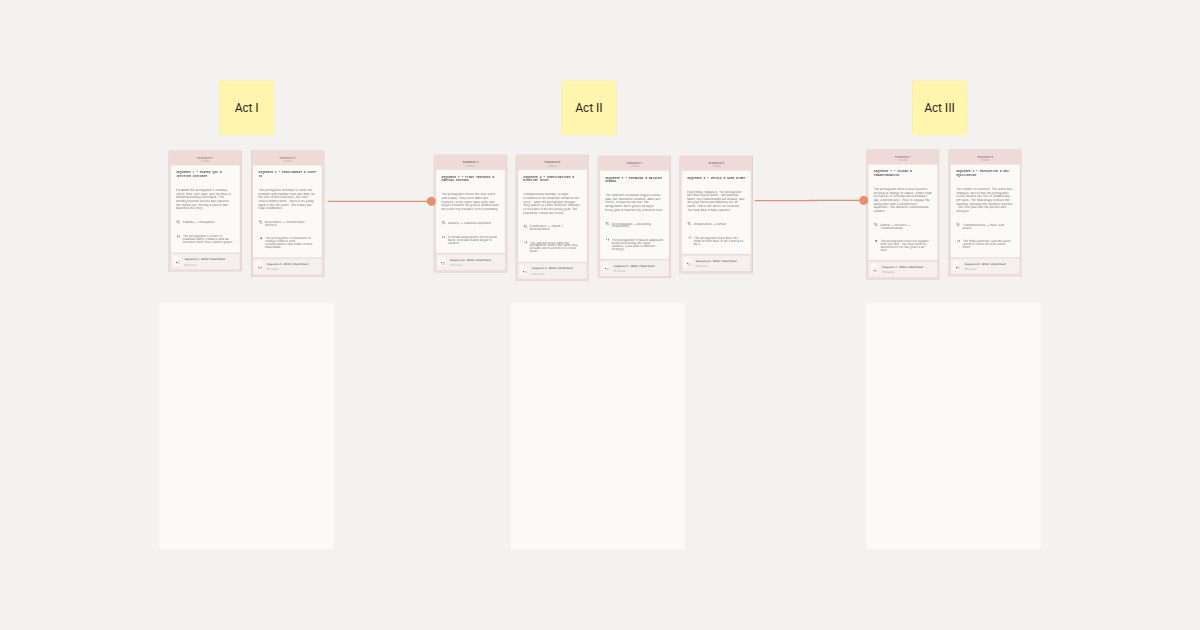
ACT I - THE SETUP
INT./EXT. [OPENING LOCATION] - [DAY/NIGHT]
SEQUENCE 1 - STATUS QUO & INCITING INCIDENT
Purpose: Establish the protagonist's ordinary world, their core want, and the flaw or limitation holding them back. The Inciting Incident arrives and ruptures the status quo, forcing a choice that launches the story.
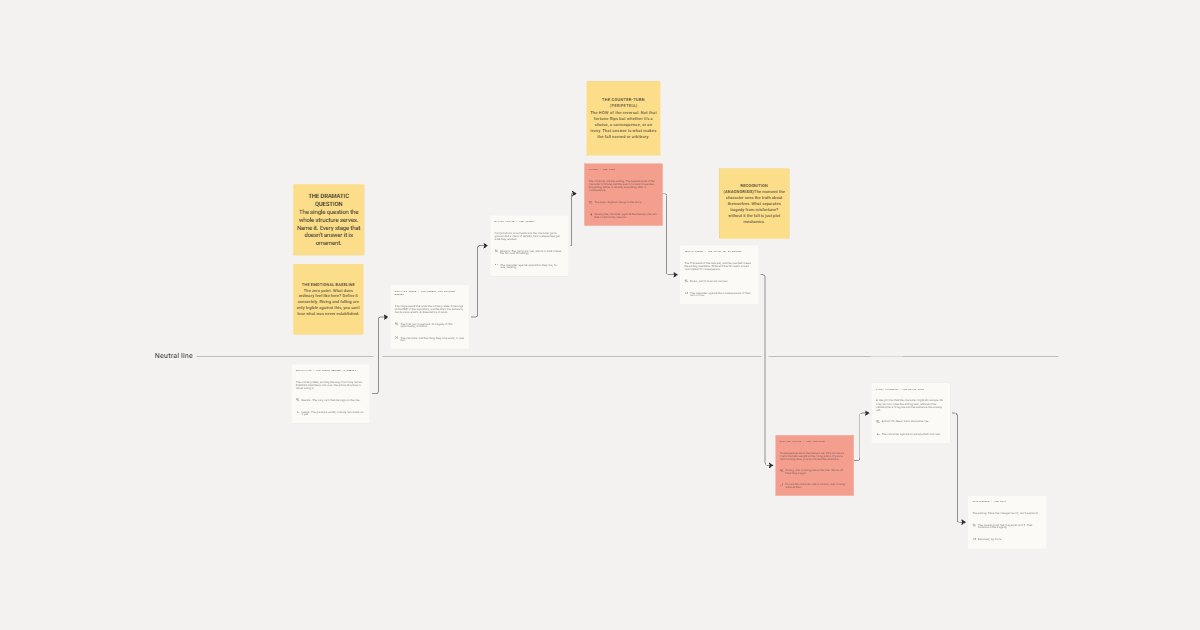
Emotional arc: Stability -> Disruption
Conflict: The protagonist's desire to maintain safety clashes with an intrusive force they cannot ignore.
[Ask yourself: What does the protagonist want before the story forces a want on them? What does their ordinary world cost them by standing still? What is the specific, visible flaw in the opening scenes? What is the Inciting Incident, and why can't it be ignored or postponed? What is the last image of stability before disruption?]
INT./EXT. [LOCATION] - [DAY/NIGHT]
SEQUENCE 2 - PREDICAMENT & LOCK-IN
Purpose: The protagonist attempts to solve the problem with familiar tools and fails. By the end of this sequence, the door closes behind them, there is no going back. The stakes are fully established.
Emotional arc: Reluctance -> Forced commitment
Conflict: The protagonist's resistance to change collides with circumstances that make retreat impossible.
[Ask yourself: What familiar tool does the protagonist try first, and why does it fail here? What is the specific moment the door closes? What are the stakes by the end of this sequence? Is the reluctance rooted in character or just plot convenience? What forces the commitment?]
Act I ends with the protagonist locked into a problem they cannot walk away from. The question is no longer whether they will act, but how.
ACT II - THE CONFRONTATION
INT./EXT. [NEW WORLD LOCATION] - [DAY/NIGHT]
SEQUENCE 3 - FIRST OBSTACLE & PARTIAL SUCCESS
Purpose: The protagonist enters the new world with a plan. They meet allies and enemies, score early wins, and begin to believe the goal is within reach. But each step forward costs something.
Emotional arc: Anxiety -> Cautious optimism
Conflict: External antagonistic forces push back; internal doubts begin to surface.
[Ask yourself: What is the protagonist's plan entering this sequence? What early win do they score, and what does it cost them? Who are the allies and enemies introduced here? Is every step forward generating a new complication? Where does the cautious optimism crack?]
INT./EXT. [LOCATION] - [DAY/NIGHT]
SEQUENCE 4 - COMPLICATIONS & MIDPOINT TWIST
Purpose: Complications multiply. A major revelation at the midpoint reframes the story, what the protagonist thought they wanted is either achieved falsely or revealed to be the wrong goal. The real battle comes into focus.
Emotional arc: Confidence -> Shock/Reorientation
Conflict: The gap between what the protagonist wants and what they actually need widens to a crisis point.
[Ask yourself: What is the midpoint revelation? Is the false achievement or wrong-goal reversal visible to the audience even if not to the protagonist? What assumption does this sequence destroy? What is the real battle the midpoint reveals?]
INT./EXT. [LOCATION] - [DAY/NIGHT]
SEQUENCE 5 - SETBACKS & RAISING STAKES
Purpose: The midpoint revelation triggers a new plan, but obstacles escalate. Allies are tested, resources run low. The antagonistic force grows stronger. Every gain is matched by a heavier loss.
Emotional arc: Determination -> Mounting desperation
Conflict: The protagonist's flawed approach keeps producing the same wounds, even with a different strategy.
[Ask yourself: What is the new plan triggered by the midpoint, and why is it riskier? For every gain, what is the heavier loss that follows? Which ally is tested or broken here? What resources are visibly thinning?]
INT./EXT. [LOCATION] - NIGHT
SEQUENCE 6 - CRISIS & DARK NIGHT
Purpose: Everything collapses. The protagonist hits their lowest point, the plan has failed, key relationships are broken, and the goal seems permanently out of reach. This is the All Is Lost moment. The fatal flaw is fully exposed.
Emotional arc: Desperation -> Defeat
Conflict: The protagonist must face the truth of their flaw or be destroyed by it.
[Ask yourself: What is the specific All Is Lost moment? How is the fatal flaw nakedly exposed here? What must the protagonist face about themselves that they've been avoiding since Sequence 1? Is the defeat external, internal, or both?]
ACT III - THE RESOLUTION
INT./EXT. [FINAL CONFRONTATION LOCATION] - [DAY/NIGHT]
SEQUENCE 7 - CLIMAX & TRANSFORMATION
Purpose: The protagonist finds a new resource, internal or external. They re-engage the antagonist with a transformed approach. The climactic confrontation unfolds.
Emotional arc: Defeat -> Resolve -> Transformation
Conflict: The protagonist must act against their old self, the flaw must be surrendered for the goal to be won.
[Ask yourself: What is the new resource the protagonist discovers, is it genuinely new? What does the protagonist have to surrender to move forward? Is the transformed approach visibly different from Sequence 1? Does the climax require action, or does it allow rescue?]
INT./EXT. [CLOSING LOCATION] - [DAY/NIGHT]
SEQUENCE 8 - RESOLUTION & NEW EQUILIBRIUM
Purpose: The conflict is resolved. The world has changed, and so has the protagonist. Loose threads are tied or deliberately left open. The final image echoes the opening, showing the distance traveled.
Emotional arc: Transformation -> Hard-won peace
Conflict: The final question, was the price worth it? Does the new world hold?
[Ask yourself: What has changed in the world, visibly and concretely? What has changed in the protagonist, shown in behavior not dialogue? Does the final image echo the opening? Was the price worth it?]
END OF TEMPLATE. Replace every bracketed placeholder above, delete the "Ask yourself" prompts once used, and let the story diverge from this shape wherever it needs to.