Skrib

Fichtean Curve Template: Plot Rising Crises For Screenplay

Start in the middle and never let go. Map your rising crises with Skrib's free Fichtean Curve template - built for thrillers, mysteries, and short fiction.

Skrib team29 elements60383
This template includes both a Plan and a Draft
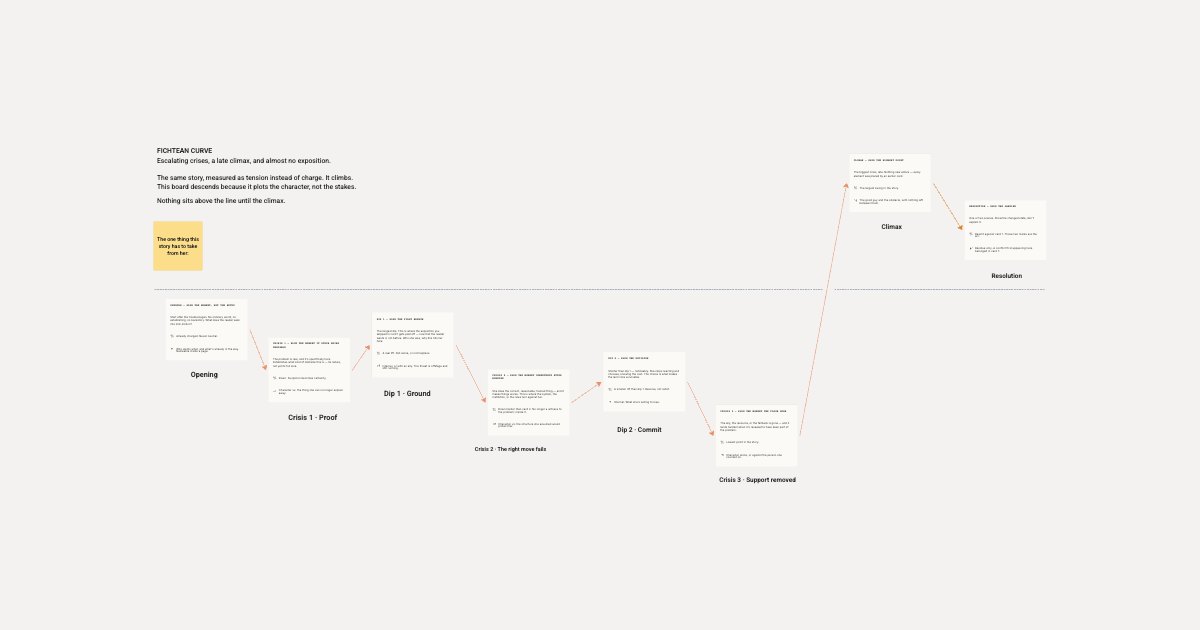
INT./EXT. [OPENING - SLUG THE MOMENT, NOT THE SETUP] - DAY
[OPENING BEAT: Start after the trouble began. No ordinary world, no establishing, no backstory. What does the reader walk into mid-motion? Emotional change: already charged, never neutral. Conflict: who wants what, and what's already in the way, nameable inside a page.]
INT./EXT. [DIP 1 - SLUG THE FIRST BREATH] - DAY
[DIP 1 BEAT: The longest dip. This is where the exposition you skipped in the opening gets paid off, now that the reader wants it, not before. Who she was, why this hits her here. Emotional change: a real lift, not alone or not helpless. Conflict: internal, or with an ally. The threat is offstage and still running.]
INT./EXT. [DIP 2 - SLUG THE DECISION] - DAY
[DIP 2 BEAT: Shorter than dip 1, noticeably. She stops reacting and chooses, knowing the cost. The choice is what makes the last crisis survivable. Emotional change: a smaller lift than dip 1, resolve not relief. Conflict: internal. What she's willing to lose.]
INT./EXT. [CRISIS 1 - SLUG THE MOMENT IT STOPS BEING DENIABLE] - DAY
[CRISIS 1 BEAT: The problem is real, and it's specifically hers. Establishes what kind of obstacle this is, its nature, not yet its full size. Emotional change: down, suspicion becomes certainty. Conflict: character vs. the thing she can no longer explain away.]
INT./EXT. [CRISIS 2 - SLUG THE MOMENT COMPETENCE STOPS WORKING] - DAY
[CRISIS 2 BEAT: She does the correct, reasonable, trained thing, and it makes things worse. This is where the system, the institution, or the rules turn against her. Emotional change: down harder than crisis 1, no longer a witness to the problem, inside it. Conflict: character vs. the structure she assumed would protect her.]
INT./EXT. [CRISIS 3 - SLUG THE MOMENT THE FLOOR GOES] - DAY
[CRISIS 3 BEAT: The ally, the resource, or the fallback is gone, and it lands hardest when it's revealed to have been part of the problem. Emotional change: lowest point in the story. Conflict: character alone, or against the person she counted on.]
INT./EXT. [CLIMAX - SLUG THE HIGHEST POINT] - DAY
[CLIMAX BEAT: The biggest crisis, late. Nothing new enters, every element was placed by an earlier beat. Emotional change: the largest swing in the story. Conflict: the good guy and the obstacle, with nothing left between them.]
INT./EXT. [RESOLUTION - SLUG THE LANDING] - DAY
[RESOLUTION BEAT: One or two scenes. Show the changed state, don't explain it. Emotional change: read it against the opening, those two marks are the arc. Conflict: residue only. A conflict first appearing here belonged in crisis 3.]
Fichtean Curve Template: Plot Rising Crises For Screenplay template

Fichtean Curve Template

For stories that can’t afford a slow start

The Fichtean Curve throws out the gentle setup. It opens in motion, then drives the protagonist through a series of escalating crises - each one raising the stakes - until the climax and a short, sharp falling action.

It’s the structure behind most thrillers, mysteries, horror, and short fiction: the shape you use when a reader will not give you thirty pages of patience.

How the Fichtean Curve works

Exposition, threaded not front-loaded. Backstory arrives in motion, while something is already happening.

Rising action through crisis. Typically six to eight escalating crises, each with a cost. The protagonist doesn’t just face problems - they lose something to each one.

The climax. The largest crisis, the one everything before it has been sharpening.

Falling action. Brief. The curve drops fast and stops.

The discipline is in the escalation: no crisis may be smaller than the one before it. That’s exactly the thing that’s hard to check in a linear document, and easy to see on a canvas.

Why map the curve visually?

See the escalation. Lay your crises out in order and spot instantly where tension flattens or dips.

Track stakes and cost. Note what each crisis takes from your protagonist, and make sure the losses compound.

Keep the pressure honest. Colour-code intensity across the curve so pacing is something you can look at, not just hope for.

Thread the exposition. Pin backstory and world detail to the crises where they’ll be revealed, instead of stacking them in chapter one.

Draft in the same place. Move from your curve to the manuscript in one click and keep every revision in your Library.

Who is the Fichtean Curve template for?

Thriller and mystery writers who need momentum from the first line.

Horror writers building dread through escalating incident.

Short story writers working in a form with no room for a slow setup.

Serial authors who need every installment to end on pressure.

Novelists whose beta readers keep saying it takes a while to get going.

Start on the curve

Open Fichtean Curve Template: Plot Rising Crises For Screenplay in your own studio

Free to start. Rename it, cut it, build on it — it is yours from the first click.

More templates

Book Writing for Novelists board previewPlanDraft
Writing process

Book Writing for Novelists

Plan, draft and keep every version of your book in one studio. Book writing built for long work, not office memos. Free to start, no credit card.

Skrib team · 96 elements19988
Story Outline & Research Template for Writers board previewPlanDraft
Writing process

Story Outline & Research Template for Writers

Keep your outline, characters, and sources on one page. Skrib's free story outline and research template holds the whole book - and the draft sits beside it.

Skrib team · 5 elements2.1k350