Google Docs, Final Draft, Celtx: Where Screenwriting Tools Stop Working
An honest look at Google Docs, Final Draft, Celtx and Notion for screenwriters, plus what a shooting script is, revision colors and how scene numbering works.
Google Docs, Final Draft, Celtx: Where Screenwriting Tools Stop Working
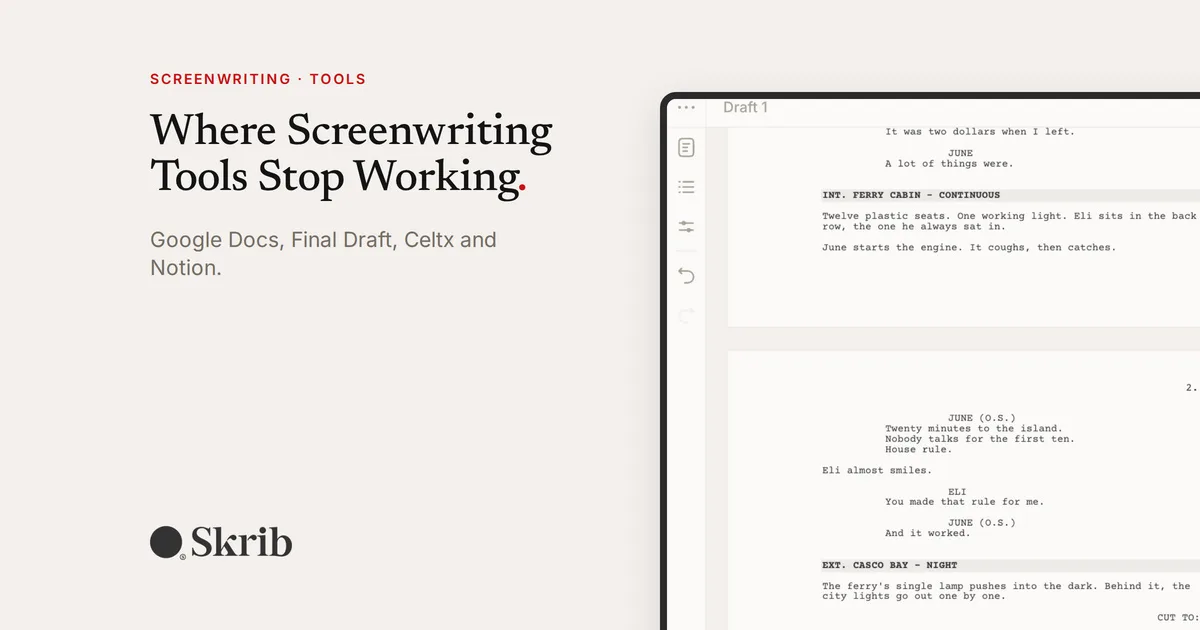
Every screenwriting tool is good at something. Most stop working somewhere between the beat board and the final draft. This is a fair look at the common options, plus the production terms you'll meet once a script moves toward shooting. We wrote our examples in Skrib.
Google Docs
Good at: free, easy sharing and comments. Stops working: screenplay format has to be faked with styles or add-ons, and there's nowhere to plan beats.
Final Draft
Good at: the long-time industry standard, production features. Stops working: it's paid desktop software, and planning tools are limited next to the script.
Celtx
Good at: pre-production tools like breakdowns and scheduling. Stops working: many features sit on paid plans, and the writing experience is only one part of the product.
Notion
Good at: notes, databases and research. Stops working: it doesn't format screenplays.

Do it in Skrib: a Screenplay project formats the script for you, and the board sits beside it in split screen.
Spec script vs shooting script
A spec script is written to sell and to read well: no scene numbers, few camera directions. A shooting script is the version used in production: scenes are numbered, and it's locked so pages can be tracked.
How scene numbering works
In a shooting script, each scene gets a number on both sides of the scene heading. When a scene is added after locking, it gets a letter, like 12A, so the other numbers don't change.
Revision colors
After a script is locked, changed pages are printed on colored paper so everyone knows which version they hold. A common sequence starts white, then blue, pink, yellow and green. Productions can vary it.
Adapting a book into a screenplay
Secure the rights first. Then cut hard: a novel's subplots rarely fit into 110 pages. Find the spine of the story and externalise the inner life.

Try one studio for the whole script
Copy the free Script Board: plan on the board, write the script beside it. It is free to start.
New to Skrib? Create your account.