How to Write a Short Story: Plan It on One Page in 6 Steps
How to write a short story in 6 steps: one moment, one character, rising crises and an ending that lands. A full short story planned on one Skrib board, free template.
How to Write a Short Story: Plan It on One Page in 6 Steps
A short story has no room for a slow start, three subplots or a cast of twelve. It has room for one character, one problem and a few moments that keep getting worse. That is why the best way to plan one is on a single page.
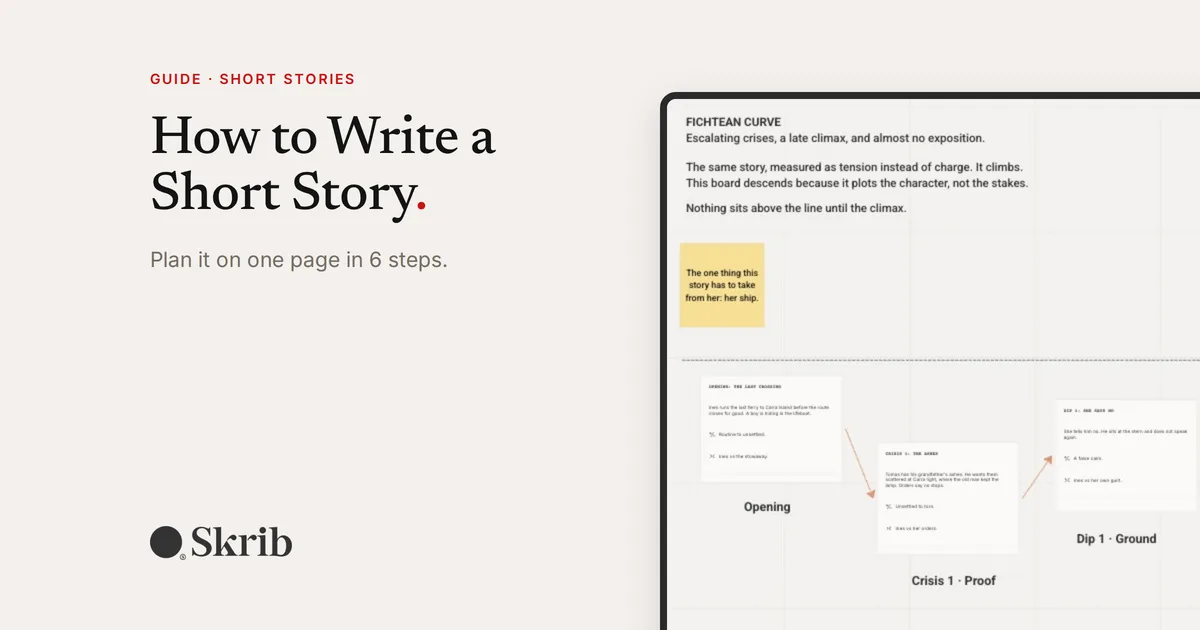
This guide shows you how to write a short story in six steps. We planned a complete story, The Last Ferry, on the free Fichtean Curve board in Skrib, and every step below shows the real board.

Step 1: Start with one moment
A short story is usually about one moment of change. The Last Ferry: Ines runs the last ferry to Carra Island on the night the route closes for good, and finds a boy hiding in the lifeboat. Write your story in one sentence like that before you write anything else.
Step 2: Keep the cast tiny
Two or three characters is plenty. Ines, the boy Tomas, and the storm. Every extra name costs words you don't have.
Step 3: Start as late as you can
Skip the backstory. The Fichtean Curve starts almost straight into the first crisis, and fills in the past as the story moves.

Do it in Skrib: each crisis is a scene card with a value change and a conflict line. If a card doesn't change the value, cut it.
Step 4: Build rising crises
Plan three crises, each harder than the last, with a short dip after each. In our story Ines says no, the night route fails, and then the last thing she could rely on is taken away. The board literally climbs, so you can see whether tension keeps rising.
Step 5: Land the climax and a short ending
The climax is the character's biggest choice. Ines and Tomas row the tender to the rocks and he scatters the ashes from the lamp room. The resolution is short: at dawn a rescue boat arrives, Ines loses her licence, and she keeps the lamp room key Tomas gives her.

Step 6: Draft it in one sitting
With the plan on one page, write the first draft fast, ideally in one sitting. Then cut ten percent.
Do it in Skrib: open your draft beside the board in the same tab, so the next crisis is always in view while you write.
Short story mistakes to avoid
- Too much setup. If the first crisis arrives after page three, start later.
- A twist with no setup. The ending should feel surprising and inevitable.
- An ending that explains itself. Stop one line earlier than feels safe.
FAQ
How long is a short story? Usually 1,000 to 7,500 words. Flash fiction is under 1,000.
What structure is best for a short story? The Fichtean Curve works well because it starts in the action and keeps tension rising.
Plan your short story in Skrib
Copy the board, write your one sentence, and fill in three crises tonight. Your plan and your draft sit side by side, and it is free to start.
New to Skrib? Create your free account in under a minute.