World Bibles for Game Studios: Documenting Lore at Scale
Structure a world bible for lookup, not narrative: canon tiers, the trust problem, building from questions, terminology, governance and onboarding writers.
Search for how to build a world bible and you’ll be handed a list of sections. Geography, history, factions, magic system, cosmology. Fill them in, and you’ll have a document.
You’ll also have something almost nobody at your studio will use, and the reason has nothing to do with what’s in it.
Nobody reads a world bible. People query it.
An artist needs to know whether this faction uses iron or bronze. A QA tester needs to know if a spelling is a bug. A localisation lead needs to know whether a term is a proper noun. None of them are reading - they’re looking something up, under deadline, and they will give up after about thirty seconds and ask in chat instead.
Which means a world bible is not a document. It’s a reference system, and it’s judged on retrieval rather than completeness. A scrappy thirty-page bible that answers questions fast beats a beautiful three-hundred-page one that doesn’t.
The wider discipline is covered in our video game writer’s handbook.
What is a world bible?
A world bible is the authoritative reference for a game’s setting - its rules, history, geography, factions, terminology and canon - maintained so that everyone building the game makes consistent decisions about it. It’s a working system rather than a creative document: it’s queried during production, updated as decisions are made, and expected to outlive any individual on the project.
World bible, character bible, story bible
Three documents, constantly conflated, doing different jobs.
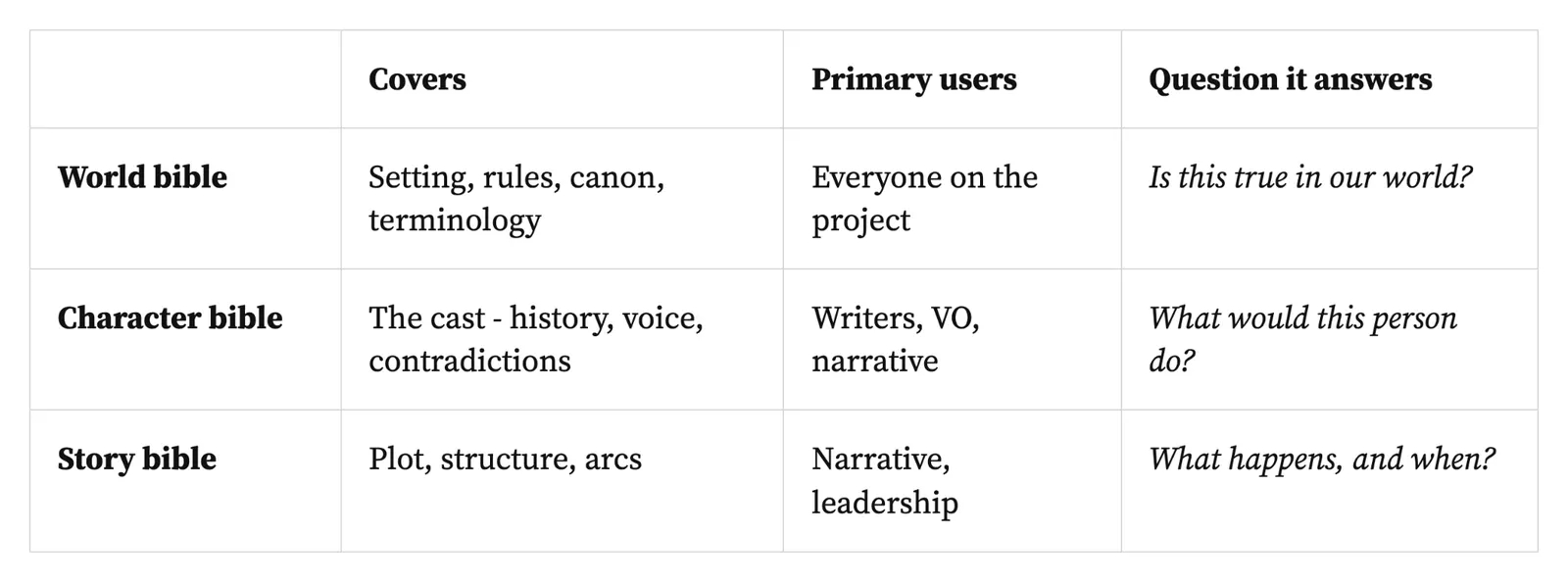
The character bible is a separate discipline with different rules, because it exists to generate behaviour rather than to settle disputes - our character bible template covers that side, and the two documents should link to each other rather than duplicate.
In practice studios often merge all three, which works at small scale and becomes unusable past a certain size - mostly because the three have completely different update rhythms.
Structure for lookup, not for narrative
The most common structural error is organising a world bible the way you’d tell its story.
Chronological history is the worst possible organisation for a document people query by entity. Nobody arrives asking “what happened in the third age.” They arrive asking “what is this faction called and who do they hate.”
Organise by the thing being asked about:
Entity-first. One entry per faction, place, species, technology, event. Named, findable, self-contained.
Self-contained entries. Each should answer its question without requiring three others to be read first.
Cross-references, not nesting. Link between entries rather than burying one inside another.
A timeline as a view, not as the structure. History is genuinely useful - as an index that points at entries, not as the container for them.
The test: pick five questions a colleague plausibly asked last week. Time how long it takes to answer each from the bible. If any takes more than a minute, the structure is wrong regardless of the content.
Canon has tiers
Most bibles record facts without recording their authority, which is why teams argue about things the bible technically covers.
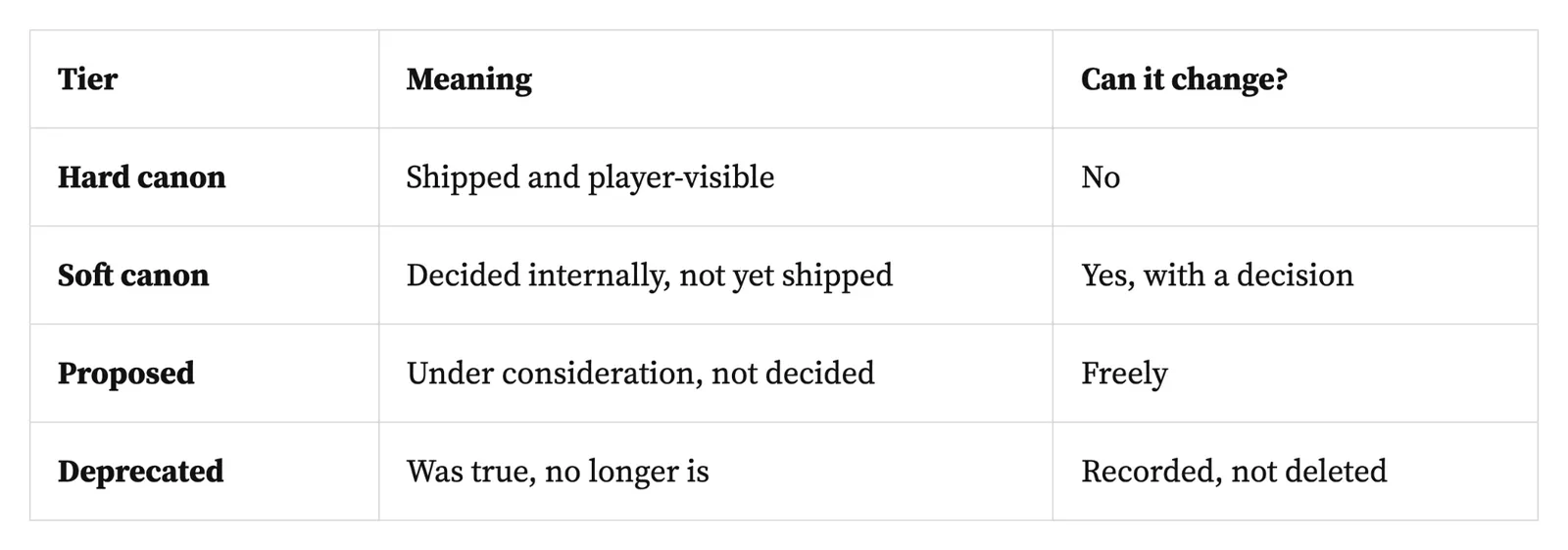
Marking tiers costs almost nothing and prevents a specific recurring argument - the one where somebody builds on a fact that was never actually decided.
Deprecated entries must be kept, not deleted. This is the rule teams break most often and regret most reliably. When a piece of lore is cut, deleting it means somebody re-proposes the same idea in eighteen months, unaware it was killed for a reason. Keep the entry, mark it dead, and record why.
The trust problem
The failure mode that kills world bibles isn’t incompleteness. It’s a single confident wrong answer.
A bible that is wrong once loses its authority permanently. Somebody checks it, builds on what it said, discovers it was stale, and thereafter asks a person instead. Once enough people do that, canon lives in individual heads and chat threads, which is exactly the condition the bible existed to prevent.
Three habits protect trust:
Date every entry. An undated fact is unverifiable. A reader who can see something was confirmed last month treats it differently from one last touched two years ago.
Record the source of the decision. Who decided, and where - a meeting, a director’s note, a shipped build. This turns disputes into lookups.
Flag uncertainty explicitly. An entry that says a question is open is more useful than one that guesses. Guessing is what destroys trust.
Build it from questions, not from a plan
The practical alternative to filling in a template of sections.
Start with what’s decided and what’s been asked. A world bible assembled in advance documents guesses; one assembled from real decisions documents facts.
The rule that works: if two people have asked the same question, it belongs in the bible. That single heuristic produces a document shaped by what the team actually needs rather than by what seemed important at the outset - and it means the bible grows fastest in exactly the areas causing the most friction.
Keep a running open-questions list. Things nobody has decided, visible, so they get decided deliberately rather than by whoever ships first.
The structure
A working shape. Adapt freely - the section list matters less than the retrieval principle above.
WORLD BIBLE - [Project]
Last reviewed: [date] · Canon owner: [name]
00 PRIMER One page. What this world is, in five minutes.
01 PILLARS Tone, themes, what this world is and isn't.
02 RULES What is possible here. Physics, magic, tech limits.
03 TERMINOLOGY Spelling, capitalisation, approved terms, banned terms.
04 PLACES One entry per location. Entity-first.
05 PEOPLES Cultures, species, factions. Relationships between them.
06 ORGANISATIONS Who holds power, and how.
07 TIMELINE An index pointing to entries, not a narrative.
08 SYSTEMS Magic, technology, economy - how they work and their limits.
09 NAMING Conventions per culture. How to invent a name that fits.
10 OPEN QUESTIONS Undecided, with owner and deadline where known.
11 DEPRECATED Killed lore, with the reason it was killed.
ENTRY FORMAT
Name · Tier [hard/soft/proposed/deprecated] · Last confirmed [date]
Source of decision:
Summary (2–3 lines, answers the common question):
Detail:
Related entries:
Player-visible? [yes/no - and where]
The player-visible field is worth the extra line. It’s the difference between something you can change and something already in front of an audience, and it’s the first thing anyone proposing a retcon needs to know.
The terminology section does the most work
The least glamorous part of a world bible and by a wide margin the most used.
Most queries are about words, not lore. Is it one word or two? Capitalised? Is this the current name or the one we changed? Do we say the Concord or Concord?
Artists, UI designers, QA, marketing and localisation all hit this constantly, and getting it wrong produces visible inconsistency in shipped product.
What the section needs:
Approved spelling and capitalisation for every proper noun
Deprecated terms, with their replacements - so QA can flag old ones as bugs
Plurals and possessives, which are where invented names break
Pronunciation, for anything going to VO
Banned terms - words that don’t exist in this world, or that carry unintended meaning
This section is also your localisation contract. Translators need to know what’s a proper noun, what’s translatable, and what must stay in English. Getting that documented early prevents a category of expensive late-stage rework - Localization-Friendly Writing: Formatting Game Scripts for Translation covers the rest.
Governance: someone decides
A world bible without an owner becomes a wiki of contradictions.
Name a canon owner. One person with final say on what’s true. Not a committee - committees produce entries that hedge.
Define how a change gets made. Who can propose, who approves, where it’s recorded. A change process that takes a week means people route around it.
Give people a place to ask. Most canon questions aren’t disputes; they’re gaps. A visible queue for questions is what feeds the open-questions list and, eventually, the bible.
Review on a cycle. Quarterly is enough for most projects. The purpose isn’t to add - it’s to re-confirm dates and catch entries that quietly went stale.
Where canon decisions collide with what systems can actually support, that’s a cross-discipline negotiation - Working with Game Designers: Aligning Story Beats with Mechanical Systems covers it.
Onboarding a new writer
A four-hundred-page bible with no entry point is unusable, and games hire mid-project constantly.
Write a one-page primer and keep it current. What this world is, its five defining rules, its tone, and the three things newcomers most commonly get wrong. That page does more for a new hire than the other three hundred and ninety-nine.
Then a reading path - five entries in order, not the whole document.
Then the reference, which they’ll query rather than read, as everyone does.
For live-service projects this compounds: teams rotate across years and every new writer inherits canon written by people who left. Writing for MMOs and Live-Service Games covers the specific problems of narrative that never ends.
Tooling, honestly
Most studios use a wiki - Confluence, Notion, an internal tool - and the choice matters less than three habits.
Search has to work. If your search is bad, your bible is bad, regardless of content.
One source of truth. The most common real-world failure is three partial bibles: a wiki, a design doc, and a folder of Word files. Pick one and make the others point at it.
Ownership of the tool. Somebody has to maintain structure, or entity-first organisation degrades into whatever people happened to create.
Where world bibles fail
Organised as narrative. Chronological, unsearchable.
Undated. Nobody knows what’s still true.
No canon tiers. Teams build on undecided facts.
Deprecated lore deleted. Dead ideas get re-proposed.
Built in advance. Documents guesses rather than decisions.
No owner. Contradictions accumulate with nobody empowered to resolve them.
Wrong once. Trust gone, canon returns to chat threads.
Terminology section missing - the part most people needed.
No entry point. New hires can’t get in.
Keeping canon one search from the page
The retrieval problem is the whole problem. A bible lives in a wiki, the writing happens somewhere else, and the cost of checking a fact is a context switch - which is why people stop checking and start guessing, and why canon drifts even when the documentation is good.
Skrib narrows that gap. The Library keeps every project, draft and imported file searchable in one place, so confirming a term or a faction detail is a search rather than a tab change. The Plan takes file uploads alongside documents on an unbounded surface, so entity relationships, maps and reference art sit together and the connections between entries are visible rather than implied. Reference material and tables move in and out as .csv, .xlsx, .docx and .md, so nothing is trapped.
Being clear about scope: Skrib isn’t a wiki platform, and it doesn’t replace Confluence or an internal canon tool with permissions, approval workflows and studio-wide access. It’s where a writer keeps the world and the pages adjacent while working. You can start free.
Frequently asked questions
What is a world bible? The authoritative reference for a game’s setting - rules, history, factions, terminology and canon - maintained so everyone building the game makes consistent decisions. It’s queried during production rather than read, and it’s expected to outlast any individual on the project.
What’s the difference between a world bible and a character bible? A world bible settles questions about the setting and is used by the whole team. A character bible generates behaviour for the cast and is used mainly by writers and VO. They serve different questions, have different update rhythms, and work best as linked documents rather than one merged file.
How do you organise a world bible? By entity rather than by chronology. People query it for a specific faction, place or term, so self-contained entries with cross-references retrieve far faster than a narrative history. A timeline is useful as an index pointing at entries, not as the structure containing them.
How much should a world bible contain? Only what’s decided and what’s been asked about. A useful rule: if two people have asked the same question, it belongs in the bible. Documents built in advance record guesses; documents built from real questions record facts.
Should you delete lore you’ve cut? No - mark it deprecated and record why it was cut. Deleting it means somebody re-proposes the same idea in a year or two without knowing it was already rejected, which is one of the more avoidable ways contradictions get reintroduced.
Who owns the world bible? One named person with final say. Committees produce hedged entries and unresolved contradictions. The owner doesn’t have to write everything, but somebody has to be able to decide what’s true and keep the structure from degrading.