Writing for MMOs and Live-Service Games | Skrib
Live-service narrative has no resolution. What replaces it, the two clocks, the new-player problem, seasonal structure, and retcon and continuity at scale.
Every narrative form you’ve trained on has an ending. It’s where meaning gets assigned - the arc completes, the theme resolves, the audience is released.
A live game has no ending, and it isn’t allowed to want one. The commercial requirement is that players never leave, which means the story can never conclude, which means it can never do the thing stories do.
That’s the constraint. Everything difficult about the discipline comes out of it, and most of the failures come from writers treating a live game like a very long single-player game.
It isn’t one. It’s a serial - and serials solved this problem a century before games existed.
For the discipline generally, see our video game writer’s handbook.
What is live-service narrative?
Live-service narrative is story content delivered on an ongoing release cadence to a persistent game world - seasons, expansions, events and updates - written by rotating teams across years, for a player base that joins at different times and misses most of it. The defining constraint is that it must satisfy repeatedly without ever resolving.
What replaces resolution
If you can’t spend the ending, satisfaction has to come from somewhere else. Four sources, and strong live games use all of them.
Local resolution. A season completes even though the story doesn’t. This is the workhorse - the same principle as a television season inside a running series.
Recurrence. The pleasure of return. Familiar characters, seasonal rhythms, an event that comes back annually. Recurrence is a genuine narrative pleasure and it’s unavailable to finished games.
Accumulation. The player’s own history in the world - where they were when something happened, what they own from a season that will never return. Their record becomes part of the text.
Participation. Being present for a live moment that can’t be replayed. The strongest thing the format can do, and the most expensive.
The practical instruction: every content drop needs to close something. Not the story - something. A question answered, a character’s situation changed, a thread finished. Drops that only open threads accumulate debt, and players feel it as a story going nowhere.
The forms that solved this first
Soap operas have run continuity for decades. Superhero comics have managed characters across eighty years and hundreds of writers. Both faced exactly this problem, and their solutions transfer directly.
The status quo is a resource, not a constraint. It can be disturbed and restored, repeatedly, and the disturbance is the story. A live game that treats its baseline state as something to be permanently escaped runs out of world.
The illusion of change. Comics’ term for it: things appear to change dramatically, and the underlying configuration returns. Cynical when done lazily and genuinely useful when done with craft - the change is real within the arc, and the reset is earned rather than ignored.
Rotating focus. Not every arc belongs to the same character. Foregrounding different figures across seasons lets each rest and return without anyone stagnating.
The soft reset. Periodic jumping-on points - a new chapter, a new era, a deliberate line under what came before. Games that do this well use it to solve the onboarding problem below, rather than treating it as an admission of failure.
Characters cycle rather than arc. This is the hardest adjustment. A character who completes a transformative arc is finished; a character who moves through recurring configurations can run for years. Our guide to character growth across episodes and series covers why change nests at different scales, and live games operate almost entirely at the lower tiers.
What replaces resolution, at a glance
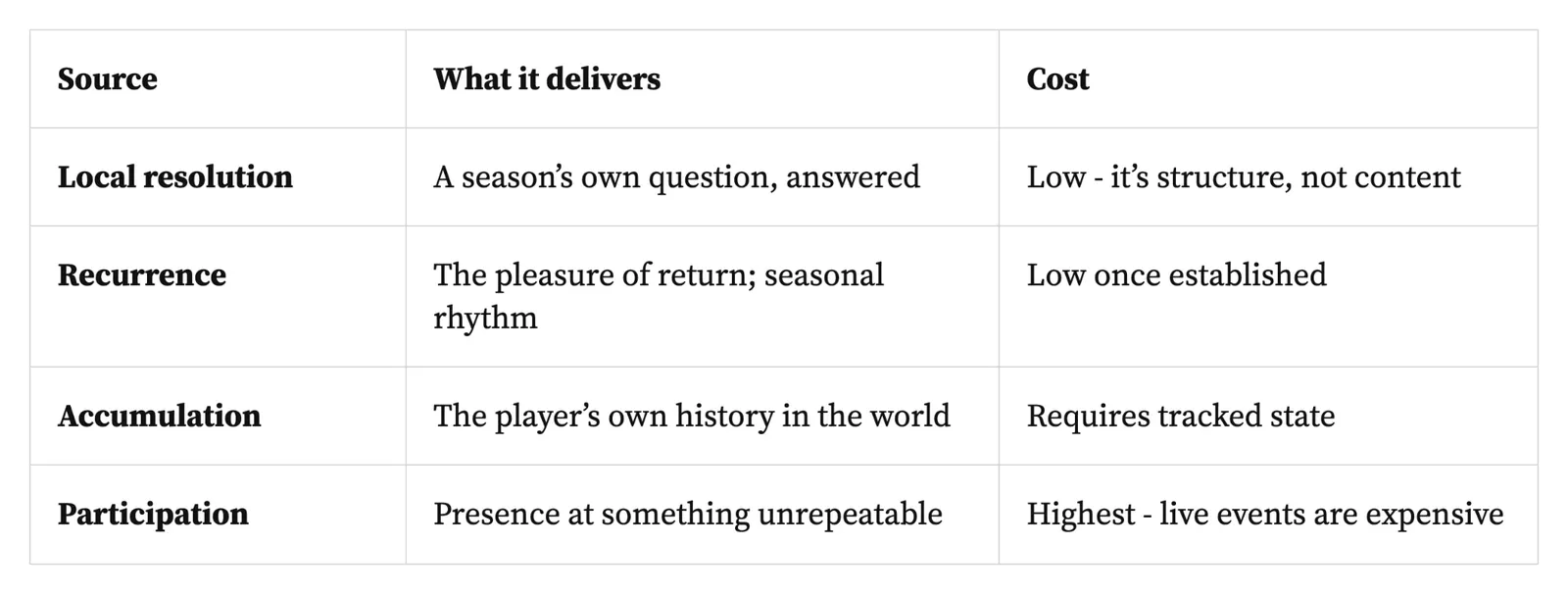
Every content drop should draw on at least two. Drops relying on participation alone are unaffordable at cadence; drops relying on local resolution alone become episodic and forgettable.
The two clocks
Live narrative runs on two timelines that must be reconciled, and confusion between them causes a specific class of continuity mess.
Story time is chronology inside the fiction. Real time is the release calendar.
Questions every live project has to answer explicitly:
Does time pass in the fiction between seasons, and how much?
Are seasons sequential in-fiction, or concurrent?
Where is a player who hasn’t done last season’s content, in story time?
Do seasonal events recur in-fiction, or is the annual festival always the same one?
Most continuity disasters in live games trace back to never deciding this. A world where three seasons happened simultaneously, or where six years of real-world content occupies an in-fiction fortnight, will contradict itself eventually - usually in a way players document before the studio notices.
The safest default is loose coupling: time passes, but vaguely, and no content depends on precise intervals.
The new-player problem
The defining structural challenge, and it gets worse every season by construction.
A player joining in year four faces four years of accumulated story, most of which they can’t play, some of which no longer exists. Meanwhile the current content assumes a history they don’t have.
Four workable responses, usually combined:
Decouple the entry point. Current content is written to be comprehensible without prior seasons. Costly in nuance, essential in practice.
Provide catch-up. A recap, a compressed replay, a story journal. Cheap and better than nothing.
Use soft resets. A chapter break that establishes a new jumping-on point with a legitimate in-fiction reason.
Separate the evergreen from the seasonal. A permanent story spine anyone can play, with seasonal content layered on it.
What doesn’t work is assuming players will read a wiki. Some will. Most will bounce, and the ones who bounce were the growth.
Onboarding into the game is a related but distinct problem - Writing Playable Prologues and Tutorials covers that side.
What can’t be permanent
Live narrative is constrained by asset economics in a way single-player writing isn’t, and writers who don’t internalise this propose beats that get cut.
Killing a character is expensive. Assets exist, a voice actor is contracted, and a substantial share of the player base never met them. The death lands for veterans and reads as nothing for everyone else.
Destroying a location is expensive. A city that burns needs a burned version built, and every quest set there needs revisiting.
Permanent world change is the most expensive thing you can write. It fragments the player experience - those who saw the before and those who didn’t are now playing different games.
Time-limited content is the format’s specific loss. A story beat that ran for six weeks and is gone exists in no other medium. Removing shipped story to manage build size is a real practice and a real cost, and players who joined afterwards experience a narrative with holes in it.
The writer’s response: propose permanence sparingly, and when you do, make sure it’s carrying something worth the price.
Seasonal structure
A season is a television season with a shop attached, and the shape is similar.
The hook. Establishes the season’s question in the first week, when engagement peaks.
The escalation. Weekly beats that develop rather than repeat.
The midpoint turn. Something changes; the question is not the one you started with.
The payoff. Local resolution - the season’s question answered.
The hand-off. One thread opened, deliberately, pointing at the next.
Two things to get right.
The hand-off has to be an opening, not a cliffhanger. Cliffhangers make players feel the season was incomplete rather than continuous. An opening - a new element introduced, an implication - does the same job without withdrawing satisfaction.
Weekly beats must develop. The most common live-content failure is a season where weeks two through six are the same beat with different objectives. Quest structure carries most of that weight - quest design and narrative covers making individual units earn their place.
Write for the player who missed everything
A discipline worth stating as a rule, because it’s counterintuitive for anyone from linear media.
Most players missed most of your content. Not because they lapsed - because they joined late, played different modes, or skipped a season.
Which means present content cannot require past content for comprehension. It can reward it - a returning character, a callback, a payoff for someone who was there. But if a new player can’t follow this season without having played the last three, the writing has excluded most of its audience.
The technique that solves this is layering. The surface reading works for everyone; the second reading rewards history. That’s the same structure as a long-running comic that has to work for someone who picked up this issue.
In dialogue specifically: avoid unexplained references to prior events. A single clause of context - who this person is, what happened last time - is nearly free and rescues the scene for the majority who need it.
Retcon and continuity at scale
You will be wrong in shipped content. The question is what to do about it.
Four responses, in order of cost:
Stop referencing it. Quiet, common, and works for minor inconsistencies nobody has built on.
Reframe it. The fact stands; its meaning changes. The cheapest genuine fix.
Explain it in-fiction. An unreliable source, a deception, an incomplete record. Elegant when set up and transparent when reached for repeatedly.
Retcon explicitly. Say it’s different now. Expensive in trust and sometimes correct - a contradiction left standing costs more than an acknowledged change.
Players document everything. Wikis catalogue live-game canon exhaustively and faster than studios track it internally, which means silent contradictions are found. Assume they will be.
The defence is documentation. Live projects run for years across rotating teams, and canon that lives in individual heads leaves when they do - World Bibles for Game Studios: Documenting Lore at Scale covers how to build a reference that survives turnover.
Where live narrative fails
Only opening threads. Debt accumulating, nothing closing.
Treating it as a long single-player game. Arcs that complete and leave characters finished.
Undecided clocks. Story time and real time never reconciled.
Onboarding ignored. Year-four players locked out by year-one assumptions.
Cliffhanger seasons. Withdrawal of satisfaction mistaken for anticipation.
Repeating weeks. Content cadence met, development absent.
Permanent change casually proposed. Costed at a cutscene, priced at a rebuild.
Canon in people’s heads. Contradictions arriving with every team change.
Holding years of canon while writing this week’s drop
Live narrative has a documentation problem that finished games don’t: the thing you’re writing this week has to be consistent with six years of shipped content, some of which was written by people who left, some of which has been removed from the game, and all of which players remember better than you do.
Skrib helps by keeping that history one search away. The Library keeps every project, draft and imported file searchable, which is how you check what a character actually said in a season that shipped three years ago. The Plan is where season maps, open threads and the two clocks sit as cards beside the drop you’re drafting - so a thread opened in season nine is visible while you write season fourteen. Tables and string lists move in and out as .csv and .xlsx.
Scope note: Skrib isn’t a live-ops tool or a studio wiki. It has no approval workflows, no permissions model and no engine connection. It’s the writer’s layer, not the canon system of record. You can start free.
Frequently asked questions
How is writing for a live-service game different? The story can never end, so it can never resolve in the way finished narratives do. Satisfaction has to come from local closure within seasons, recurrence, the player’s accumulated history, and participation in live moments instead.
How do you handle new players joining years into a live game? By decoupling current content from prior seasons so it’s comprehensible alone, providing catch-up material, using periodic soft resets as jumping-on points, and separating an evergreen story spine from seasonal layers. Assuming players will read a wiki is not a strategy.
Can characters have arcs in a live-service game? Small ones, repeatedly. A character who completes a transformative arc is finished, which is a problem when the game continues for another five years. Live characters tend to cycle through configurations rather than resolving, with the focus rotating between them so each can rest and return.
How do you deal with continuity errors in a shipped live game? Options run from quietly ceasing to reference something, through reframing its meaning, to explaining it in-fiction or retconning it explicitly. Players document live-game canon exhaustively, so silent contradictions are found - an acknowledged change usually costs less trust than a standing contradiction.
Should a season end on a cliffhanger? Generally not. Cliffhangers make a season feel incomplete rather than continuous. Closing the season’s own question and then opening a new element works better - it delivers satisfaction and continuity at the same time.
Why is permanent change rare in live games? Cost and fragmentation. Destroying a location means building its ruined version and revisiting everything set there, and killing a character means most of the player base loses someone they never met. Permanent change also splits the audience into those who saw the before and those who didn’t.