Screenplay Treatment: How to Write a Film Treatment, With an Example
What a screenplay treatment is, what goes in one, and a film treatment example for a real short script. Plus where beat sheets and step outlines fit.
Screenplay Treatment: How to Write a Film Treatment, With an Example
A screenplay treatment tells your film as a short story, in prose, before the script exists. Producers ask for a film treatment when they want to judge the story without reading 100 pages. This guide shows what goes in one, a full film treatment example for our short script Last Ferry, and where beat sheets and step outlines fit. Every step is planned in Skrib.

What is a screenplay treatment?
A treatment is a prose summary of the whole film, in present tense, usually 2 to 5 pages for a feature and one page for a short. It includes the title, the logline, the main characters and every major turn of the story, including the ending. It does not include dialogue, camera directions or scene headings.
What goes in a film treatment
- Title and logline. One sentence that sells the story.
- The main characters. Name them in capitals the first time, with age and one line of who they are.
- The story, act by act. The setup, the turns in the middle and the climax, in the order the audience sees them.
- The ending. Always. A treatment that hides the ending is a pitch, not a treatment.
- Tone. Write it so it reads like the film feels: tense, funny or quiet.
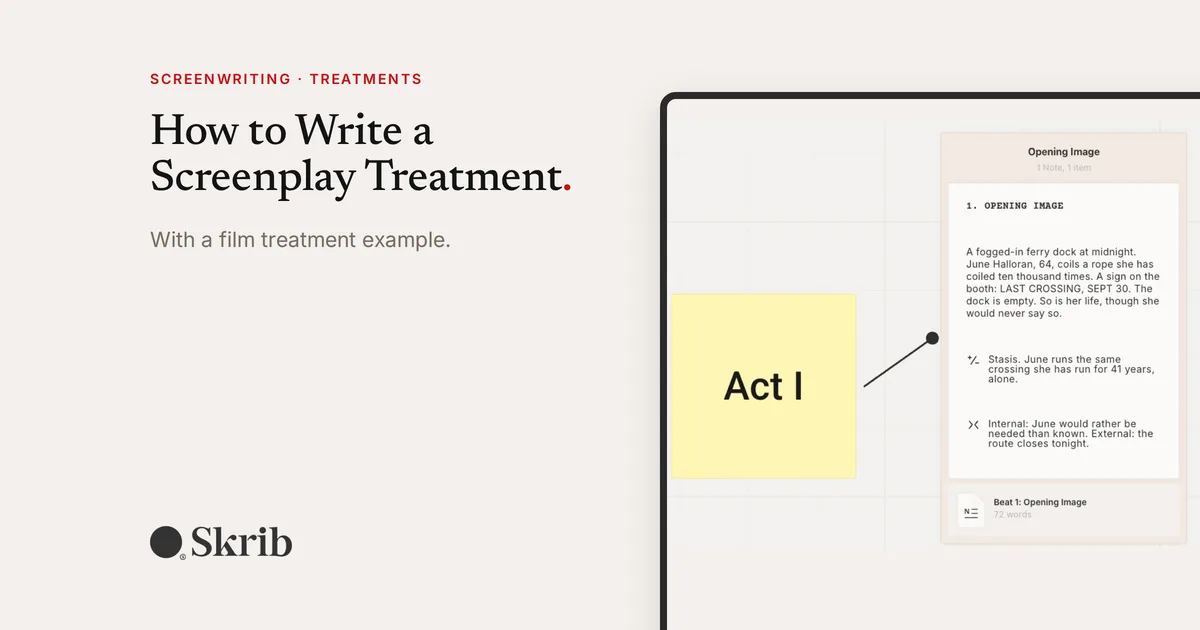
Do it in Skrib: write the treatment as a note on the same board as your beat cards, so every paragraph sits next to the beats it covers.
Film treatment example: Last Ferry
LAST FERRY
Logline: On the night her ferry route closes for good, a stubborn captain must carry her estranged son across a fogbound bay before either of them admits why he came back.
JUNE HALLORAN (64) has run the same ferry crossing for 41 years. Tonight is the last one: the route closes at midnight. The dock is empty until a single passenger walks out of the fog: ELI (30s), the son she has not spoken to in twelve years.
They cast off in silence. They talk about ticket prices, the weather, the new bridge. They do not talk about why he left. At the rail June's hand finds the spot where she held him as a boy, and we see it: 1998, a small Eli laughing into the spray.
Halfway across, fog comes down. The harbourmaster radios for June to turn back. She refuses. With the instruments failing, she needs Eli on the bow, calling out the buoys, and for the first time they have to trust each other.
When the lights of the far pier finally show, Eli admits why he came: he heard the route was closing and did not want her to make the last crossing alone. June lets him take the wheel and bring her boat in.

Treatment vs beat sheet vs step outline
- Beat sheet: the key moments, one line each. The skeleton. See what is a beat sheet and the Save the Cat board for screenplays.
- Treatment: the same story as readable prose, for producers and for you.
- Step outline: every scene in order, one or two lines each. It sits between the treatment and the script.
Most writers go beats, then treatment, then step outline, then pages. For a spec script, many skip the treatment and go straight from beats to outline.
Index cards: how to break a story
Writers have long used index cards on a wall: one scene per card, moved until the order works. That is what breaking a story means, and it makes the treatment easy to write.

Do it in Skrib: cards stay put on the board. Drag them to reorder the story, write the treatment beside them, then the script.
FAQ
How long is a film treatment? Usually 2 to 5 pages for a feature, and a page or less for a short film. Some studios ask for longer ones in development.
Do I need a treatment for a spec script? Not usually. It helps most when you pitch, apply for funding or develop with producers.
Is a treatment the same as a synopsis? Close. A synopsis is shorter and plainer. A treatment is longer and written to read like the film feels.
Write your treatment in Skrib
Copy the Story Planning Toolkit for Screenwriters, map the beats, then write the treatment and the script on the same board.
Copy the Story Planning Toolkit for Screenwriters
New to Skrib? Create your account.