Fantasy Name Generator for Writers: 200 Names and How to Choose One
200 fantasy names for heroes, villains, elves, dragons, places and surnames, five ways to build your own, and how to pick the one that fits.
Fantasy Name Generator for Writers: 200 Names and How to Choose One
A fantasy name generator will hand you five thousand names in a second. That is the easy part. The hard part starts after: deciding which one belongs to your character, making sure it does not sound like the other three names in chapter one, and still having it in front of you two weeks later when you sit down to write the scene.
This guide does the second part. It gives you 200 names by type, five ways to build your own, four checks for picking the right one, and a way to keep the shortlist on the same board as the character it belongs to in Skrib.
What a name has to do
A fantasy name is not decoration. Before you keep one, it has to pass four tests.
- It sounds like your world. Names from one place should share a few sounds. Kaelith and Ilvenna belong together. Kaelith and Bob do not, unless Bob is the joke.
- A reader can say it. If the reader stalls on it, they will skim it, and a skimmed name never becomes a person.
- It cannot be confused with another name. Three characters called Kael, Kara and Kalen will be one blurred character by chapter nine.
- It carries something. A trade, a place, a title, a rank, an insult that stuck. Meaning is what makes a name feel earned rather than rolled.
Five ways to build a fantasy name
Most good names come from one of these five directions. Pick a direction first, then generate inside it, and you get a cast that sounds related instead of a list of noises.
1. Root it in a thing. Take a word for the thing the character is tied to, in Latin, Old English, Norse or any language you like the sound of, then bend it. Lightning gives you Fulmen and Voltane. Salt gives you Salvane. Ash gives you Cinerra.
2. Give them a title. The name people use when they are not in the room: Stormcaller, the Pale Marshal, Thunder's Chosen, the Grey Wyrm. Titles do a lot of work in a first chapter because they tell the reader what the world thinks of this person.
3. Invent a first name with a sound system. Decide your rules, then stay inside them. If your elves use soft l and th sounds with two or three syllables, you get Kaelith, Elorien and Vaelora, and the fourth one writes itself.
4. Describe the power or the habit. Skysplitter, Brightfork, Coldhands, Nine Coins. Nicknames like these come from other characters, so they also tell you how those characters feel.
5. Blend two words. Arc and light gives Arclyn. Volt and Vanessa gives Voltessa. Blends are the quickest way to a name that feels invented but readable.
200 fantasy names by type
Take any of these as they are, or use them as a starting sound and change two letters.
Hero names
Kaelith, Arclyn, Voltessa, Maren Sorrel, Ilvenna, Torrin, Brannoc, Eiran, Sevrin, Wrenna, Calder, Nessith, Ysolde, Roan, Lirien, Tamsin, Aldric, Vessa, Corin, Elowen, Rhoswen, Dain, Marek, Sylas, Ondrea.
Storm and elemental names
Fulmen, Voltane, Stormcaller, Skysplitter, Brightfork, Arclight, Thunder's Chosen, Galewright, Emberwake, Tidecaller, Frostgale, Cinderpeak, Stormwright, Ash Vayne, Rimefell, Sparrowlight, Thornstrike, Dawnbreaker, Nightfathom, Saltwake, Stonewake, Flintcry, Whitefire, Deepcurrent, Skyfar.
Villain names
Malrec, Vhorn, Sable Yew, the Pale Marshal, Cassivane, Drossmere, Nikhaal, Grieve, Mordant Kell, Vraeth, Ossian Crow, the Tallow King, Hesper Vane, Karrow, Duskbane, Lord Ferrant, Ashquill, Mourne, Ivrik, the Quiet Count, Seraphel, Gorrast, Venn Marrow, Cruel Idris, the Thin Man of Ell.
Elf names
Aeltheris, Sylvaine, Ithariel, Nuvaen, Elorien, Faelith, Cirrayne, Vaelora, Thaelin, Nimwen, Aerith Lun, Saelienne, Ellarion, Thessaly, Ninuviel, Caladrin, Ysoltha, Virelle, Aenwyn, Lothiriel, Maerith, Quenvar, Sarien, Ilthanar, Wyllowe.
Dwarf and orc names
Brenndar Ironmaw, Halva Stonebraid, Korrik, Dagra Ninefingers, Thrum Oakenhelm, Brundt, Mirri Coalhand, Vosk Deepdelve, Hulda Grimm, Torvald Stonecut, Grash, Urrok, Zhagur, Mokra, Bruth Skullcleft, Nazgra, Orrek the Unbent, Vharga, Drokk, Ushka Bonechewer, Gharnek, Tulla Redaxe, Skarn, Morgruth, Yevka Ironvow.
Dragon names
Vaskarra, Ysmereth, Old Thornmaw, Aurelith, Ghorvane, Cinderath, Sylvessra, Kaurun, Emberholt, the Grey Wyrm of Pell, Nyxareth, Hessivane, Molgorath, Vaenor, Skarrowmaw, Pyrelith, Anthracite, the Long Silence, Ormungrel, Thalassor, Drakemere, Vult, Icarrith, Sorrowfang, the Salt Drake.
Fantasy last names
Ashdown, Vellacourt, Brackwater, Morrow, Thistlewaite, Hallowell, Fenn, Ravensby, Coldridge, Duskbane, Wintermere, Orrick, Stoneleigh, Harrowgate, Vane, Ellsmere, Blackfen, Quillon, Sarrowby, Marchetti, Greave, Hollowell, Tarn, Underhythe, Varros.
Place names
Velmoria, Karnath, the Ashen March, Greyhaven, Thornhollow, Ilvaris, Sablewater, Low Water, Carrowmere, the Nine Reaches, Hallowmoor, Bright Fen, Stormgate, Elder Vale, the Salt Crown, Ravensmouth, Coldharbour, Ilsmere, the Drowned Lantern, the Gilded Moth, the Tallow Hound, Quarrymouth, Windfall, the Bitter Steps, Netherby.
How to pick one
You have twenty candidates and you need one. Four checks, in this order.
- Say it out loud, twice. If your own mouth trips, cut it.
- Line the names up. Write your whole cast in one column. If two names share a first letter, a length and a rhythm, change one.
- Check it against the character's job. A blacksmith's daughter raised in a port town is not usually called Seraphel, unless someone in the family had ambitions, which is itself a story.
- Live with it for a chapter. A name that still fits after 3,000 words is your name. This is the check a generator cannot give you, because by then the tab is closed.
Do it in Skrib: keep the shortlist on the board beside the character while you write, so check four takes a glance rather than a search.
Name your cast without leaving the story
This is where a name generator usually loses you. The names live in a browser tab, the book lives somewhere else, and the good one is gone by Thursday.
In Skrib, the naming happens on the same board as the book. Ask the Companion beside your board for names for a character, tell it what the character can do and what the world sounds like, and it comes back with options grouped by direction: a storm-rooted surname, a title, an invented first name, a nickname from the power, a blend.

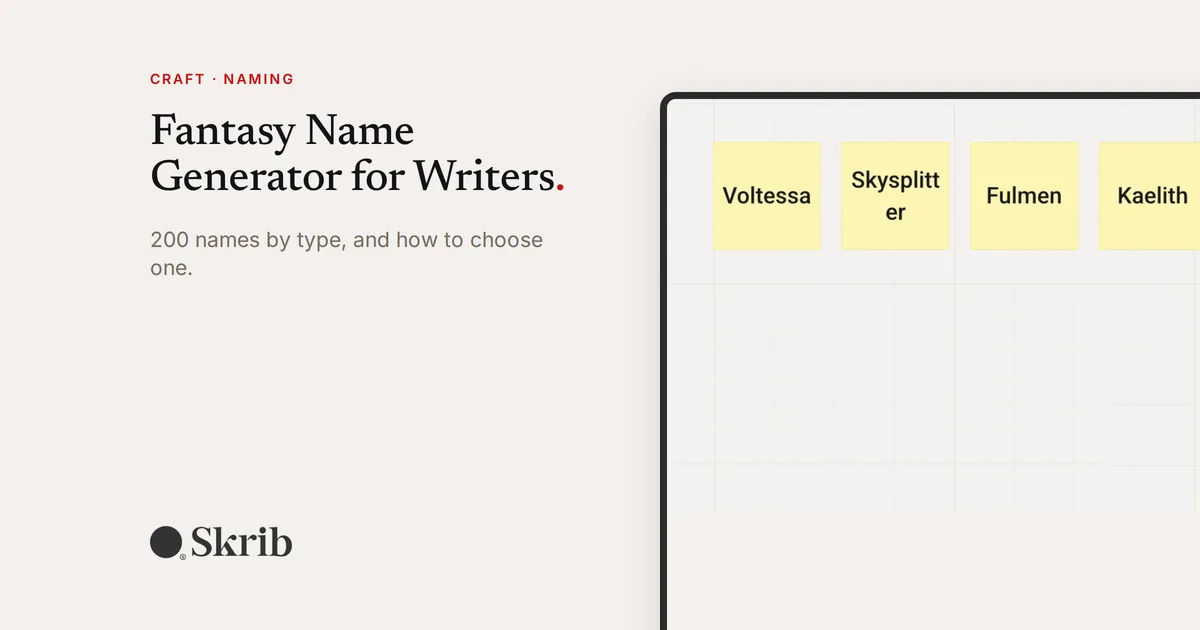
Pick the ones worth keeping and they go onto the Plan as sticky cards, in a row, ready to be moved, coloured or thrown away.

Anything the Companion puts on your board arrives as a suggestion first. Cards show up marked, and you take them one at a time or reject the lot. Nothing changes your plan on its own.

From there the name stops being a loose word:
- Drop it on the character card with want, need, wound and voice, so the name sits with the person it belongs to. The Character Board template has a card ready for it.
- Keep the rejects. The four names you did not use stay on the board for the sister, the rival and the ship.
- Check yourself later. Search the Library in month three to see what you called her sister in chapter two, instead of finding out in an editorial letter.

Do it in Skrib: copy the Character Board, name the cast, and start the draft beside it.
Names are the smallest part of a world
Once you have people, the names spread: houses, gods, cities, ships, taverns, the coin they spend. That is worldbuilding, and the same board holds it.

- The World Building template has a naming and language card, so your names keep sounding like they come from the same place.
- Running a campaign rather than a novel? The D and D character sheet template holds a party's worth of names and stats.
- Writing more than one book in the world? The Book Series Planning template keeps the canon straight across them.
For the questions behind the world itself, see our worldbuilding checklist and how to create a character.
What else Skrib does
Naming is a five minute job. Skrib is built for the two years around it.
- Plan on the Board. An infinite canvas for acts, scene cards, characters and the names you just picked. Start from a template or lay out your own shape.
- Write in the Draft. A real editor beside the plan, with chapter navigation that still works at four hundred pages and a live word count in the footer.
- Keep everything in the Library. Every version, note, research PDF and deleted chapter, searchable months later. Nothing is overwritten.
- Work side by side. Split screen, so the plan is on the left and the scene is on the right, which is where most naming and continuity mistakes get caught.
- Export clean. .docx for your editor, .md for your own pipeline, .pdf for beta readers, .fdx and .fountain if the book turns into a script.
- Prove the work is yours. Skrib is building HAAS, a record of the writing as it happens, so authorship is something you can show rather than argue about.
- Your book stays yours. We do not scrape it, sell it, or train anything on it.
The Companion is a panel you can open or ignore. It suggests, you accept or reject, and the draft stays yours either way.

Frequently Asked Questions
What is a good fantasy name? One a reader can pronounce, that sounds like the world it comes from, and that cannot be mistaken for another name in the book. Meaning helps, but readability comes first.
How do I make up fantasy names? Pick one of the five directions above, root it in a thing, a title, a sound system, a description or a blend, then build the rest of the cast inside the same direction so the names sound related.
Can I use names from a generator in a published book? Names themselves are generally not protected, but names closely tied to a particular published work or brand are a different matter, so avoid anything a reader would recognise from someone else's book, film or game. If you are unsure, change two letters and make it yours.
How many names does a novel need? Fewer than you think. Name the people who come back. A porter who appears once can be the porter.
Where do I keep the names I picked? On the board with the character. In Skrib the shortlist lives as sticky cards on the Plan and on the character card, so it is still there in month three.
Name your cast in Skrib
Copy the Character Board, put the shortlist on the Plan, and write the first scene beside it.
New to Skrib? Create your account, then join the other writers on Discord.