How Long Should a Screenplay Be? Page Count by Genre
How many pages should your screenplay be? Discover the optimal page range for action, comedy, drama, horror, rom-com & thriller scripts.
How Long Should a Screenplay Be? Page Count by Genre
Standard Screenplay Length: The 90 to 120-Page Rule
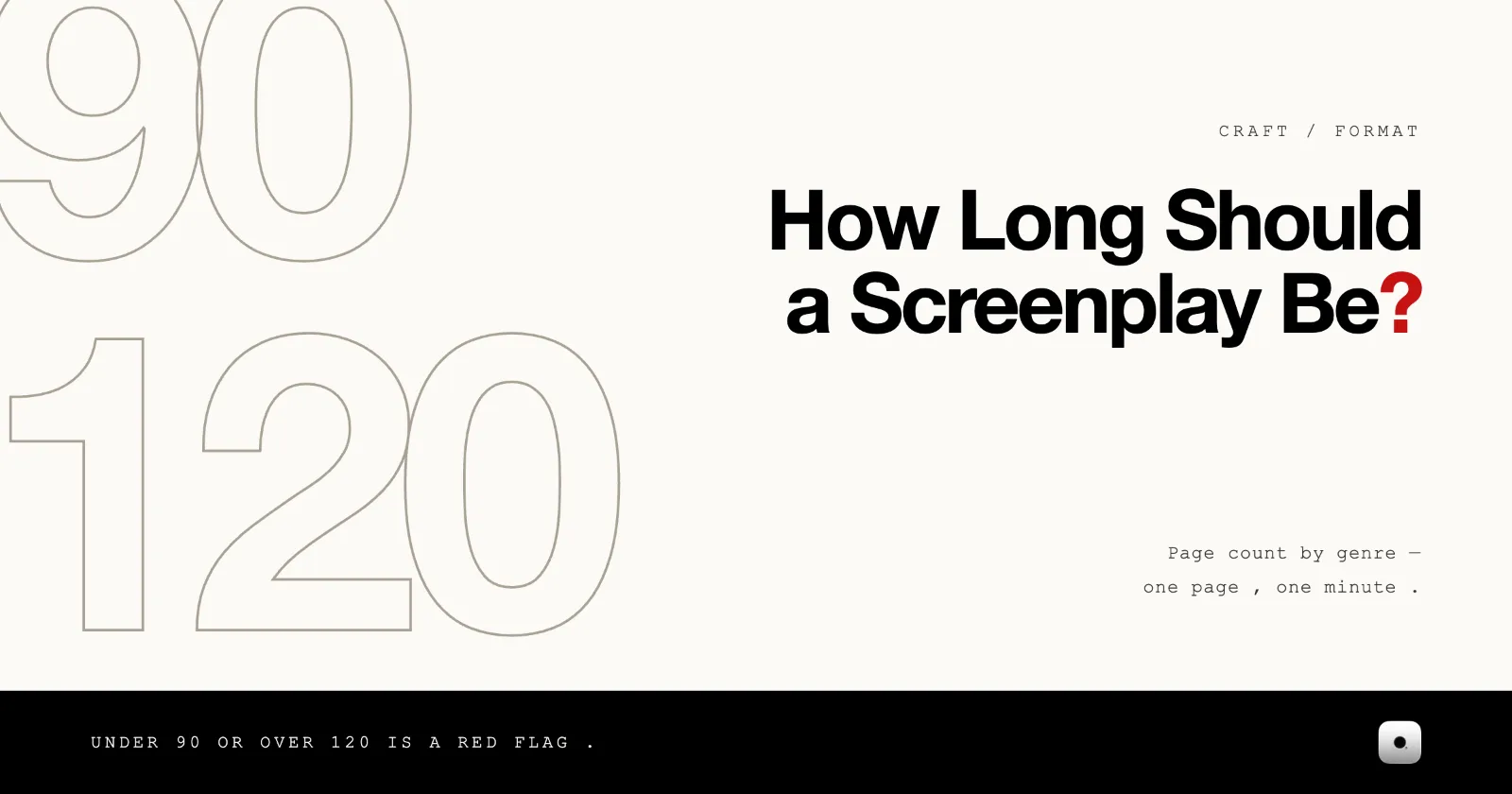
A feature screenplay usually runs between 90 and 120 pages. Standard screenplay formatting averages roughly one minute of screen time per page, giving a script a running time between 90 minutes and two hours. Scripts under 90 pages or over 120 pages often raise red flags for studio readers.
A reader sitting down with a stack of PDFs looks at the bottom right corner of the page before reading a single line of dialogue. That number tells them everything about how well a writer knows the craft. A 140-page script suggests a writer who cannot bear to cut a line. A 75-page draft usually means underdeveloped characters or a thin second act.
If you are starting a feature, setting your structure early keeps page counts tight. You can study complete story frameworks in [The Screenwriter's Blueprint: Mastering Screenplay Structure, Format, and Story Architecture]. To keep your page count lean during pre-writing, set scene targets using dedicated [beat sheet software] or a flexible [screenplay outlining tool].
Screenplay Page Count Breakdown by Genre
Ideal screenplay page counts vary by genre, running from 85 pages for animation to 120 pages for epic sci-fi. Comedy scripts skew shorter (85 - 105 pages) to keep the timing sharp, while action and fantasy scripts need space (110 - 120 pages) for world-building and complex sequences.
Genre | Target Page Count | Estimated Runtime |
|---|---|---|
Comedy | 85 - 105 pages | 85 - 105 mins |
Horror & Thriller | 85 - 100 pages | 85 - 100 mins |
Drama | 90 - 115 pages | 90 - 115 mins |
Action & Adventure | 100 - 115 pages | 100 - 115 mins |
Sci-Fi & Fantasy | 110 - 120 pages | 110 - 120 mins |
Animation (Family) | 85 - 95 pages | 85 - 95 mins |
Comedies and horror scripts live or die on speed. Extra pages drag out tension and kill punchlines. Sci-fi and historical dramas require room to describe spaces, machines, and worlds. Still, passing 120 pages on a spec script is a risk. Using proper [screenwriting format software] ensures line spacing, margins, and dialogue blocks do not bloat your overall count.
TV Script Lengths: Network vs. Streaming
A half-hour TV script runs 25 to 35 pages, while a one-hour TV script runs 45 to 63 pages. Network scripts build in extra room for commercial breaks, while streaming scripts adjust length based on episode pacing rather than rigid broadcast slots.
Television uses clear page boundaries depending on the format:
Half-Hour Comedies (Network): 22 to 30 pages. Multi-camera sitcom scripts run longer because dialogue is double-spaced, often reaching 40 to 45 pages.
Half-Hour Comedies (Streaming): 28 to 35 pages. Single-camera setups give room for longer scenes without commercial breaks.
One-Hour Dramas (Network): 50 to 60 pages. Built around four to six commercial act breaks.
One-Hour Dramas (Streaming): 45 to 63 pages. Flexible act structure, though rarely going past 65 pages.
To structure episodic pilot scripts effectively, read our guide on [Writing a Pilot Episode: TV Pilot Structure for Streaming vs. Network]. Choosing good [tv script writing software] handles act breaks and standard margins automatically.
Why Page Count Matters to Readers
Page count is not just a formatting rule. It is a budget figure. Shooting a film costs anywhere from $50,000 to $200,000 per page. Every extra page in your draft is money a producer has to spend on set.
Long drafts often point to formatting issues: heavy action blocks, wide margins, or dialogue that says the same thing twice. Running your draft through a [screenplay format checker software] catches spacing mistakes before you send your work to coverage services or pitch contests.
If you want a clear workspace, look for a [Scrivener alternative for screenwriting] that keeps your structural notes right next to your script page. Keeping your page count under control is easier when your outline lives in the same workspace as your draft.
Frequently Asked Questions
How many words are in a 100-page screenplay?
A 100-page screenplay usually contains between 18,000 and 22,000 words. Because script layout uses wide margins, centered character names, and short dialogue lines, screenplays contain far fewer words than novels of the same page count.
Can a spec screenplay be 130 pages long?
A spec screenplay should rarely cross 120 pages. Readers look at a 130-page script from an unestablished writer with immediate doubt, assuming the script suffers from slow pacing or unedited scenes.
How long should a short film script be?
A short film script usually runs between 5 and 15 pages. Keeping your script under 15 pages makes the project far easier to fund, shoot, and schedule for festival screenings.
Does line spacing affect screenplay page count?
Standard screenplay formatting requires 12-point Courier font with 1.5-inch left margins and 1-inch top, bottom, and right margins. Adjusting margins or font size to shrink your page count is obvious to anyone who reads screenplays for a living.
How long is a feature screenplay compared to a TV pilot?
A feature screenplay runs 90 to 120 pages for a standalone movie. A TV pilot runs 25 to 35 pages for a half-hour episode or 45 to 63 pages for a one-hour drama.
Build Your Screenplay with Skrib
Skrib gives screenwriters one studio to plan, draft, and keep their work together.
Instead of switching between separate apps for outlines and script pages, Skrib connects your Board directly to your Draft. Track your beat sheet, check act targets, and write standard screenplay pages in one place. Skrib handles margins, Courier fonts, and scene headings automatically so you can focus on craft and hit your exact page target.
Try Skrib for your next screenplay.