How to Create a Character: 7 Steps With a Character Profile Example
How to create a character readers remember, in 7 steps: want, need, wound, flaw, arc and voice. Real character profile examples in Skrib, free to start.
How to Create a Character: 7 Steps With a Character Profile Example
A good character is not a list of eye colours and star signs. It is someone who wants something, is wrong about something, and has to change or pay for it. This guide shows you how to create a character in seven steps, with a full character profile example built in Skrib.
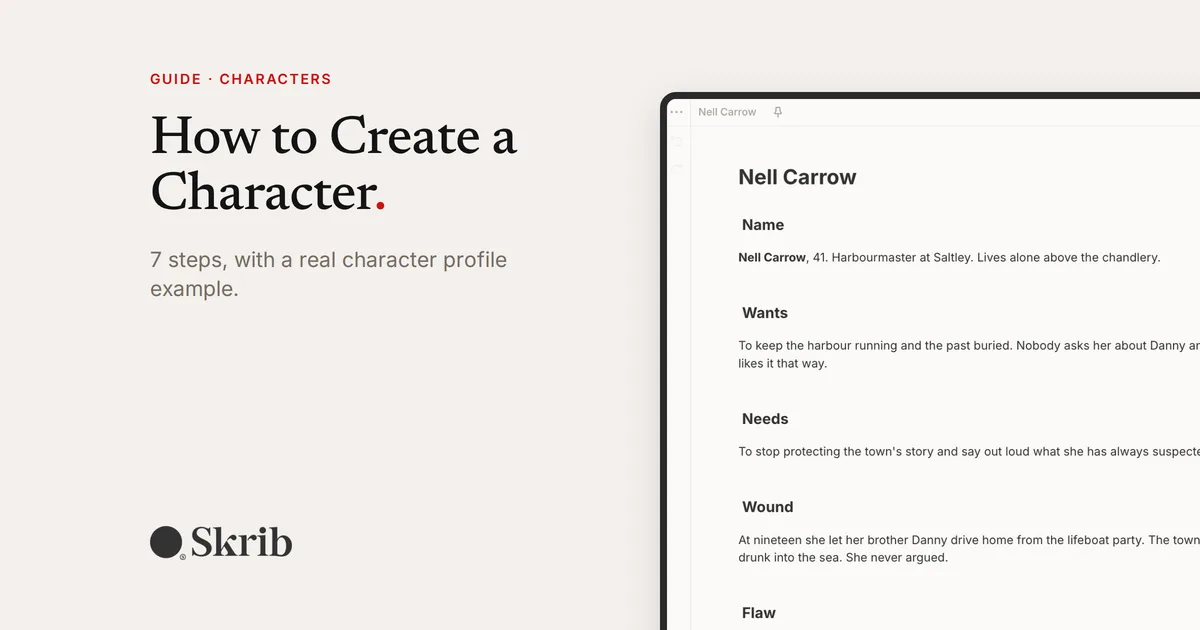
Our example is Nell Carrow, the harbourmaster at the centre of a small mystery novel called Low Water. By the end of the post you will have a profile like hers for your own character.

Step 1: Start with a role and a name
Decide what the character does in the story before who they are. Nell is the protagonist. She runs the harbour at Saltley, and she is 41. A job, an age and a place already suggest a daily life.
Do it in Skrib: create a note on your board and pick the Character starting template. Name, Wants, Needs, Wound, Flaw, Arc and Voice are already laid out for you.
Step 2: Give them a want
The want is what the character chases out loud. Nell wants to keep the harbour running and the past buried. Make the want concrete enough that we can see her chase it in scenes.
Step 3: Find the need underneath
The need is what they actually need, usually the opposite of what they think. Nell needs to stop protecting the town's story and say out loud what she has always suspected. The gap between want and need is where your plot lives.
Step 4: Give them a wound
The wound is the past event that shaped them. At nineteen Nell let her brother Danny drive home from a party. The town decided he drove drunk into the sea, and she never argued. One specific memory beats a page of backstory.
Step 5: Name the flaw
The flaw is how the wound shows up now. Nell keeps the peace at any price. She would rather be useful than be right. A good flaw gets in the way of the want.
Step 6: Sketch the arc
Write who they are at the start and who they are at the end, in one line each. Nell starts as a woman who fixes other people's boats and never talks about her own life, and ends by standing up at the inquest. For more on this step, see our guide to character arcs.
Step 7: Find their voice
How do they talk, and what would they never say? Nell speaks in short sentences, tide times and knots. She would never say "I'm fine", because she never says how she is at all.
Do it in Skrib: keep the character note on the same board as your plot, so when you write a scene you can check her want and her voice without leaving the page.
A second character profile example
Here is the same method used for Marcel, a lodger from a different novel, The Held Breath, with the profile sitting right next to the plot:

Go deeper with questions
Once the profile is done, ask your character a few hard questions. We keep them in a second note:

FAQ
How long should a character profile be? One screen. If you need more, it is probably backstory that belongs in the book, not the profile.
Should I plan a character before writing? Plan the want, need, wound and flaw. Let the rest surface in the draft.
Create your character in Skrib
Open a free Skrib board, add a Character note and fill in the seven sections for your protagonist tonight. It sits beside your plot and your draft in one tab, and it is free to start, no card needed.