Prologue vs Epilogue: What Each One Does and Whether Your Book Needs One
Prologue and epilogue meaning, when each one helps a book and when it hurts, plus a prologue example and an epilogue example from a real novel plan.
Prologue vs Epilogue: What Each One Does and Whether Your Book Needs One
A prologue comes before the story starts. An epilogue comes after it ends. Both are optional, and both can make a book better or worse. This guide explains what each one is, when it helps, when it hurts, and shows a prologue example and an epilogue example from Low Water, a mystery novel planned in Skrib.

What is a prologue?
A prologue is a short opening section that comes before chapter one and stands apart from the main story. It is usually set at a different time, in a different place, or told from a different point of view.
Prologue meaning: the word comes from the Greek prologos: pro, "before", and logos, "speech". In plays it was the speech before the action. Romeo and Juliet opens with one, spoken by the Chorus.
What is an epilogue?
An epilogue is a short closing section that comes after the last chapter, once the main story is resolved. It usually jumps forward in time to show what the ending changed.
Epilogue meaning: from the Greek epilogos: epi, "in addition", and logos, "speech". In plays it was the closing speech after the action. The "Nineteen Years Later" chapter at the end of Harry Potter and the Deathly Hallows is a famous epilogue.
When a prologue helps
- It shows something chapter one can't. An event years earlier, or a scene the main character never sees.
- It is a hook. A crime, a disappearance, a danger the reader knows about before the hero does.
- It uses a different point of view. The villain, a victim, or a witness who will not survive to chapter one.
A Game of Thrones works this way: its prologue follows three men of the Night's Watch beyond the Wall, and plants a threat that hangs over the whole series.
When a prologue hurts
- It is an info dump. Pages of history or world-building before anything happens.
- It is just backstory. If the reader could learn it later, they should.
- It delays the real start. Many agents read only the first pages. If those pages are a slow prologue, they may never reach your chapter one.
If you are querying, ask yourself: would the book work if chapter one were page one? If yes, cut the prologue or fold it into the story.
Prologue example
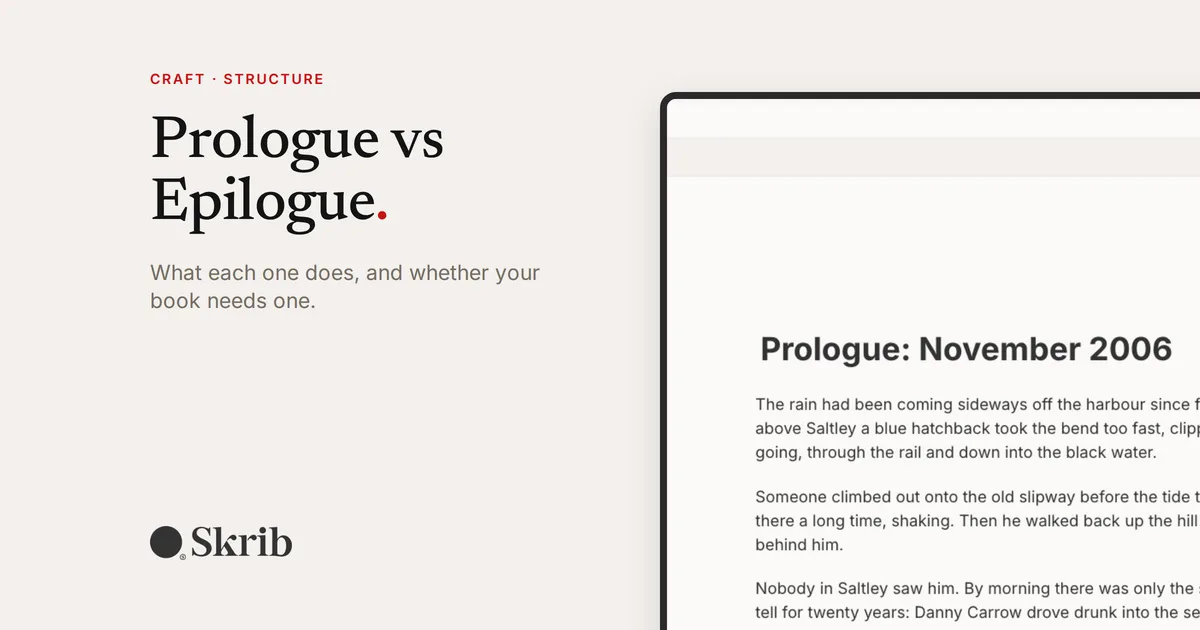
In Low Water, the main story starts twenty years after Danny Carrow's car goes into the harbour. The prologue is the night it happens, in 2006, and it hides the one thing the book is about: who was driving.

It works because it is short, it shows an event no character in chapter one witnessed, and it plants a question the climax answers.
Do it in Skrib: add the prologue as its own heading at the top of your draft. It shows up in the chapter navigation, so you can jump to it, move it or cut it in one click.
What a good epilogue does
- A time jump. Months or years later, so the reader sees the change last.
- A series setup. A hint of the next book, without undoing this one.
- A final beat. One quiet image that says what the ending cost.
A bad epilogue repeats what the last chapter already said, or ties up threads that were better left to the reader.
Epilogue example
Low Water ends when Tom admits he was driving and Danny's name is cleared. The epilogue jumps one year: Nell takes the boat out past the wreck buoy, and the harbour has a new master. One image, and the reader knows what she lost and what she chose.
Plan them on the board first
Before you write either one, put it on the plan as a card, next to the three acts. Then check the connection: does the prologue ask something Act 3 answers? Does the epilogue show what the ending cost? If a card doesn't connect, you don't need it.

For the acts themselves, see our three-act structure example and how to outline a book.
Do it in Skrib: copy the Three-Act Structure template, add a prologue card before Act 1 and an epilogue card after Act 3, and draw the line to what each one sets up or pays off.
How to write a prologue
- Pick one moment the main story can't show.
- Keep it to one scene, usually a few pages.
- End on a question, not an answer.
- Make sure chapter one still works as a beginning.
How to write an epilogue
- Jump forward in time.
- Show one change, not every loose end.
- Keep it to one scene.
- End on an image, not a summary.
FAQ
Prologue vs epilogue: can a book have both? Yes. They often mirror each other: the prologue asks, the epilogue shows the answer's cost.
Do agents hate prologues? Many agents say they skip them or prefer books without one. A short prologue that works as a hook is still fine.
Is a prologue the same as a preface or an introduction? No. A preface or introduction is written by the author about the book. A prologue is part of the story.
Plan your prologue and epilogue in Skrib
Put both on the board beside your acts, check they connect, then write them in the same project as the draft.
Plan your prologue and epilogue in Skrib
New to Skrib? Create your account.