The Sequence Approach: Your Screenplay in 8 Mini-Movies
Elevate your screenplay with the 8-sequence structure used by top screenwriters. Implement this proven framework to craft a compelling emotional arc.
What is the 8-Sequence Structure in Screenwriting?
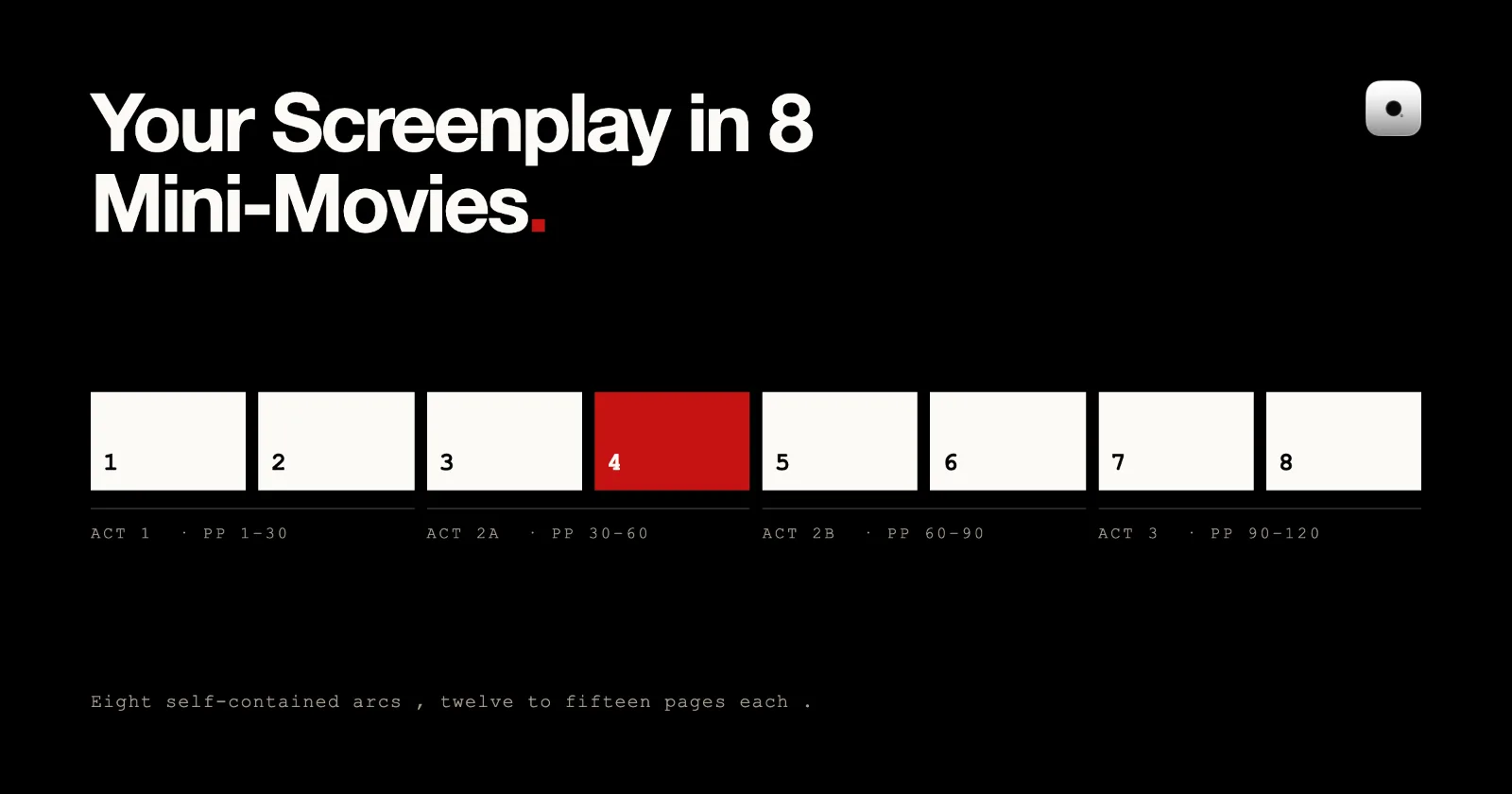
The 8-sequence structure divides a standard feature screenplay into eight 10-to-15-minute mini-movies. Developed at USC by Frank Daniel, each sequence operates as a self-contained story arc with its own goal, tension, and climax, keeping the narrative moving while preserving overall structural control.
Act | Sequence | Core Story Objective |
|---|---|---|
Act 1 | Sequence 1 | Status Quo & Inciting Incident |
Act 1 | Sequence 2 | Predicament & Crossing the Threshold |
Act 2A | Sequence 3 | First Obstacles & Rising Action |
Act 2A | Sequence 4 | Midpoint Turn & Major Escalation |
Act 2B | Sequence 5 | Complications & Subplot Development |
Act 2B | Sequence 6 | Main Culmination & All Is Lost |
Act 3 | Sequence 7 | Climax & Final Confrontation |
Act 3 | Sequence 8 | Resolution & New Normal |
Anatomy of the 8 Sequences
Staring at page one of a blank 110-page document scares almost everyone. A feature film is long, easy to lose control of, and full of places to get stuck around page 45. Breaking your script into eight self-contained mini-movies turns that long drag into a series of clear steps.
Each sequence runs roughly 12 to 15 pages. It carries its own immediate tension, a character goal, and a resolution that hands the story off to the next scene. When one sequence closes, the new problem it leaves behind pushes the reader right into the next block of pages.
Act 1: Setup and Complication (Pages 1 - 30)
Sequence 1 (Pages 1 - 15): Status Quo. Establish the world, the protagonist, and the daily reality before everything breaks. The sequence ends when an unexpected event hits.
Sequence 2 (Pages 15 - 30): The Predicament. The character tries to deal with the shock or dodge the problem, only to realize the old way of living is gone. They make a firm choice to step into Act 2.
Act 2A: Rising Action to Midpoint (Pages 30 - 60)
Sequence 3 (Pages 30 - 45): First Obstacles. The protagonist enters unfamiliar ground. Simple fixes fail, and the stakes start rising.
Sequence 4 (Pages 45 - 60): The Midpoint Shift. A major turning point, a temporary win, or a sudden realization changes what the character thinks they are fighting for.
When you map these moments out before drafting, keeping index cards alongside your script pages in a dedicated screenplay outlining tool makes structural shifts far easier to spot.
Act 2B: Escalation to Disaster (Pages 60 - 90)
Sequence 5 (Pages 60 - 75): Pressures and Subplots. Opposition grows sharp. Outside threats close in while personal ties strain under the weight of the main goal.
Sequence 6 (Pages 75 - 90): The Culmination. The protagonist pushes all their chips into the middle. The effort leads to a major crisis or a false victory that forces the final push.
Act 3: Climax and Resolution (Pages 90 - 120)
Sequence 7 (Pages 90 - 105): The Climax. The confrontation everything has built toward. Subplots merge, and the protagonist uses whatever they learned to face the main conflict.
Sequence 8 (Pages 105 - 120): The Resolution. The quiet after the storm. We see the protagonist in their changed life, settling into a new status quo.
Outlining Your Script with Sequence Mapping
Understanding the eight sequences is easy on paper. Setting them up without getting lost in separate files or messy notes is where writers hit friction. Many screenwriters use a beat sheet software template or specific screenwriting tools for outlining to test sequence goals before writing scene dialogue.
Tool Category | Primary Purpose | Ideal Sequence Phase |
|---|---|---|
Beat Sheet Software | Structural mapping | Pre-writing & outline phase |
Dedicated Formatting | Script formatting | Drafting pages 1 - 120 |
Unified Studio | Outline & draft | Real-time sequence development |
Working with a beat sheet software free option or a screenplay outlining tool collaborative workspace lets you test plot moves early.
Writers hunting for a modern Scrivener alternative for screenwriting often run into the same problem: traditional apps isolate your outline from your script. Moving a 15-page sequence around should not mean switching back and forth between three different windows.
To see how sequence structure connects to the larger picture, read our core guide, The Screenwriter's Blueprint: Mastering Screenplay Structure, Format, and Story Architecture. For writers building episodic stories, check out our breakdown on TV Pilot Structure for Streaming vs. Network.
Write Your Sequences in Skrib
Writing an 8-sequence screenplay should feel organized and direct.
Skrib gives you one clean place where planning and drafting sit side by side. Open your Board on the left to organize your 8 mini-movies, and keep your Draft open on the right. Reorder sequence beats, review your structure, and write your script without switching tabs or losing context.
If you want a better Scrivener alternative screenwriting studio with clear formatting and immediate board-to-draft workflow, Skrib steps out of the way so you can focus on the story.
Build your next screenplay in Skrib.
Here is a clean, natural rewrite of your FAQ section. It keeps all the crucial keywords and semantic depth that search engines and AI generative engines look for, but delivers them in an approachable, human voice.
Frequently Asked Questions
What is the 8-sequence structure in screenwriting? Think of the 8-sequence structure as a roadmap for your feature film. It takes a standard 90-to-120-page screenplay and breaks it down into eight mini-movies, each running about 10 to 15 pages. Every sequence gets its own setup, conflict, and mini-climax. This keeps your plot moving at a steady clip and helps you avoid that dreaded second-act slump.
Who came up with the 8-sequence method? We owe this method to Frank Daniel, a legendary film professor and screenwriter from USC. He created it as a practical tool for his students, giving them an easier way to tackle a full-length movie script by focusing on smaller, connected chunks of story.
How long is a typical sequence? In a standard feature script, each sequence usually lands between 12 and 15 pages - which translates to roughly 10 to 15 minutes on screen. Added up across a typical script, that gives you roughly 30 pages for Act 1, 60 pages for Act 2, and 30 pages for Act 3.
What's the difference between a scene and a sequence? A scene is a single moment in time and space - one location, one continuous piece of action. A sequence is a bigger group of scenes (usually 10 to 15 pages long) tied together by a specific mini-goal. Once that goal is reached or upended in a mini-climax, it propels the story right into the next sequence.
Does the 8-sequence structure work for TV pilots? The 8-sequence model was built for feature films, but the core idea works brilliantly for TV. Because television relies on act breaks for commercials or streaming cliffhangers, writers simply adapt the concept into 4 or 5 sequence blocks instead, using those mini-climaxes to keep viewers hooked through the breaks.