7-Point Story Structure: Explained With a Full Example
The 7-point story structure explained: hook, plot turns, pinch points, midpoint and resolution, with a full example mapped on a Skrib board. Free to start.
7-Point Story Structure: Explained With a Full Example
The 7-point story structure, popularised by author Dan Wells, gives you seven moments to hit, and a clever way to find them: start at the end. If you know where your character finishes, you can work backwards to where they must begin.
This guide explains all seven points and shows a full example for our mystery novel Low Water, mapped on a board in Skrib.

The 7 points
- Hook: the character's starting state, usually the opposite of the ending.
- Plot Turn 1: the event that sets the story moving.
- Pinch 1: pressure from the antagonist forces action.
- Midpoint: the character stops reacting and starts acting.
- Pinch 2: things get worse. The plan fails, or a mentor is lost.
- Plot Turn 2: the character finds the last piece they need.
- Resolution: the climax and the end state.
A 7-point example: Low Water
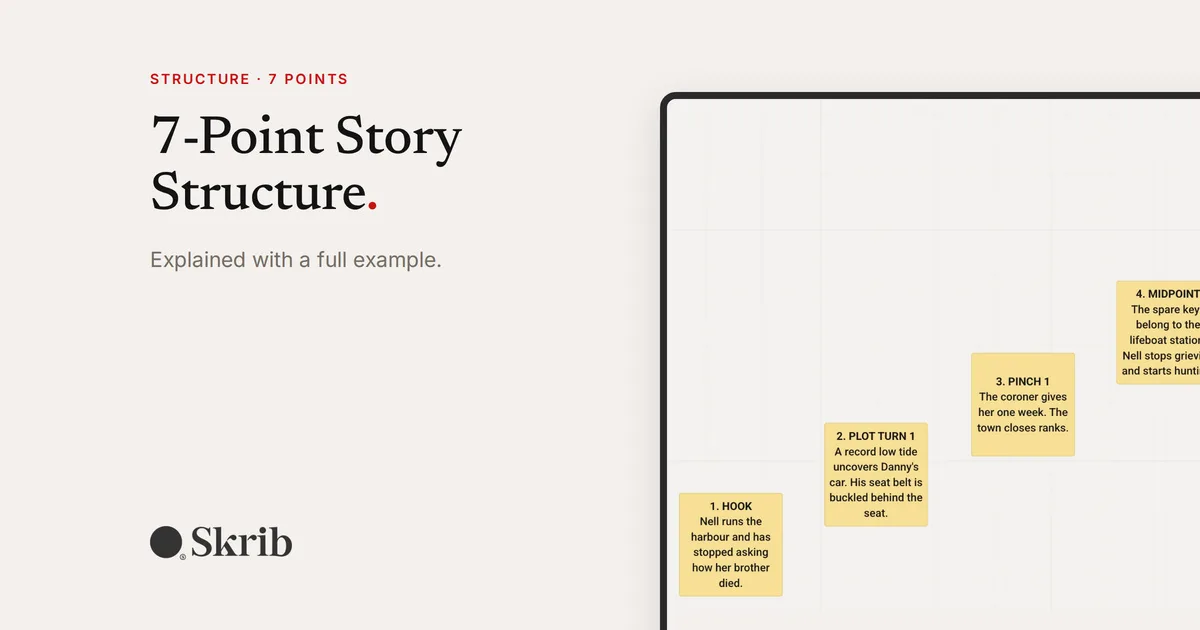
- Hook. Nell runs the harbour and has stopped asking how her brother died.
- Plot Turn 1. A record low tide uncovers Danny's car. His seat belt is buckled behind the seat.
- Pinch 1. The coroner gives her one week. The town closes ranks.
- Midpoint. The spare keys belong to the lifeboat station. Nell stops grieving and starts hunting.
- Pinch 2. Tom Ashby, now mayor, shows her a suicide note in Danny's hand.
- Plot Turn 2. The note is on paper bought after 2006. It is a fake.
- Resolution. Tom confesses at the wreck. Nell gives Danny his name back.
Look at the Hook and the Resolution together: a woman who stopped asking becomes one who gets the answer. That mirror is the heart of the structure.
Do it in Skrib: put seven sticky notes on your board as a staircase, one step per point. If two neighbouring notes sit at the same height, the story isn't moving.
How to plan with 7 points
- Write the Resolution first.
- Write the Hook as its opposite.
- Write the Midpoint: the moment the character turns from passive to active.
- Write the two Plot Turns: what starts the story, and what unlocks the end.
- Add the two Pinches: the moments the pressure bites hardest.
Do it in Skrib: once the seven points are set, add scene cards between them and write the draft beside your plan in the same tab.
7-point vs three-act structure
The seven points fit inside three acts: Plot Turn 1 ends Act 1, the Midpoint splits Act 2, and Plot Turn 2 opens Act 3. Want the full act-by-act version? See our three-act structure example.
FAQ
Who created the 7-point story structure? Author Dan Wells popularised it, building on ideas from role-playing game design.
Why plan backwards? Knowing the ending makes every earlier point easier to choose.
Plan your 7 points in Skrib
The free Story Planning Toolkit gives you the logline, characters and structure in one board. Add your seven sticky notes and start.
Copy the Story Planning Toolkit
New to Skrib? Create your free account.