Playable Prologues: Teaching Story and Mechanics | Skrib
A prologue does four jobs at once. Choosing the first verb, four opening structures, the amnesia problem, teaching through failure and pacing the first hour.
The standard framing treats the opening as a competition. The tutorial needs minutes. The story needs minutes. There are only so many minutes before players leave, so the two fight over them and somebody loses.
That framing produces the two familiar failures: an opening that teaches efficiently and establishes nothing, or one that establishes beautifully and leaves players unable to play.
They aren’t competing, and the reason is the thing worth internalising about the medium.
The first thing you ask a player to do is the first thing you tell them about the world. Not the first line of dialogue - the first verb. Whether they open a door, load a weapon, feed an animal or fill in a form, that action is a statement about what this game values and who they’re playing.
Teaching and characterising are the same act, done well. The tutorial isn’t a delay before the story starts. It’s the story’s opening sentence, written in verbs.
The wider discipline is mapped in our video game writer’s handbook.
What is a playable prologue?
A playable prologue is an opening sequence that a player controls, designed to teach core mechanics while establishing the world, the protagonist and a reason to continue. It differs from a tutorial in emphasis rather than kind - a tutorial prioritises instruction, a prologue prioritises story, and most good openings are both at once.
Four jobs, at the same time
The opening has to do all of these, and most failures come from doing one well at the expense of the rest.
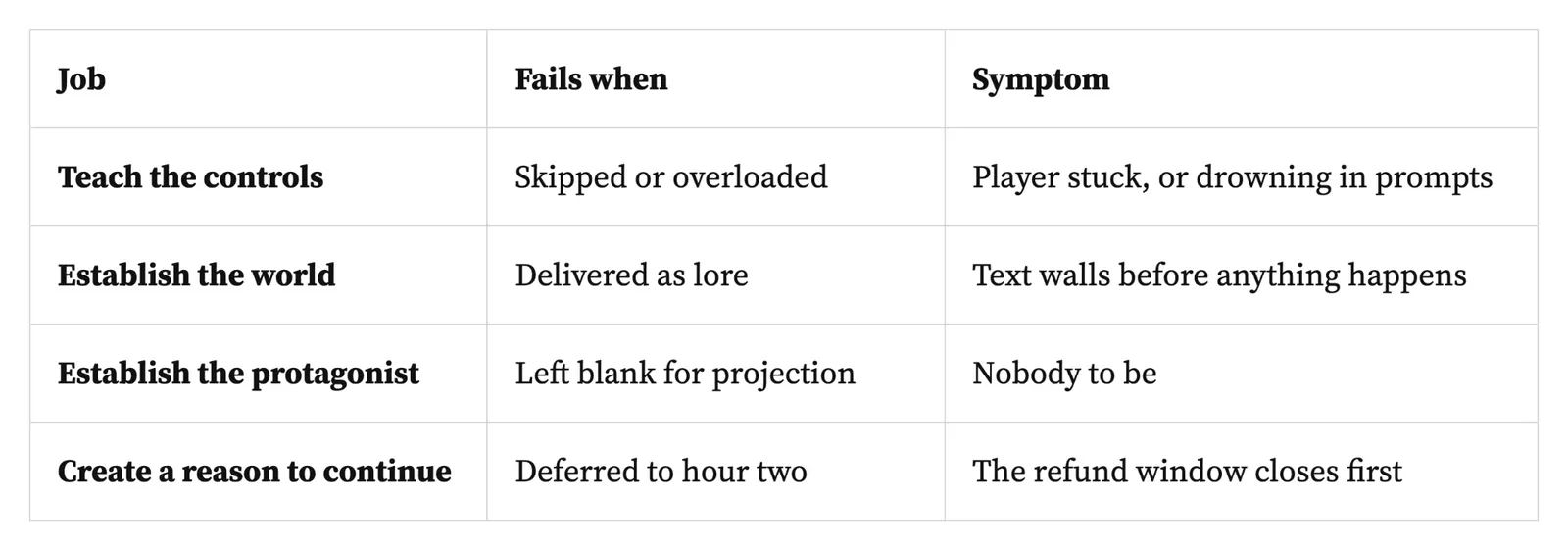
The last one is commercially decisive. A large share of players who abandon a game do so very early, and openings are the only content every single player experiences. The strongest work in a game’s opening hour is worth more per minute than anywhere else, and it’s frequently assigned to whoever is free.
The trick that resolves the conflict is refusing to sequence these. Openings that run teach, then establish, then hook feel like three separate things. Openings that do all four continuously feel like a game starting.
The first verb
Choose it for meaning, not just for the tutorial checklist.
A game that opens by having you shoot something is a different game from one that opens by having you carry something, even if both teach movement. The verb ranks your themes before a word is spoken.
Some questions worth answering deliberately:
What’s the first action? And is it the action this game is actually about?
What’s the first thing the player is allowed to fail at? Failure teaches tone - a game that lets you fail gently and one that kills you immediately have made different promises.
What’s the first choice? Even a cosmetic one signals that this game watches what you do. Our guide to player agency covers why acknowledgment matters more than consequence, and an early acknowledged choice sets the expectation cheaply.
What order do you teach in? The order is a ranking. Whatever comes first reads as most important.
The classic demonstration is an opening that teaches an entire mechanical vocabulary through space alone - rooms shaped so the only possible action is the correct one, no text, no instruction, no character explaining. The lesson generalises well beyond puzzle games: if a space can teach it, the space should teach it. That’s environmental storytelling doing double duty, and environmental storytelling covers the technique in its own right.
Four opening structures
Each is a real pattern with a known cost.
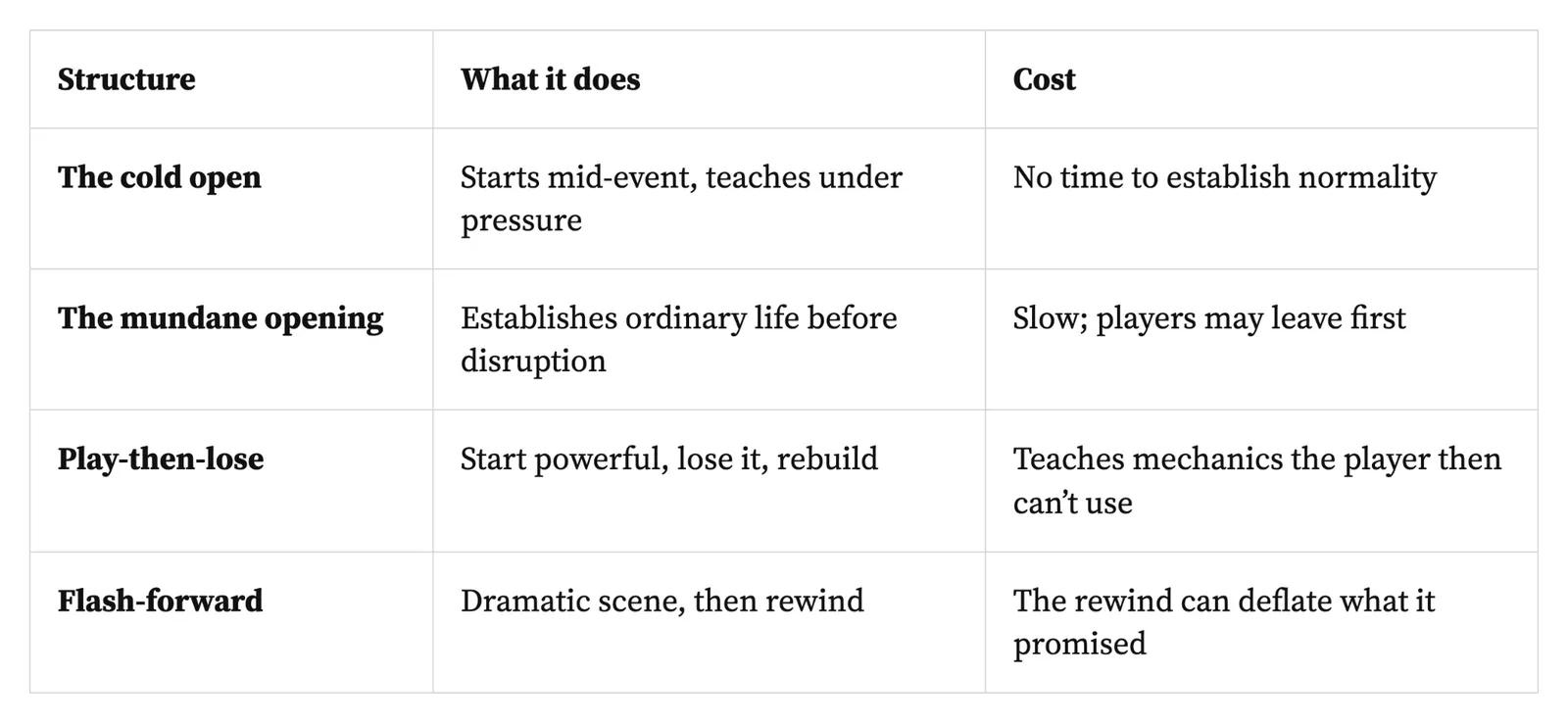
The cold open is the safest commercially and the weakest for character. If the player never sees normality, the disruption has nothing to disrupt.
The mundane opening is the strongest for story and the riskiest. Establishing an ordinary life so its loss lands is a genuine technique - and games that do it slowly are the ones people argue about most, because the payoff arrives after some of the audience left.
Play-then-lose has a specific trap beyond the obvious: teaching a full ability set and then removing it means the player’s first hours are spent doing less than they already did. The variants that work make the rebuilding the story rather than an inconvenience.
A note on prologues that play as a different character: they establish world and stakes efficiently, and they delay the player meeting the person they’ll actually be. That delay is affordable once. It’s rarely affordable twice.
Who teaches?
Every explanation has a source, and the source is a characterisation decision.
A character with a reason to explain. A handler, a mentor, a colleague on comms. Reliable, and the reason has to hold - someone explaining things the protagonist obviously knows is the most common immersion break in the medium.
Diegetic systems. Signage, training facilities, safety notices, a manual in the fiction. Elegant, and it doubles as worldbuilding.
Discovery. Nobody explains; the space does. Highest skill, best result, most expensive to build.
Non-diegetic UI. Prompts and overlays. Honest, cheap, and it costs a little fiction each time. Worth spending where the alternative is a contrived conversation.
The mixed approach is normal. Teach movement through space, teach systems through UI, teach the world through a character who has reason to speak.
The amnesia problem
Worth naming, because it’s the most-used solution and it has a real price.
Amnesia solves the knowledge gap perfectly. The protagonist doesn’t know what the player doesn’t know, so anyone can explain anything without contrivance.
What it costs is the protagonist. A character with no history has no false beliefs, no relationships under strain, no reason to want anything in particular - and the interior structure that makes characters generate behaviour is precisely what amnesia deletes. Our character architecture guide covers what’s being removed.
Cheaper alternatives that solve the same problem:
The newcomer. Competent, but new here. Knows how to do their job, doesn’t know this place.
The returner. Been away long enough that things have changed.
The outsider. Different background, so the norms need explaining to them specifically.
Asymmetric knowledge. The protagonist knows the world and not the situation.
All four preserve a history while creating a legitimate reason for exposition.
Teaching through failure
Under-used, and it’s the mechanism that makes a lesson stick.
A player who fails once and understands why has learned something. A player told the rule has been informed. Designing a safe, early, low-cost failure is one of the most efficient teaching devices available.
It’s also characterisation. How the game responds to your first failure - punishing, forgiving, amused, indifferent - establishes its relationship with you.
Two conditions: the failure must be recoverable, and the reason must be legible. An early failure the player can’t diagnose teaches nothing except that the game is unfair.
Pacing the first hour
Front-load the hook, not the lore. The reason to continue should exist within minutes. The explanation of the world can wait - and mostly should, since players absorb setting far better once they care.
Introduce mechanics in usable clusters. Teach a thing, then immediately give a reason to use it. A tutorial that teaches five systems before requiring any of them has taught nothing.
Leave gaps. An opening that explains everything has removed the player’s reason to be curious. Half the setting should still be a question at the end of hour one - the demand principle covered in backstory dumps vs. earned reveals applies with full force here.
Watch the density of instruction. Prompts arriving during a dramatic beat cancel the beat. If a moment is doing story work, it should not also be teaching a button.
The veteran and the returning player
Openings serve two audiences with opposite needs, and most games serve only one.
New players need everything.
Returning players - sequels, replays, people coming back after months - need almost none of it, and a mandatory tutorial is actively hostile to them.
Practical responses:
Make instruction contextual, firing on first use rather than in a fixed block
Let mastery skip ahead - a player demonstrating a skill doesn’t need it taught
Offer a skip, and make it honest about what’s being skipped
Separate the prologue from the tutorial, so story can be replayed without instruction
For live-service games this compounds, because the “returning player” may be years behind - a different problem, covered in writing for MMOs and live-service games.
Where openings fail
Lore first. Setting before reason to care.
Sequenced jobs. Teach, then story, then hook - three separate things in a row.
Instruction over drama. Prompts during the emotional beat.
Teaching without use. Five systems, no application.
The unmotivated explainer. A character telling the protagonist what they already know.
Amnesia by default. The protagonist deleted to solve an exposition problem.
No failure. Nothing learned, only informed.
Mandatory for everyone. Veterans held hostage.
The first verb chosen by design alone, with no thought to what it says.
Mapping the teach order against the story
The opening is the densest interleaving in a game - mechanical beats, story beats, world details and a hook, all inside twenty minutes, all constrained by what’s been introduced. It’s also the sequence most likely to be restructured late, and every reorder breaks assumptions about what the player already knows.
Skrib helps hold that. The Plan runs the teach order and the story beats as parallel tracks - what’s introduced when, what depends on it, where the hook lands - so moving a mechanic reveals which lines now reference something the player hasn’t seen. The Draft sits beside it for the dialogue, and the Library keeps every version searchable when the opening gets rebuilt for the fourth time, which it will.
Scope note: Skrib isn’t a design tool and doesn’t connect to an engine. It won’t tell you a tutorial prompt fires too early - that’s playtest, and playtest is the only reliable judge of an opening. It’s where the two tracks stay visible while you write. You can start free.
Frequently asked questions
How do you write a game tutorial that isn’t boring? Stop treating it as separate from the story. The first action a player performs is the first statement about the world, so choose it for meaning as well as instruction, and teach mechanics in clusters where each is immediately used rather than in a block before anything happens.
What should a game’s opening establish? Four things at once - the controls, the world, the protagonist, and a reason to continue. The last is commercially decisive, since a large share of players who abandon a game do so very early, and openings are the only content everybody sees.
Is amnesia a bad way to start a game? It solves the exposition problem cleanly and costs the protagonist their interior life - no history, no false beliefs, nothing generating behaviour. A newcomer, a returner or an outsider creates the same legitimate reason for explanation while preserving a character.
How long should a game tutorial be? Shorter than most, and ideally not a discrete block at all. Contextual instruction that fires on first use serves new players without holding returning ones hostage, and it avoids the failure where five systems are taught before any of them is needed.
Should a prologue let the player be powerful before taking it away? It’s a real structure with a specific cost: teaching an ability set and removing it means the player’s early hours are spent doing less than they already did. Versions that work make rebuilding the story rather than an inconvenience.
Who should explain things to the player? Whoever has a legitimate reason to. A character explaining what the protagonist obviously already knows is the most common immersion break in openings - diegetic signage, a genuinely new colleague, or a space designed so the correct action is the only one available all avoid it.