How to Write a Screenplay: Step by Step for Beginners
How to write a screenplay, step by step: plan it, format it, and learn how long a screenplay should be. Every step shown in a real script.
If you want to know how to write a screenplay, here is the short answer: plan the story first, then let the format do the heavy lifting. This guide walks you through it in seven steps, from a one-line idea to a formatted first page and a title page. Every step shows the same real script being built, so you can follow along with your own.
It works for a feature, a short film or a pilot. You don't need film school. You need an idea and about an afternoon.
We built every example in Skrib, a writing studio where your plan and your script live side by side in one tab. Create your account and you can build your screenplay as you read.
Why most first screenplays stall on page twelve
Page one is easy. You have seen the opening shot in your head a hundred times. Page five still runs on the energy of the idea. Then page twelve arrives and you don't know what the next scene is for.
That is where most first scripts stop. It is rarely a talent problem. It is a planning problem, made worse by a blank document that fights you on every margin and indent.
The fix is a light plan you can see, and an editor that already knows what a screenplay looks like. That is what a Skrib Screenplay project gives you: the beats on a board, the script formatted beside it.
The finished project
Here is where you are heading. This is our example script, Last Ferry, a short feature about June, a ferry captain on the last night of her route, and the son who turns up as her only passenger. On the left, the story beats on the board. On the right, the formatted script.

Step 1: Write the movie in one sentence
Before any scene, write a logline: who the story is about, what they want and what stands in the way. One sentence, no more.
On the last night of her ferry route, a stubborn captain has twenty minutes to face the son she drove away, who has come back holding a letter she never sent.
If the sentence won't come, you don't have a script yet. You have a mood. Keep working on the sentence until it names a person, a want and a problem.
Step 2: Open a Screenplay project
Anyone who has tried to write a movie script in a normal word processor knows the pain: character names drift off centre, dialogue margins break, and a page stops meaning a minute. Start in a tool that formats for you.

Do it in Skrib: click New Project and choose Screenplay. Scene headings, action, character names and dialogue are formatted to industry standard from the first line. Start your screenplay in Skrib.
Step 3: Borrow a structure
You don't have to invent the shape of a movie. Screenwriters have used the same few structures for decades. Pick one to start:
- Three-Act Structure for Screenplay. Setup, confrontation, resolution. The simplest place to begin.
- Save the Cat Beat Sheet for Screenplay. 15 beats, each with a rough page target. The one we use in this example.
- Hero's Journey for Screenplay. 12 stages. A natural fit for adventure and coming of age.
- Story Planning Toolkit for Screenwriters. Six structures on one board, if you want to compare before you choose.

Do it in Skrib: open the Plan tab, click See all templates, and choose a screenplay structure. The beats land on your board in one click. Copy any template to your board.
Step 4: Fill in the beats
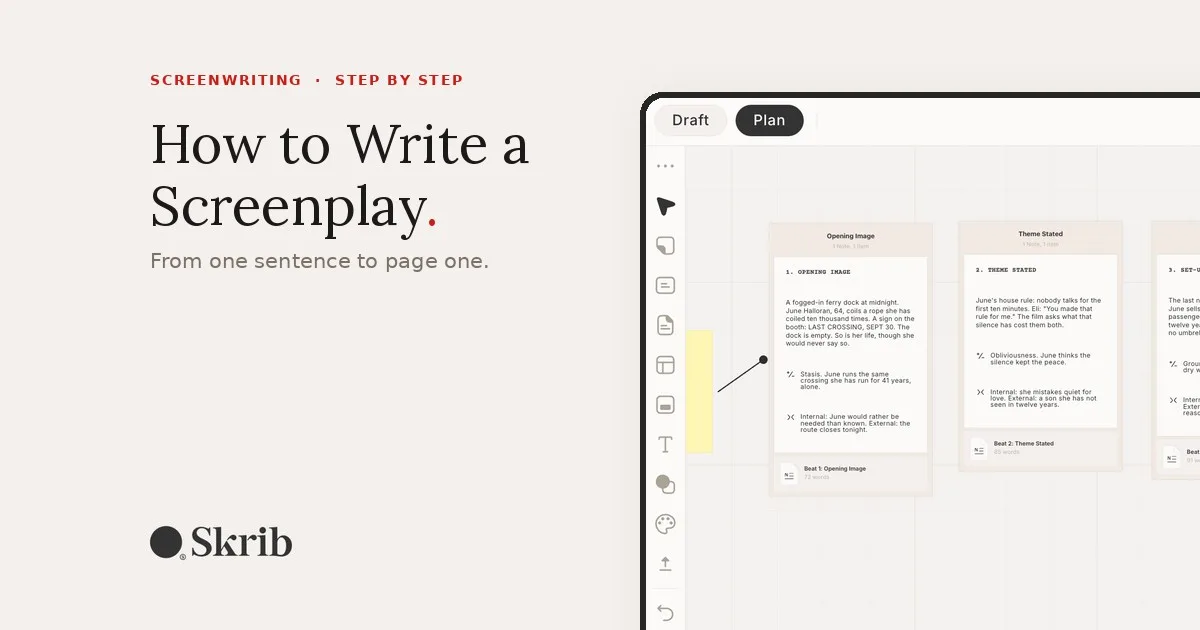
A structure only helps once you fill in the moments where the story turns. Here are the first five Save the Cat beats for Last Ferry:
- Opening Image: a fogged-in dock at midnight. June coils a rope she has coiled ten thousand times. The dock is empty.
- Theme Stated: June's house rule: nobody talks for the first ten minutes. Eli: "You made that rule for me."
- Set-Up: the last crossing. Her only passenger is her son, gone twelve years.
- Catalyst: Eli takes out a letter in June's handwriting. She never sent it. Somebody did.
- Debate: does she admit the letter is true, or steer the boat and say nothing, the way she always has?

Do it in Skrib: double-click any beat card to type your version over the prompt. When your story changes, edit the card, not a 20 page outline.
You don't need all 15 beats before you write. Fill the ones you know. The empty cards show you where to think next.
Step 5: Write your first page
A screenplay uses only a handful of building blocks. Learn these five and you can write any scene:
- Scene heading: where and when, in capitals.
EXT. PORTLAND FERRY TERMINAL - NIGHT - Action: what we see, in the present tense. Only what a camera could film.
- Character: the name of whoever speaks, in capitals.
- Parenthetical: a tiny note on how a line is said. Use it rarely.
- Dialogue: what they say.

Do it in Skrib: press Tab to switch element type, from action to character to dialogue, and the page formats itself. Open the Plan beside the Draft in split screen and glance at the beat card before each scene.
What does FADE IN mean?
FADE IN: is the first line of most screenplays. It means the picture comes up from black, and it tells the reader the movie has started. Type it at the top left, in capitals, with a colon. Most scripts end with FADE OUT. for the same reason. You only need it once. After that, just write scenes.
Step 6: Watch your page count
How long is a screenplay?
A feature film script is usually 90 to 120 pages. For a first spec script, 95 to 110 is a safe target. Comedy and horror tend to run shorter, dramas longer.
| Format | Typical length |
|---|---|
| Short film | 5 to 30 pages |
| Half-hour TV episode | 25 to 35 pages |
| One-hour TV episode | 50 to 65 pages |
| Feature film | 90 to 120 pages |
The one page one minute rule
The screenplay page count rule says one page of script is about one minute of screen time. It works because every script uses the same font (Courier 12), the same margins and the same spacing. A 100 page script suggests a film of about 100 minutes.
It is a rule of thumb, not a law. A page of quick dialogue plays faster. A page describing a chase plays slower. Over a whole script, it evens out.

Do it in Skrib: the footer shows "Page 1 of 2", your scene count and your word count at all times. Check it at the end of each session to see how many minutes you wrote today.
Step 7: Add a title page
How to write a screenplay title page is simpler than most people think. Keep it plain:
- Title in capitals, centred, about a third of the way down the page.
- "Written by" on the line below, then your name.
- Contact details in the bottom left corner.
No pictures, no fancy fonts, no page number. For the title itself, choose something short that hints at the feeling of the story, not the plot. Last Ferry tells you it is about an ending before you read a word.

Do it in Skrib: click Edit Title Page at the top of your draft. The layout is already set. You just type the title, your name and your contact details.
Screenwriting terms glossary
- Action: what the audience sees and hears.
- Beat: a turning point in the story. Also a short pause in dialogue.
- CONT'D: a character keeps talking after an action line.
- CUT TO: a transition to the next scene. Use sparingly.
- EXT. / INT.: exterior or interior location.
- FADE IN / FADE OUT: the start and end of the film.
- Logline: the whole story in one sentence.
- O.S. (off screen): a character speaks from nearby but out of frame.
- V.O. (voice over): narration, or a voice not physically in the scene.
- Scene heading (slugline): location and time of day, in capitals.
- Spec script: a screenplay written without being hired, to sell or to show.
- Treatment: a prose summary of the film, usually a few pages.
Frequently Asked Questions
How do I write a screenplay as a complete beginner? Write your logline, pick a simple structure like three acts or Save the Cat, and fill in the first few beats. Then write in a screenplay editor that formats for you, so all your energy goes into the story.
How do I write a movie script step by step? Logline, structure, beats, first page, page count, title page. That is the order in this guide, and you can do the first three in one sitting.
How many pages is a feature film script? Usually 90 to 120. Aim for 95 to 110 on your first.
Is the one page one minute rule accurate? Close enough for planning. Dialogue-heavy pages play faster and action-heavy pages slower, but across a full script it averages out.
Do I need special software to write a screenplay? You can use any word processor, but you will spend hours on margins. A screenplay editor like Skrib handles the formatting and page count, and keeps your plan beside the script.
Start your screenplay in Skrib tonight
You don't need the whole movie. You need one sentence, five beats and a first page. The Save the Cat Beat Sheet for Screenplay template gives you the board we used for Last Ferry:
- All 15 beats laid out across three acts
- Prompts on every card for what the character feels and what pushes on them
- A beat doc linked to each card for longer notes
- Your script open beside the plan, formatted as you type
Copy it, replace our example with your story, and write page one tonight.
Copy the Save the Cat screenplay board
Or create your Skrib account and pick Screenplay.
Keep reading: How to Start Writing a Book (and Actually Finish It)