Working with Game Designers: Aligning Story & Systems
Mechanics always win. Three ways to resolve a story-systems conflict, reframing the fiction, why pre-production is the window and writing requirements.
The protagonist is characterised as decent, thoughtful, reluctant. By the end of act two the player has killed four hundred people.
That gap has a name - ludonarrative dissonance - and it’s usually discussed as an artistic failure, as though someone made a bad creative choice.
Almost nobody did. Dissonance is an organisational artefact. Mechanics and story are authored by different people, on different schedules, with wildly different costs to change. When the two conflict, one of them wins, and it’s never a fair fight.
Which means the fix isn’t better taste. It’s better timing and better paperwork - and a writer who understands the production reality gets more of their story into the game than one who argues for it on merit.
For the discipline around it, see our video game writer’s handbook.
What is ludonarrative dissonance?
Ludonarrative dissonance is a contradiction between what a game’s story says and what its mechanics have the player do. The term was coined by designer Clint Hocking in 2007, writing about BioShock, and it has since become the standard shorthand for any gap between a game’s fiction and its play.
It’s worth separating from a related problem: a game can be perfectly consistent and still have a thin story. Dissonance is specifically a contradiction, and contradictions have causes you can trace.
Why mechanics always win
Three reasons, none of them about quality.
Players believe what they do. A game that tells you a character is desperate while letting you breeze through has already lost the argument. Action is the loudest channel a game has, and it’s authored by design.
Systems are expensive to change; story content is cheap to cut. Removing a quest breaks nothing. Changing a combat system breaks the build, the balance, the levels and the schedule. At every milestone, the cheapest available cut is narrative - which is why it’s the one that gets made.
Systems are built first. By the time most narrative teams are staffed, the core loop exists. You are writing fiction around decisions already taken.
None of this is unfair. It’s what a real production looks like, and treating it as an injustice is the fastest way to become the person design routes around.
Three ways to resolve a conflict
When story and mechanic disagree, there are exactly three moves, and they’re wildly different in cost.
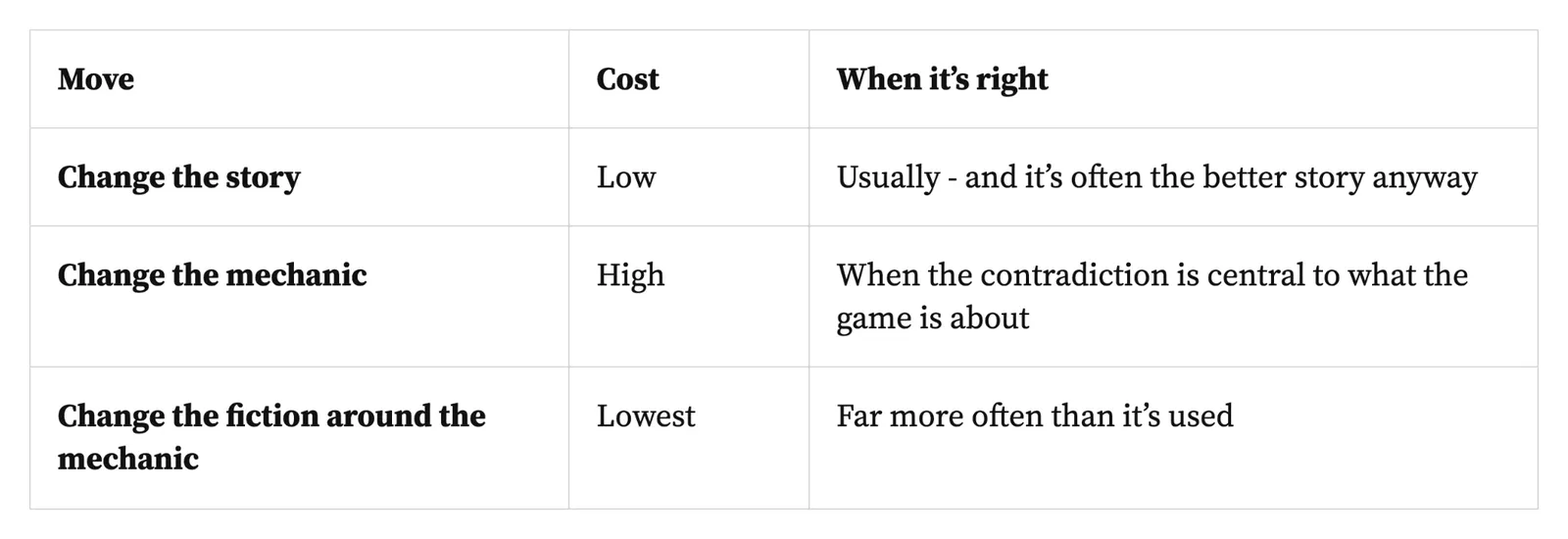
The third is the writer’s highest-leverage skill and the most under-used. The mechanic stays exactly as built. What changes is what it means - the fiction is rewritten so that what the player does stops contradicting who they are.
Reframing the fiction
The practical version, with the recurring cases.
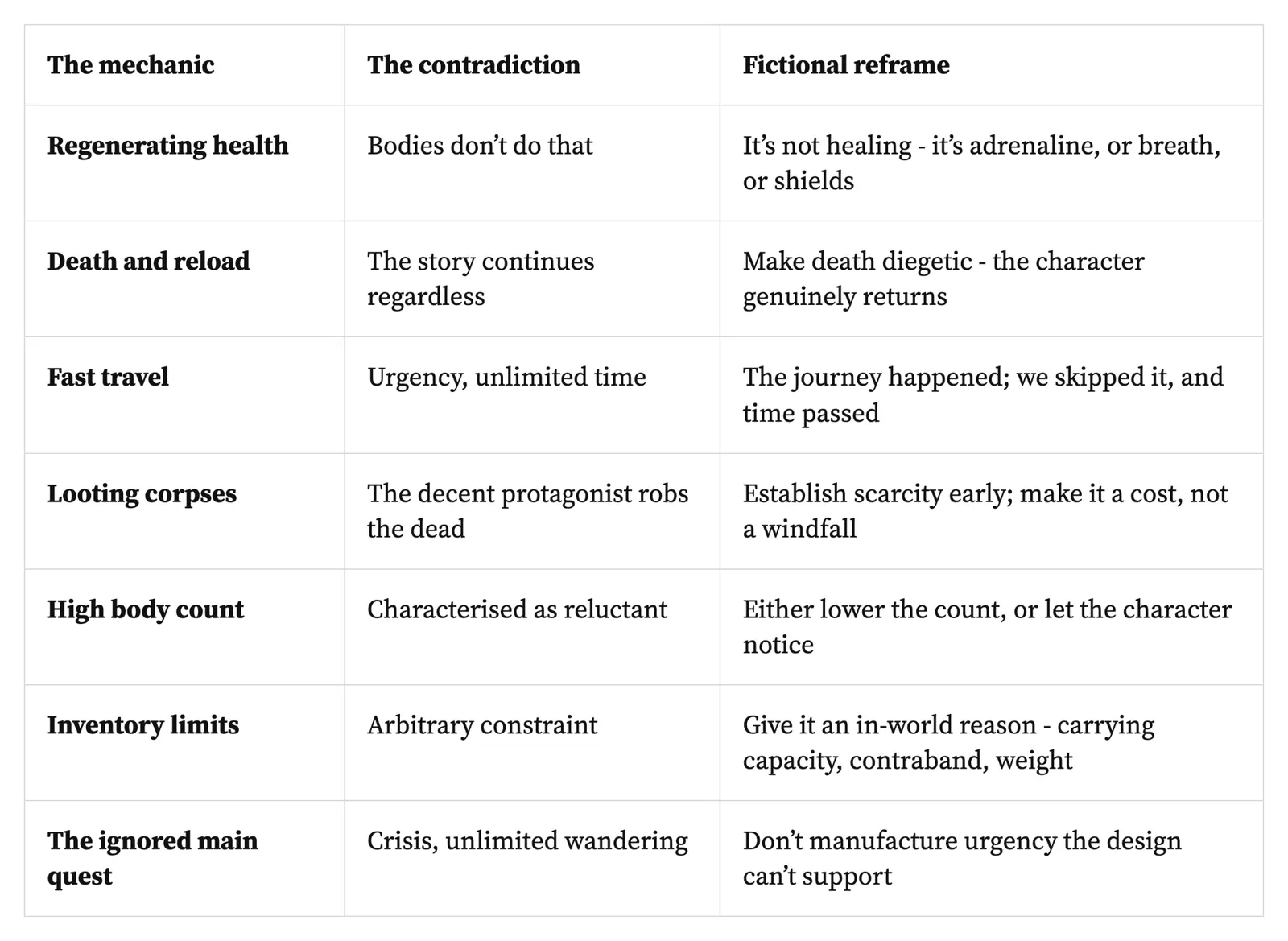
The best-known success is making death diegetic - building a game whose fiction explains why the protagonist returns after dying, so the reload loop stops being a concession and becomes the premise. The mechanic didn’t change at all. The fiction did.
The reframe test: can you write two sentences that make this mechanic true in the world? If yes, you’ve solved it for the cost of two sentences. If no, it’s a genuine conflict and you’re choosing between the other two moves.
One caution. Reframing has a limit. A fiction stretched too far to accommodate a mechanic reads as an excuse, and players can tell the difference between an explanation and an apology.
The window is pre-production
The structural fact that determines how much story ends up in the game.
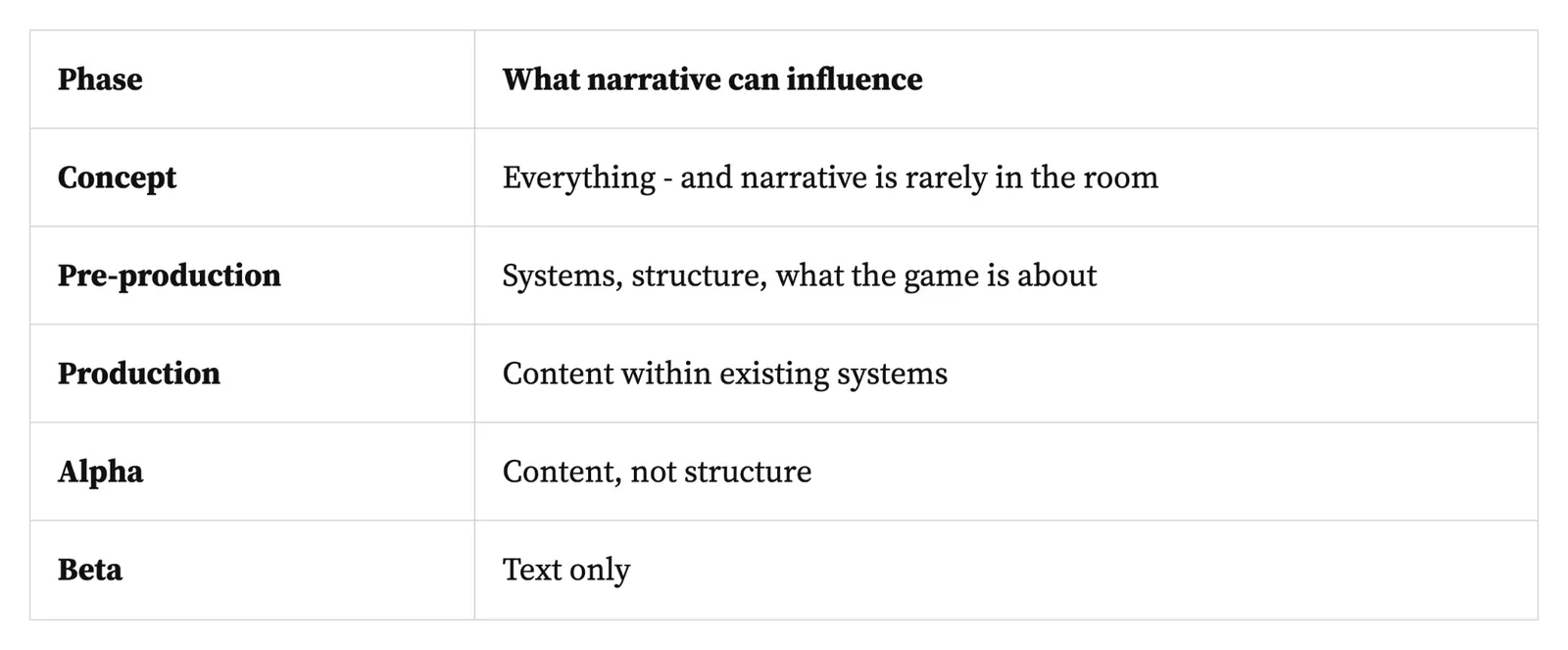
Read those two top rows together. The only phase where narrative can genuinely shape mechanics is pre-production, and most projects staff narrative after it. That’s the discipline’s structural problem, and it explains most dissonance in shipped games better than any account of individual choices.
What follows for a writer:
Win early or don’t win. A beat proposed at concept costs nothing. The same beat at alpha costs a system rebuild and will be refused.
Spend influence on systems, not scenes. In pre-production, arguing for one mechanic change is worth more than a hundred pages of dialogue.
If you arrive late, stop trying to change systems. Reframe instead. That’s the tool available to you.
The first thing a game asks a player to do is also a narrative decision made in this window - our guide to game prologues and tutorials covers why the opening verb is the story’s first sentence.
Write a requirement, not a request
The single most useful professional habit in this relationship.
A request: It would be great if the player felt more isolated in act two.
A requirement:
NEED: No friendly NPCs in the mid-game hub between beats 12 and 17
WHY: The reunion in beat 18 depends on the player having been alone
IF NOT: The reunion has no weight; beat 18 becomes a plot handoff
CHEAPEST: Keep the NPCs, remove their idle chatter and lock the shops
COST EST: Audio flag + shop state - no new systems
The fourth line is the one that gets things built. Offering the cheapest version that still works changes the conversation from what narrative wants to what narrative will accept, and designers can act on the second.
Four rules for the format:
State the outcome, not the implementation. You’re describing what must be true, not how to build it.
Name the dependency. Which beat breaks. Vague needs get filed.
Say what happens if it’s refused. Sometimes the honest answer is not much, and admitting that buys credibility for the times it isn’t.
Cost it roughly. Being wrong about cost is fine; not attempting it reads as not caring.
The same discipline applies to environmental beats and bark triggers, both of which are specifications rather than prose - see environmental storytelling and barks and ambient dialogue.
When narrative gets cut
It will. The question is whether you cut well or get cut badly.
Know your spine. The set of beats without which the story doesn’t function. Everything else is negotiable and should be visibly labelled as such, because content nobody has ranked gets cut arbitrarily.
Volunteer cuts before they’re taken. A narrative lead who arrives at a milestone with a ranked list of what can go is a partner. One who defends everything equally gets overruled and loses the next argument too.
Watch for narrative debt. Cuts leave references behind - a character mentioned in three places who no longer appears, a quest that assumes a scene that was removed. Track them. Shipping with dangling references is the most visible form of a bad cut.
Cut whole things, not the middle of things. Removing a complete side quest costs less coherence than trimming half of every scene.
Some cuts are load-bearing for canon. If a cut removes something the world bible treats as established, the bible needs updating - world bibles for game studios covers keeping that record honest through change.
Being in the room
Influence in this relationship is earned in a specific way, and it isn’t through craft.
Learn the constraints. A narrative person who knows what’s expensive and what’s free proposes things that get built. One who doesn’t gets handed specs and asked to write dialogue for them.
Speak in design terms. Not this should feel lonely but no friendly NPCs in this space. The translation is your job, not theirs.
Turn up to the meetings that aren’t about story. Systems decisions with narrative implications are made in systems meetings, and nobody will think to invite you.
Be right about cost. Credibility here is cumulative and it’s built on estimates that hold up.
Understand the other discipline’s pressures. Designers are balancing, tuning and fighting their own cuts. A narrative ask that ignores that reads as naive regardless of its merit.
One durable observation: the narrative people who get consulted early are almost never the best writers on the team. They’re the ones design finds easiest to work with - and those are different qualities, both learnable.
Where the roles formally divide is its own question, covered in narrative design vs. game writing.
Where it goes wrong
Arguing on merit. Story quality is not the axis on which these decisions are made.
Late system asks. Proposed at alpha, refused for good reason.
Requests instead of requirements. No dependency, no cost, no cheapest version.
Defending everything. Nothing ranked, so everything is cut arbitrarily.
Ignoring the reframe. Fighting for a mechanic change when two sentences of fiction would have solved it.
Reframing past the limit. Explanations that read as apologies.
Absent from systems meetings. Decisions made without narrative in the room, then discovered.
Narrative debt untracked. Dangling references shipping.
Keeping requirements beside the beats
The awkward part of this work is that it lives in two registers at once. The story is prose; the requirement is a spec. They depend on each other - a beat that needs a system, a system that constrains a beat - and they almost always live in different documents, which is how a cut system leaves an orphaned scene nobody notices until QA.
Skrib keeps them adjacent. The Plan carries story beats and the systems they depend on as linked cards - what each beat needs, what breaks without it, what the cheapest acceptable version is - with the Draft open beside it for the scene itself. The Library keeps every version searchable, which is what lets you find the three places a cut character is still referenced.
Scope note: Skrib isn’t a production tracker. It has no tickets, sprints, dependencies or milestone reporting, and it doesn’t replace whatever your studio runs. It’s the writer’s layer - where the beats and their requirements stay legible before they become tasks. You can start free.
Frequently asked questions
What is ludonarrative dissonance? A contradiction between what a game’s story says and what its mechanics have the player do - a protagonist characterised as reluctant who kills hundreds of people, for instance. The term was coined by designer Clint Hocking in 2007 writing about BioShock.
Why does story usually lose to gameplay in development? Because players believe what they do over what they’re told, because systems cost far more to change than story content costs to cut, and because systems are typically built before narrative staffs up. At every milestone the cheapest available cut is narrative.
How do you fix a conflict between story and a game mechanic? Three options: change the story, change the mechanic, or change the fiction around the mechanic. The third is the cheapest and the most under-used - the mechanic stays exactly as built and the fiction is rewritten so what the player does no longer contradicts who they are.
When can a writer actually influence a game’s systems? Almost only during pre-production, when systems are still being chosen. Most projects staff narrative after that window, which explains more shipped dissonance than any account of individual creative decisions.
How should a writer ask a designer for something? As a requirement rather than a request: what must be true, which story beat depends on it, what breaks if it’s refused, and - most importantly - the cheapest version that still works. Offering the cheap version is what turns a conversation into something buildable.
What should you do when narrative content gets cut? Know which beats are load-bearing, volunteer cuts before they’re taken, cut whole things rather than trimming everything, and track the references left behind. Dangling mentions of removed content are the most visible sign of a badly managed cut.